Si Collection, Middle Volume
Radical: Fire (huǒ)
Kangxi stroke count: 12
Page 485, Entry 01
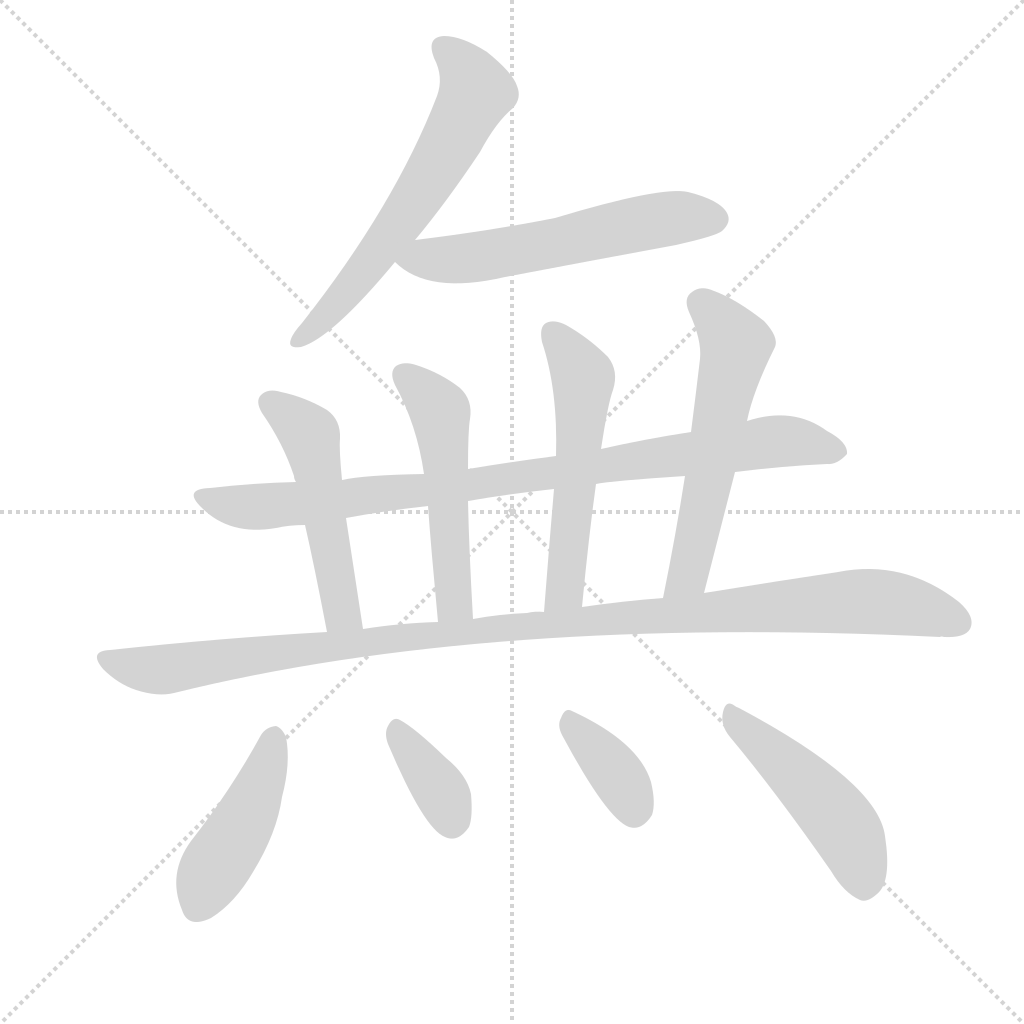
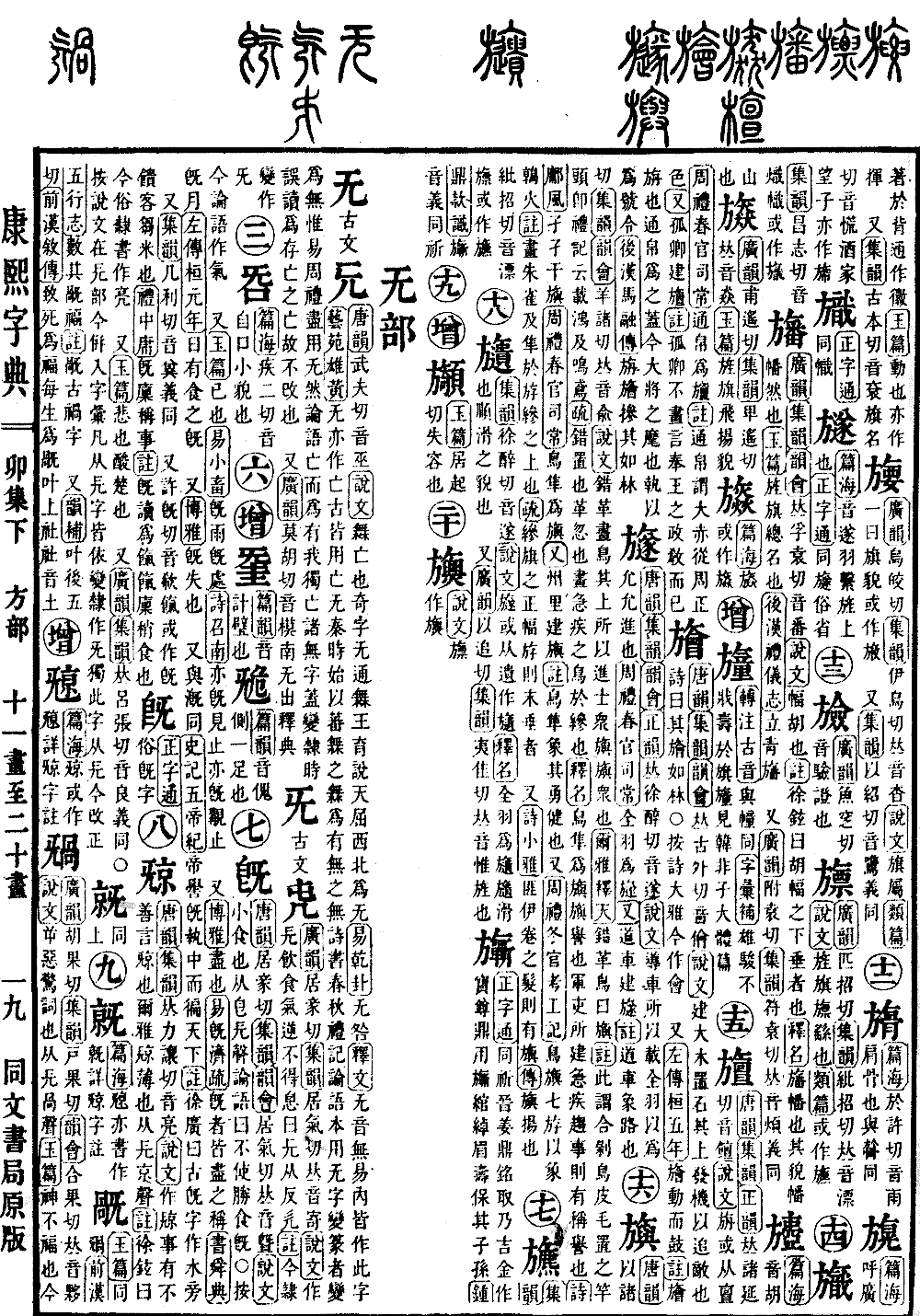
Ancient character. Pronounced wu. According to the Explaining Graphs and Analyzing Characters (Shuowen Jiezi), it means to not exist. According to the Jade Chapters (Yupian), it means to not possess. In the Book of Documents (Shangshu), in the Canon of Shun (Shundian), it means firm and strong yet not tyrannical, modest and harmonious yet not arrogant. Also, in the Creative Contributions (Yiji), it refers to encouraging trade to circulate goods. Also, in the Literary Expositor (Erya), in the section on explaining ancient terms, it refers to the space between void and nothingness. The commentary notes that gaps exist within void and nothingness. In the Tao Te Ching (Daodejing) by Laozi, all things are produced from being, and being is produced from non-being. In the Diagram of the Supreme Ultimate (Taijitusuo) by Zhou Dunyi, it speaks of the Non-polar and the Supreme Ultimate. Also, in the Book of Rites (Liji), in the section on the three-year mourning period, this is an immutable principle. The commentary notes that here, the character means the same as the word not. It is also the name of a county. In the History of the Former Han (Qianhan Shu), in the Treatise on Geography, it mentions Huiwu County in the Yuesui Commandery. It is also a surname. According to the Guide to Correct Characters (Zhengzitong), during the Han Dynasty there were individuals named Wuqie, Wuming, and Wuneng. Also, according to the Broad Rhymes (Guangyun), there were compound surnames during the Han Dynasty such as Wuyong and Wugou, both originating from the State of Chu. There is also the item wenwu, which is the name of a medicinal herb. According to the Records of Past and Present (Gujin Zhu), it was given as a gift upon parting. Wenwu is also known as danggui (angelica). Also, as a rare character from the Explaining Graphs and Analyzing Characters (Shuowen Jiezi), it is written in a variant form. According to the Jade Chapters (Yupian), it refers to void. In the Book of Changes (Zhouyi), the character is always written in its variant form. Also, according to the Collected Rhymes (Jiyun), it is sometimes written as a variant form. In the Book of Odes (Shijing), in the Odes of Wei (Weifeng), it appears as a variant. It is also commonly used as the character for do not. For example, the chapter "Against Indulgence" (Wuyi) in the Book of Documents (Shangshu) is written as "do not be indulgent" in the Records of the Grand Historian (Shiji), in the Hereditary House of Lu. It is also used interchangeably with the character for hair. In the Biography of Feng Yan from the History of the Later Han (Houhan Shu), it refers to starving people who have no food to eat. The commentary notes that in Feng Yan’s collected works, the character is written in the variant form. This is still common in vernacular speech today, and perhaps it was also used interchangeably in ancient times. The Pei-Qui Collection (Peiqiji) notes that regions north of the Yellow River refer to this character using the word for hair. The Comprehensive Refinement (Tongya) notes that in the regions of Jiang, Chu, and Guangdong, it is also referred to using the word for hair. Also, according to the Collected Rhymes (Jiyun), it is sometimes written as the character for martial. According to the Record of Ritual Vessels (Liqi), it states to advise and assist. The commentary states that the character used there should be the character for non-being, and that the text is an error caused by similarity in pronunciation. The commentary by Zheng Xuan clearly states that it is an error. The Collected Rhymes (Jiyun) incorrectly groups these two characters together. According to the Collected Rhymes (Jiyun), it is sometimes written as another variant. The Dictionary of Rhymes (Yunhui) states this was originally an ancient character for spreading. The seal script form was borrowed to represent the non-being of existence. When Li Si converted it to clerical script, he changed the tree component into four dots. According to the Explaining Graphs and Analyzing Characters (Shuowen Jiezi), the character belongs to the radical for death, where it serves as the phonetic element. The character for the luxuriance of plants belongs to the tree radical. Their pronunciations and meanings are different, and there is no evidence they are interchangeable. Furthermore, the meaning of non-being is the complete opposite of the luxuriance of plants; it should not have been borrowed. The claims in the Jade Chapters (Yupian), the Collected Rhymes (Jiyun), and the Dictionary of Rhymes (Yunhui) are all incorrect. The Dictionary of Rhymes (Yunhui) is particularly wrong to suggest the compound for luxuriance is written with this character. Also, according to the Reading Comprehensive (Dushu Tong), it is stated that it is used interchangeably with many other characters, but some are only related by meaning and others by sound; they are not actually the same character. The claims in the Reading Comprehensive (Dushu Tong) are incorrect. There is also a Sanskrit term, namo, which is read as na and mo. Na is read with a rising tone like the character for grab, and mo is read like the character for rub, meaning to take refuge.