Wu Collection, Upper Volume
Radical: Tile (wǎ)
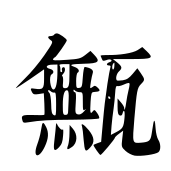
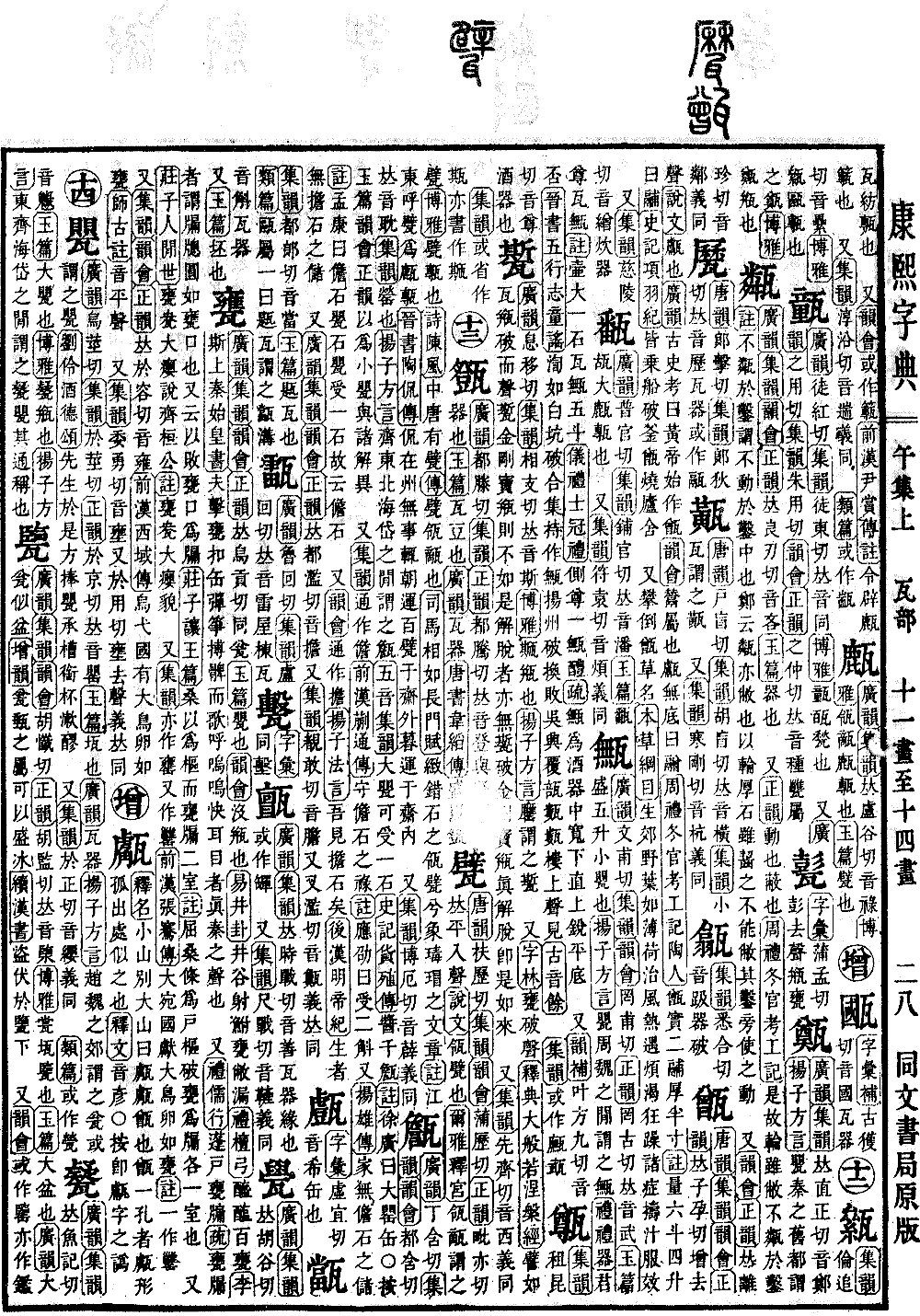
Wu (entry 13)
Kangxi stroke count: 17
Page 752, Entry 13
Pronounced wu (falling tone)
According to the Extensive Dictionary of Sounds (Guangyun), the Book of Collected Rhymes (Jiyun), and the Collection of Rhymes (Yunhui), the pronunciation is wu (rising tone). According to the Corrected Rhymes (Zhengyun), the pronunciation is wu (rising tone).
According to the Jade Chapters (Yupian), it is a small earthenware jar that holds five pints.
According to the regional language study by Yang Xiong (Fangyan), in the regions of Zhou and Wei, a jar is called a wu.
In the Book of Rites (Liji), it is said that the ruler uses an earthenware jar. The commentary explains that a hu vessel holds one dan, while an earthenware jar holds five dou.
In the Ceremonial Rites (Yili), it is mentioned that a jar of sweet wine is placed to the side. The sub-commentary explains that the wu is a vessel for wine, wide in the middle and straight at the bottom, with a tapered top and a flat base.
Additionally, according to the Supplement to the Rhymes (Yunbu), it also rhymes with the sound fou (rising tone).
In the History of the Jin Dynasty (Jinshu), specifically the Treatise on the Five Elements, a children's folk song mentions: like a broken white pit, gathered together to make a wu. The ruins of Yangzhou are destroyed, and in Wuxing the jars are overturned. The character lou is pronounced with a rising tone, as found in the Additional Notes on Ancient Sounds (Guyinyu).
According to the Book of Collected Rhymes (Jiyun), it is sometimes written in a variant form.