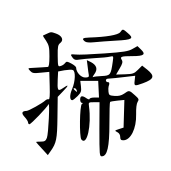
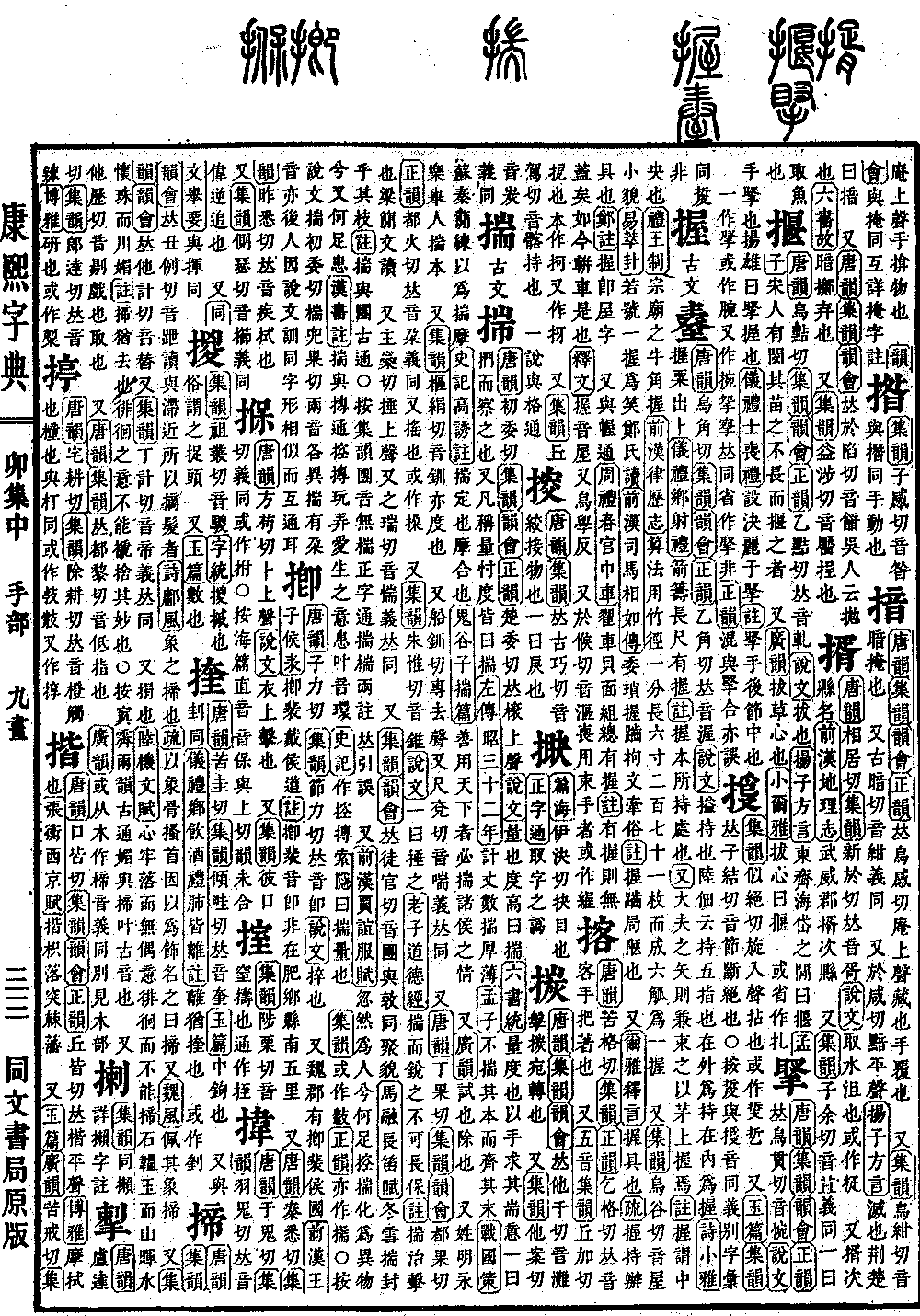
Mao Collection, Middle Volume. Radical: Hand (shǒu). Kangxi strokes: 13. Page 443, Entry 21.
Pronounced yi (falling tone). Read near the sound of zhi (falling tone). A tool used for pinning up hair.
Book of Odes (Shijing): An ivory hair-pin (ti).
Commentary: Using an ivory bone to scratch the head and serve as an ornament is called a ti.
Also, Book of Odes (Shijing): Wearing its ivory hair-pin.
Pronounced ti (falling tone).
Pronounced di (falling tone). The meaning is the same.
Also, to discard.
Lu Ji, Essay on Literature (Wenfu): The heart is lonely and has nothing to match it, thoughts wander and cannot be discarded. The stone hiding the jade makes the mountain shine; the water holding the pearl makes the river appear beautiful.
Annotation: Ti is like the meaning of removing. A wandering, uncertain heart that cannot part with its excellence. Note: The zhi and ji rhymes were interchangeable in ancient times. Mei and ti were rhymed according to ancient sounds.
Pronounced ti (entering tone). To tease or obtain.
Pronounced di (level tone). To point at.
Broad Rimes (Guangyun): Sometimes written with the Wood (mù) radical as ti. The sound and meaning are the same. See also the Wood (mù) radical.