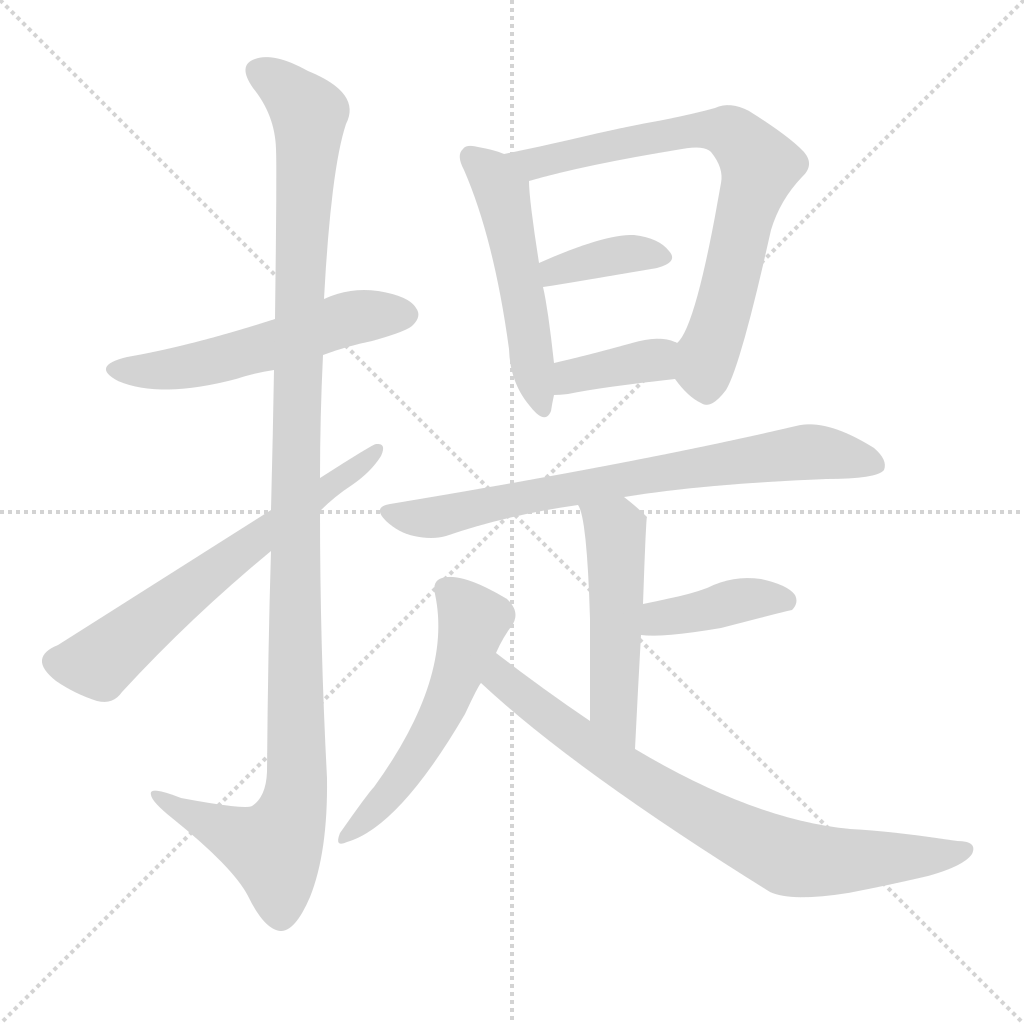
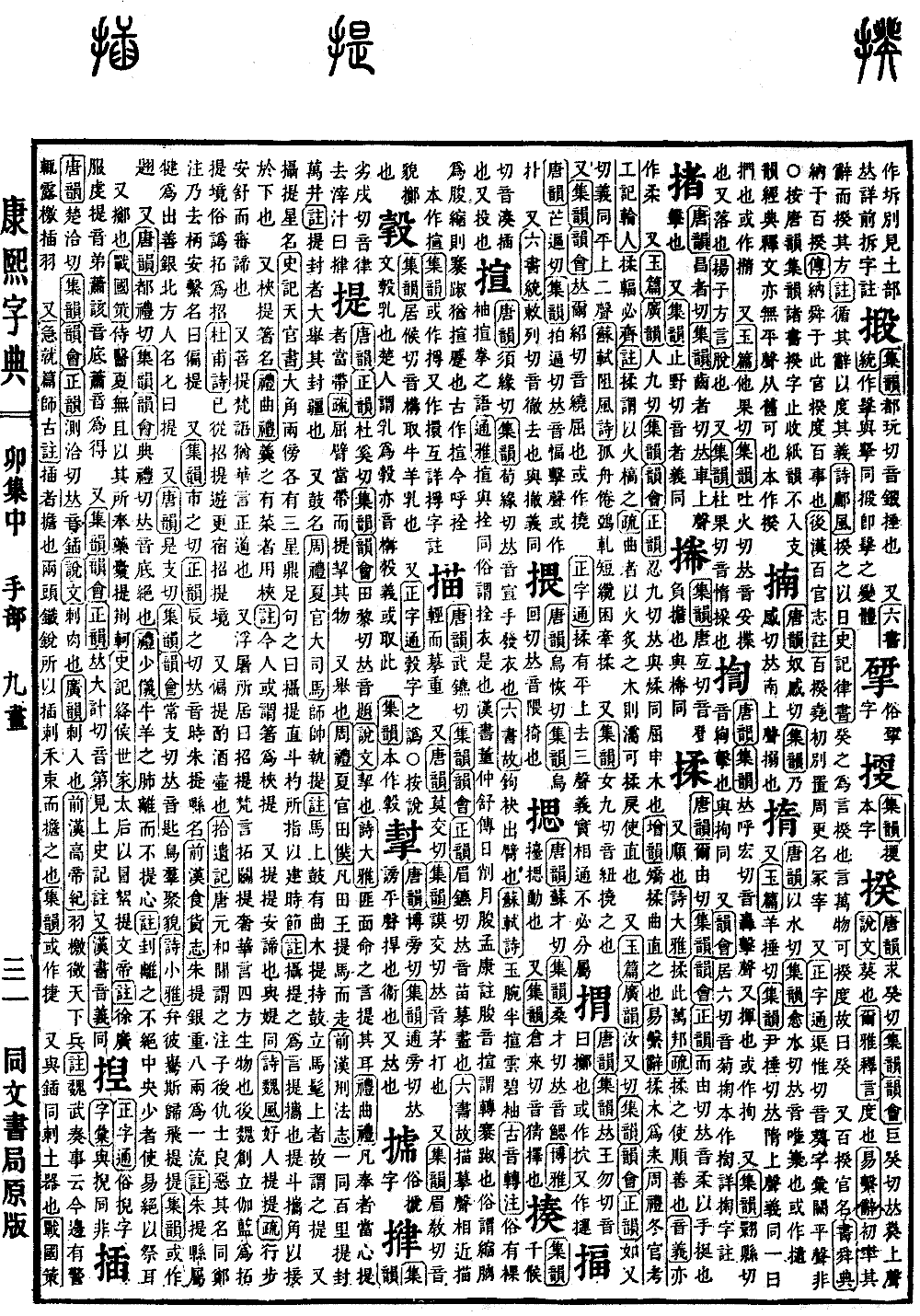
Mao Collection, Middle Volume
Radical: Hand (shǒu)
Kangxi Strokes: 13
Page 441, Entry 22
Pronounced ti.
Explanatory dictionary of writing (Shuowen): To carry by hand.
Book of Odes (Shijing), Greater Odes: Not merely instructed face to face, but literally held by the ear.
Book of Rites (Liji), Songs of Qu: When holding items with both hands, they should be kept near the heart; when carrying by hand, they should be kept near the belt.
Commentary: To bend the arm near the belt and carry an object.
Also means to lift.
Rites of Zhou (Zhouli), Offices of Summer, Field Attendants: During a hunt, the king holds the horses and walks.
History of the Former Han (Hanshu), Treatise on Law: An area of one hundred square miles, with total boundaries of ten thousand wells.
Commentary: To carry or define the boundaries broadly.
Also the name of a drum.
Rites of Zhou (Zhouli), Offices of Summer, Grand Minister of War: The commanders hold the drums.
Commentary: Drums used on horseback, equipped with curved wood to hold the drum upon the horses mane, hence called ti.
Also Sheti, the name of a constellation.
Records of the Grand Historian (Shiji), Treatise on Celestial Offices: On both sides of the Great Horn constellation are three stars each. Like the feet of a tripod, they are called Sheti, pointing in the direction of the handle of the Dipper to establish the seasons.
Commentary: Sheti implies holding and carrying, holding the Dipper and carrying the horn to connect with the lower regions.
Also Xieti, the name of chopsticks.
Book of Rites (Liji), Songs of Qu: Those who eat soup with vegetables use jia chopsticks.
Commentary: Modern people sometimes call chopsticks xieti.
Also titi, meaning calm and careful. Similar to ti.
Book of Odes (Shijing), Odes of Wei: Good men are calm and careful.
Commentary: Walking with a calm, steady, and careful gait.
Also bodhi, a Sanskrit term. Equivalent to the Chinese term for the correct path.
The place where monks reside is called zhaoti. The Sanskrit term tuodouti-she translates to Chinese as the living things of the four directions. During the Northern Wei dynasty, when temples were first established, they were called tuoti sites; usage later corrupted tuoti into zhaoti.
Du Fu poem: Having already toured the zhaoti, I shall stay overnight in the zhaoti grounds.
Also pianti, a vessel for pouring wine.
Records of Forgotten Matters (Shiyiji): During the Yuanhe era of the Tang dynasty, it was called a zhuzi (spouted ewer). Later, because the eunuch Qiu Shiliang disliked the name because it sounded like the scholar Zheng Zhu, he removed the handle and attached a cord, renaming it pianti.
Pronounced shi. Zhuti, a county name.
History of the Former Han (Hanshu), Treatise on Food and Money: Zhuti silver, eight taels in weight, constitutes one unit.
Commentary: Zhuti county belongs to the Jianwei commandery and produces fine silver. Northern people call it ti.
Pronounced chi. The appearance of birds gathering in a flock.
Book of Odes (Shijing), Lesser Odes: Look at those jackdaws, flying back in a flock.
Pronounced di. To cut off.
Book of Rites (Liji), Minor Rites: When serving the lungs of cattle or sheep, slice them but do not sever the heart.
Commentary: Slice the meat without completely severing the center, making it easier to break during the sacrifice.
Also to throw.
Strategies of the Warring States (Zhanguoce): The court physician Xia Wuju used his medicinal bag to throw at Jing Ke.
Records of the Grand Historian (Shiji), Biography of the Marquis of Jiang: The Empress Dowager used a felt covering to strike Emperor Wen.
Commentary (Suoyin): Fu Qian pronounces it di; Xiao Gai pronounces it di; Xiao pronounces it de.
Pronounced di. See the commentary in the Records of the Grand Historian above.
Also History of the Former Han (Hanshu), Notes on Pronunciation: Same as above.
Textual research: Records of the Grand Historian (Shiji), Biography of the Marquis of Jiang: The Empress Dowager used a felt covering to strike Emperor Wen.
Commentary: Xu Guang and Fu Qian pronounce it di. According to the original text, the three characters Xu Guang have been changed to Suoyin.