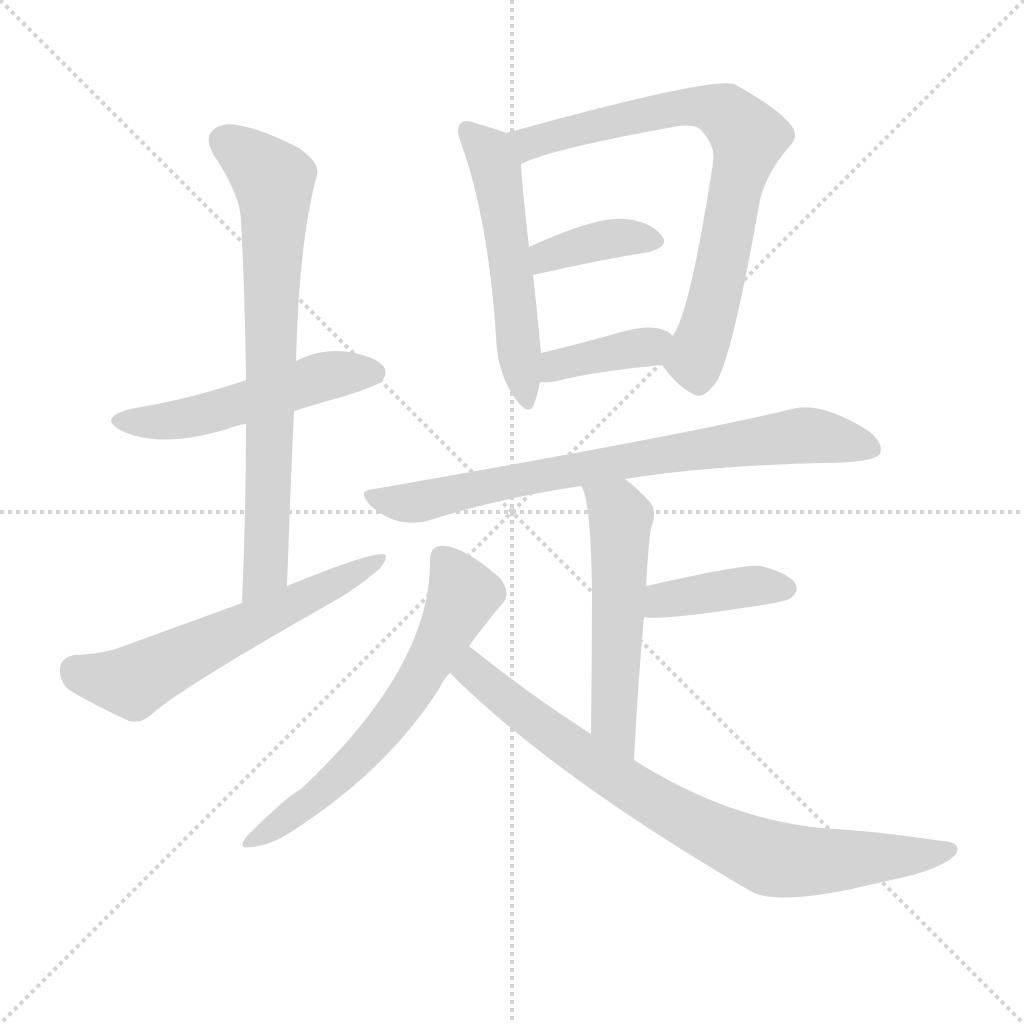
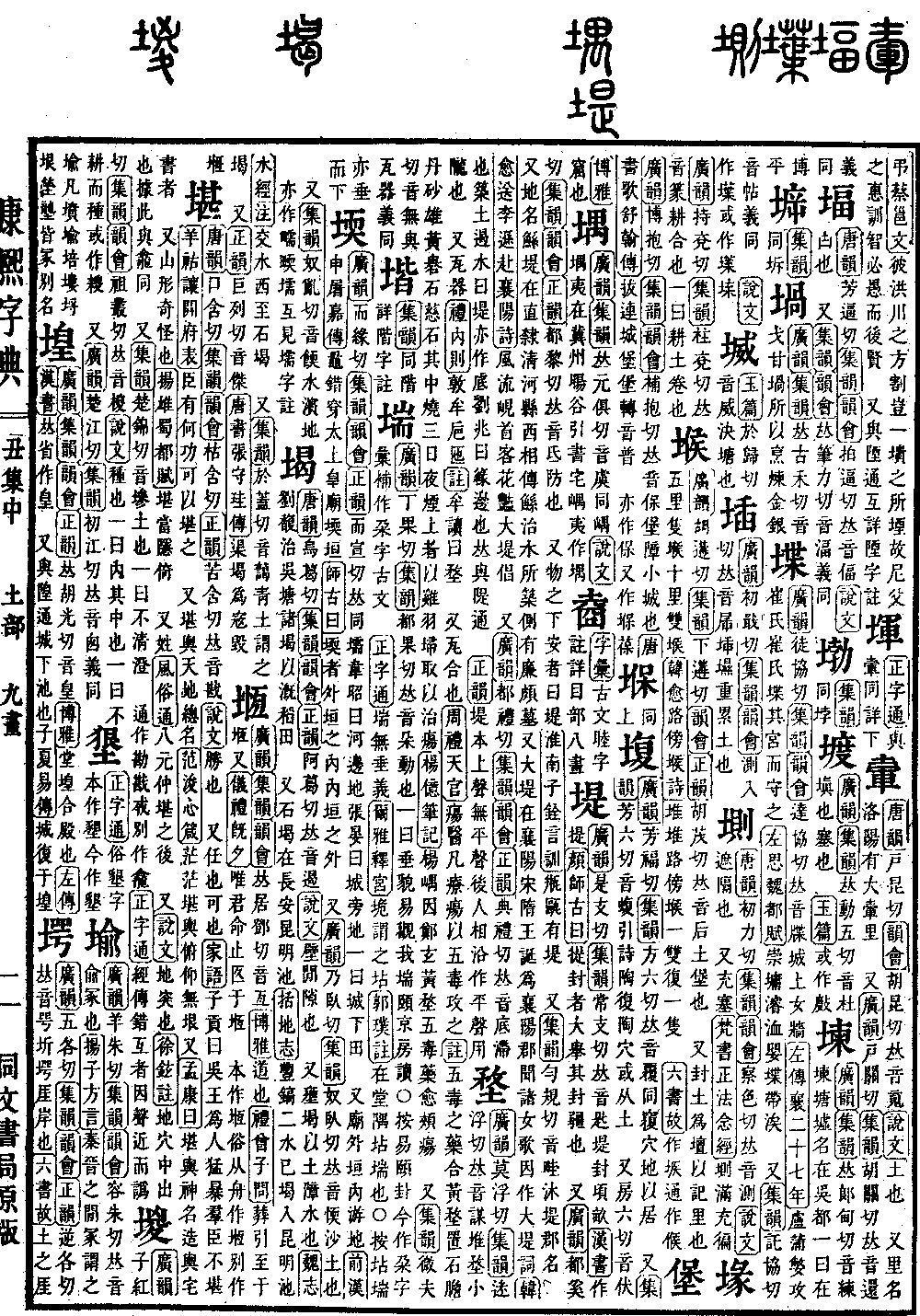
Chou Collection, Middle Volume. Radical: Earth (tǔ). Kangxi stroke count: 12. Page 233, Entry 20.
Broad Rhymes (Guangyun): Pronounced shi. Also recorded in Collected Rhymes (Jiyun): Pronounced chi. Meaning: The boundaries of land fields. In the Book of Han (Hanshu), it is written as a variant form. Yan Shigu states: Tifeng refers to the comprehensive designation of border territories.
Broad Rhymes (Guangyun): Pronounced di. Also recorded in Collected Rhymes (Jiyun), Rhyme Compilation (Yunhui), and Orthodox Rhymes (Zhengyun): Pronounced di. Meaning: An embankment or dike. Also, the lower stable part of an object is called a di. In Huainanzi: Quan Yan Xun, it is noted that bottles and jugs have a base.
Collected Rhymes (Jiyun): Pronounced qi. Mudi, the name of a prefecture.
Also a place name. Gundi is located west of Qinghe County in Zhili. Legend holds that it was built by Gun to control the floodwaters, and the tomb of Lian Po is located nearby.
Also, Dati is located in Xiangyang. When Prince Dan of the Song dynasty served as the Governor of Xiangyang, he heard the songs of the palace maids and composed the Dati Ci. Han Yu, in his poem sent to Li Xun as he departed for Xiangyang, wrote: The elegant guests of Mount Xian, and the floral beauty of the Dati singers.
Broad Rhymes (Guangyun): Pronounced di. Also recorded in Collected Rhymes (Jiyun), Rhyme Compilation (Yunhui), and Orthodox Rhymes (Zhengyun): Pronounced di. Meaning: To obstruct or stagnate. Constructing earth to restrain water is called a di. It is also written as a variant form. Liu Zhao states: It refers to a border edge, and is interchangeable with the standard character for dike. The Orthodox Rhymes (Zhengyun) notes: The character was originally in the rising tone and did not have a level tone; later generations followed the custom of using it in the level tone.