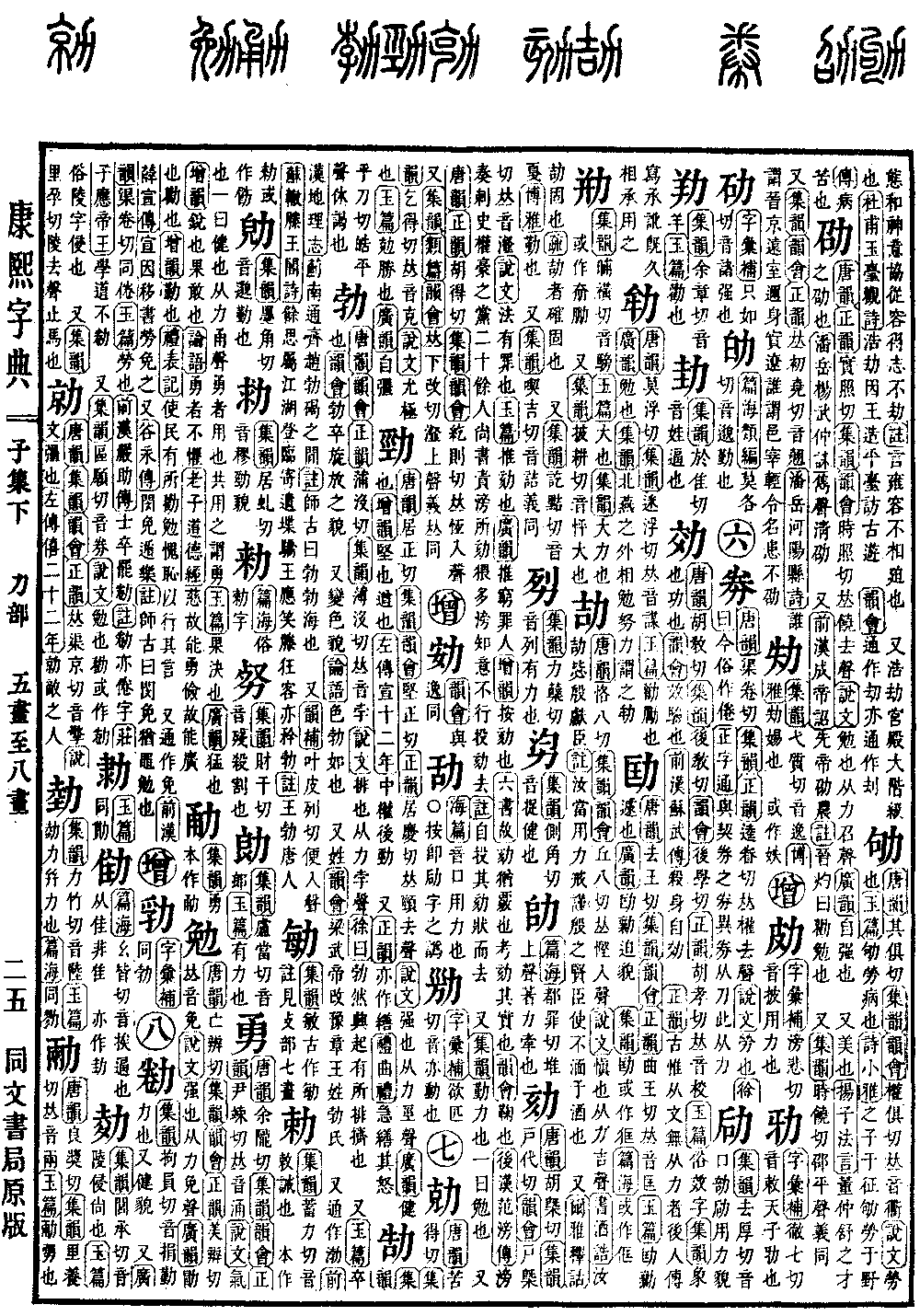
Zi Collection, Page Position: Lower
Radical: Strength (lì)
yǒng
Kangxi Strokes: 9
Page: 147, Entry 35
In the Tang Rhyme (Tangyun), pronounced Yú lǒng qiè. In the Collected Rhymes (Jiyun), Rhyme Compendium (Yunhui), and Orthodox Rhymes (Zhengyun), pronounced Yǐn sǒng qiè; the sound is yǒng.
Explaining Characters and Analyzing Compounds (Shuowen Jiezi) states it is "qi" (vital energy). Another explanation says it means "strong, robust". It is composed of the Strength (lì) radical, with yǒng as the phonetic component. The Jade Chapters (Yupian) states it means "resolute, decisive". The Expanded Rhymes (Guangyun) states it means "fierce, brave". The Supplemented Rhymes (Zengyun) states it means "sharp, keen; resolute and daring". In the Zuo Commentary (Zuozhuan), Duke Wen, Year 2: "To act for the common good is courage." In the Analects of Confucius (Lunyu): "The courageous are not afraid." In Laozi's Daodejing (Daodejing): "With compassion, one can be brave; with frugality, one can be abundant."
Editorial Note: A previous attribution in Explaining Characters and Analyzing Compounds (Shuowen Jiezi) included the phrases 'The courageous are those who use' and 'to act for the common good is courage' after the primary definition. It is hereby noted that the phrase 'The courageous are those who use' is not present in Explaining Characters and Analyzing Compounds (Shuowen Jiezi). Furthermore, 'to act for the common good is courage' is from the Zuo Commentary (Zuozhuan) and is also not from Explaining Characters and Analyzing Compounds (Shuowen Jiezi). Therefore, the citation has been corrected to 'In the Zuo Commentary (Zuozhuan), Duke Wen, Year 2: "To act for the common good is courage,"' and moved to precede the reference to the Analects of Confucius (Lunyu).