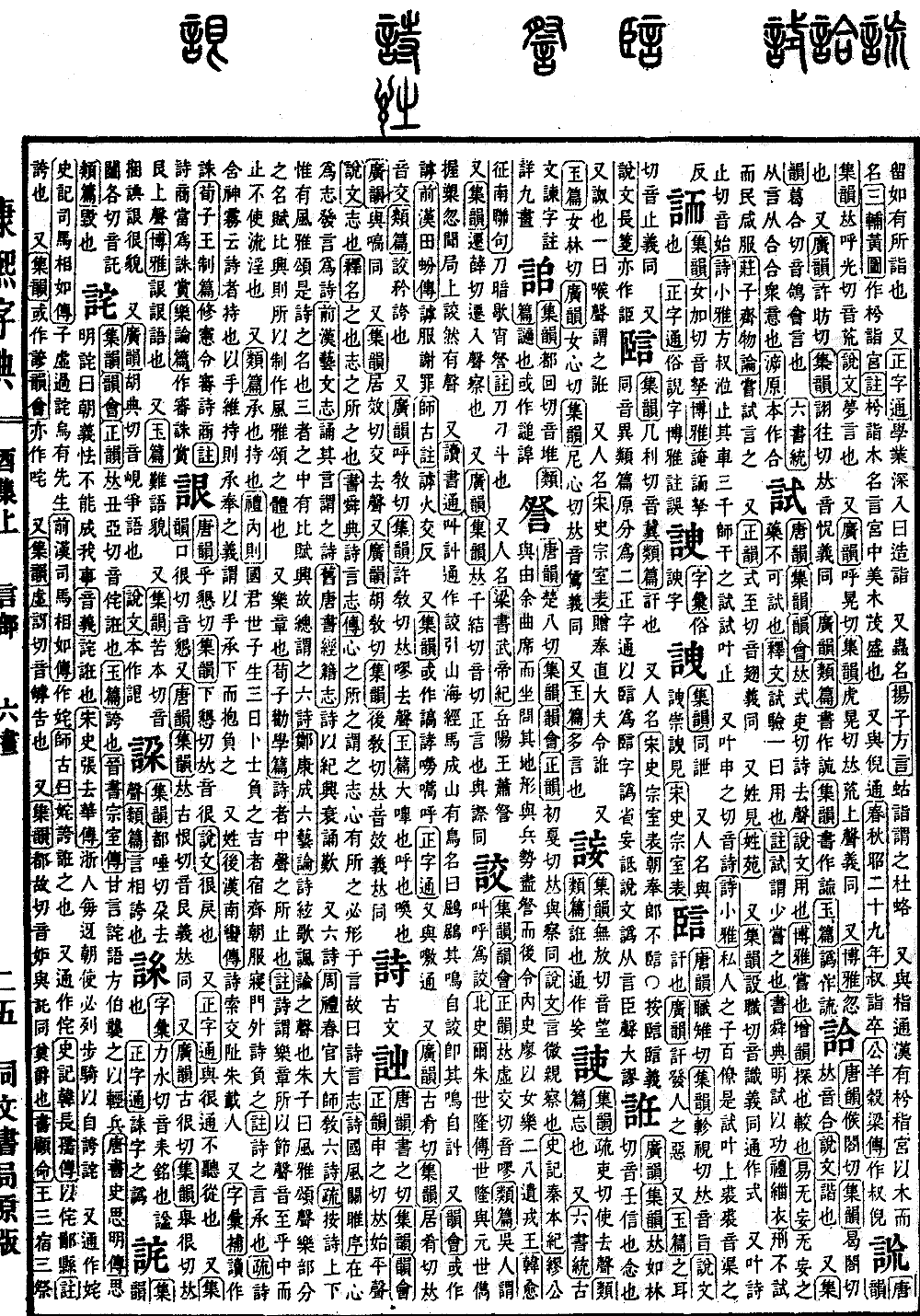
You Collection, Upper Volume
Radical: Speech (yán)
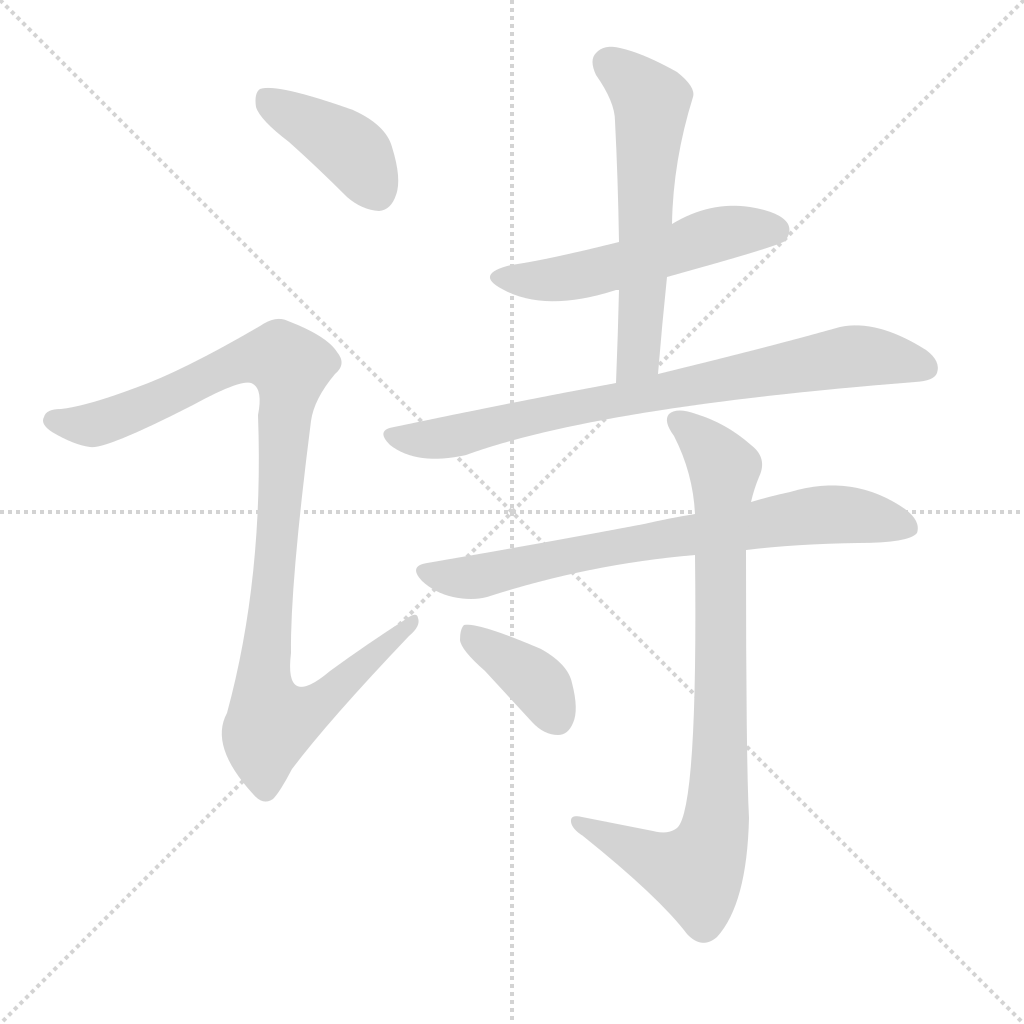
Poetry (shī)
Kangxi stroke count: 13
Page 1157, Entry 06
Ancient script. According to the Tang Rhyme (Tangyun), pronounced shi (level tone). According to the Collection of Rhymes (Jiyun), the Rhyme Collection (Yunhui), and the Correct Rhymes (Zhengyun), pronounced shen (level tone). According to the Explaining Characters (Shuowen), it means intent. According to the Explaining Names (Shiming), it means to go; it is where the intent goes. In the Book of Documents (Shujing), the chapter Canon of Yao (Shundian), it says poetry expresses intent. The commentary states that what the heart goes toward is called intent. When the heart has a destination, it must be manifested in speech, therefore it is said that poetry expresses intent. In the Book of Odes (Shijing), in the preface to Guanju of the Odes of the States (Guofeng), it says what is in the heart is intent, and when spoken it is poetry. In the History of the Former Han (Qianhan), in the Treatise on Literature and Arts (Yiwenzhi), it says reciting these words is called poetry. In the Old History of the Tang (Jiu Tangshu), in the Treatise on Classics and Books (Jingjishu), it says poetry is used to record the rise and fall of eras and to express joy.
Also refers to the Six Odes. In the Rites of Zhou (Zhouli), in the chapter Spring Officials (Chunguan), the Grand Master teaches the Six Odes. The sub-commentary notes that among the terms for poetry, there are only the Airs (Feng), the Odes (Ya), and the Hymns (Song). Within these three, there are comparisons (bi), narratives (fu), and stirring influences (xing), so they are collectively called the Six Odes. Zheng Kangcheng, in his Treatise on the Six Arts (Liuyi Lun), says that poetry is the sound of stringed songs, satires, and admonitions. Master Zhu says the Airs, the Odes, and the Hymns are names of musical categories, while narrative, comparison, and stirring influence are the forms used to create the Airs, the Odes, and the Hymns.
Also refers to musical compositions. In the Xunzi, in the chapter Encouraging Learning (Quanxue), it says poetry is where measured sounds cease. The commentary explains that poetry refers to musical compositions, which regulate sound so that it reaches a state of balance and stops, preventing it from becoming lewd or excessive.
Also, according to the Classified Chapters (Leipian), it means to support or to hold. In the Book of Rites (Liji), in the chapter Inner Regulations (Neize), it says when a state prince's heir is born, after three days, a diviner holds him. The auspicious one fasts, puts on court robes, stays outside the sleeping gate, and supports him. The commentary notes that to support is the meaning here. The sub-commentary quotes the Poetry Containing Divine Mists (Shihan Shenwu) as saying that poetry means to hold; by holding with the hands, it implies the meaning of supporting and embracing, referring to supporting from below with the hands and carrying the child.
Also a surname. In the History of the Later Han (Houhan), in the Record of the Southern Barbarians (Nanman Zhuan), there is a person named Shisuo, from the Jiaozhi region.
Also, in the Supplement to the Collection of Characters (Zihui Bu), it is read as zhu. In the Xunzi, in the chapter Kingly Governance (Wangzhi), it says to refine the laws and ordinances and carefully manage the punishments and rewards. The commentary notes that the original text here should be read as punishments and rewards. In the chapter Treatise on Music (Yuelun), it is written as examine punishments and rewards.