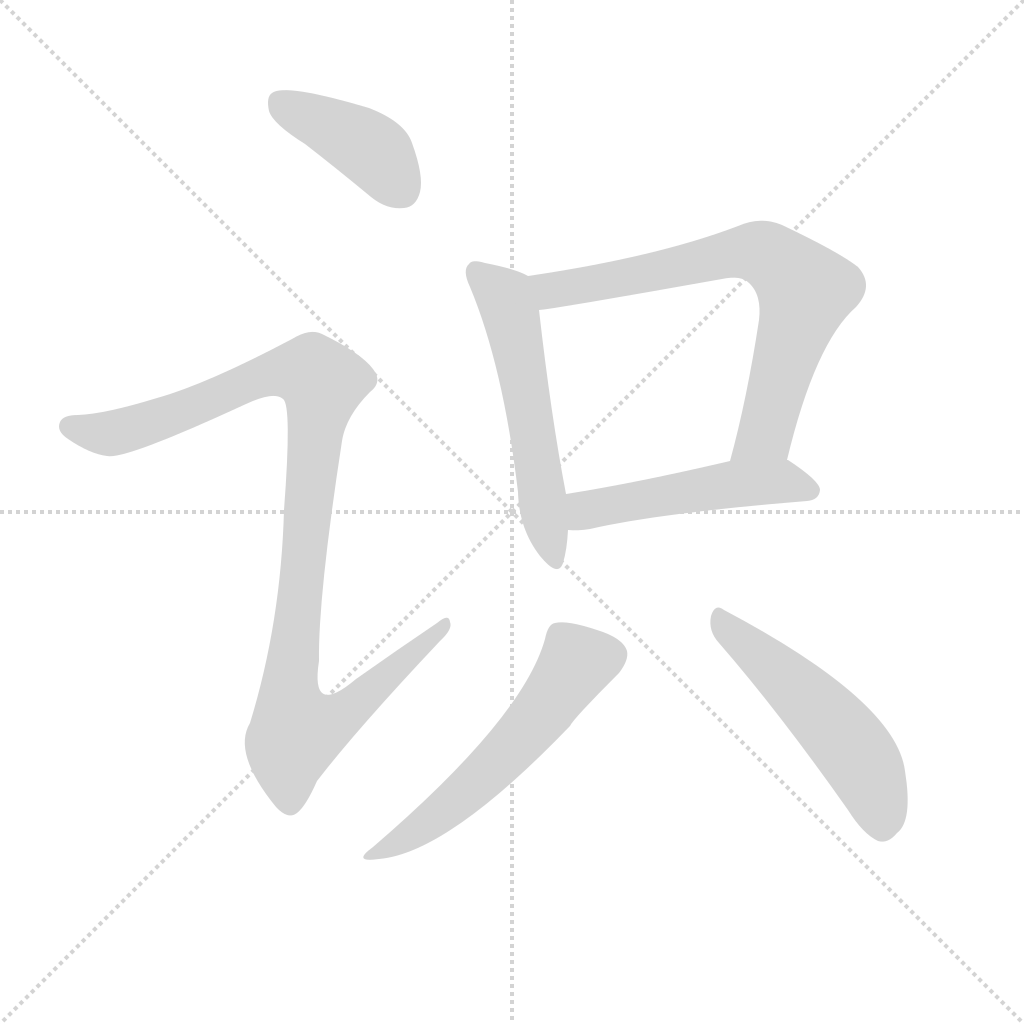
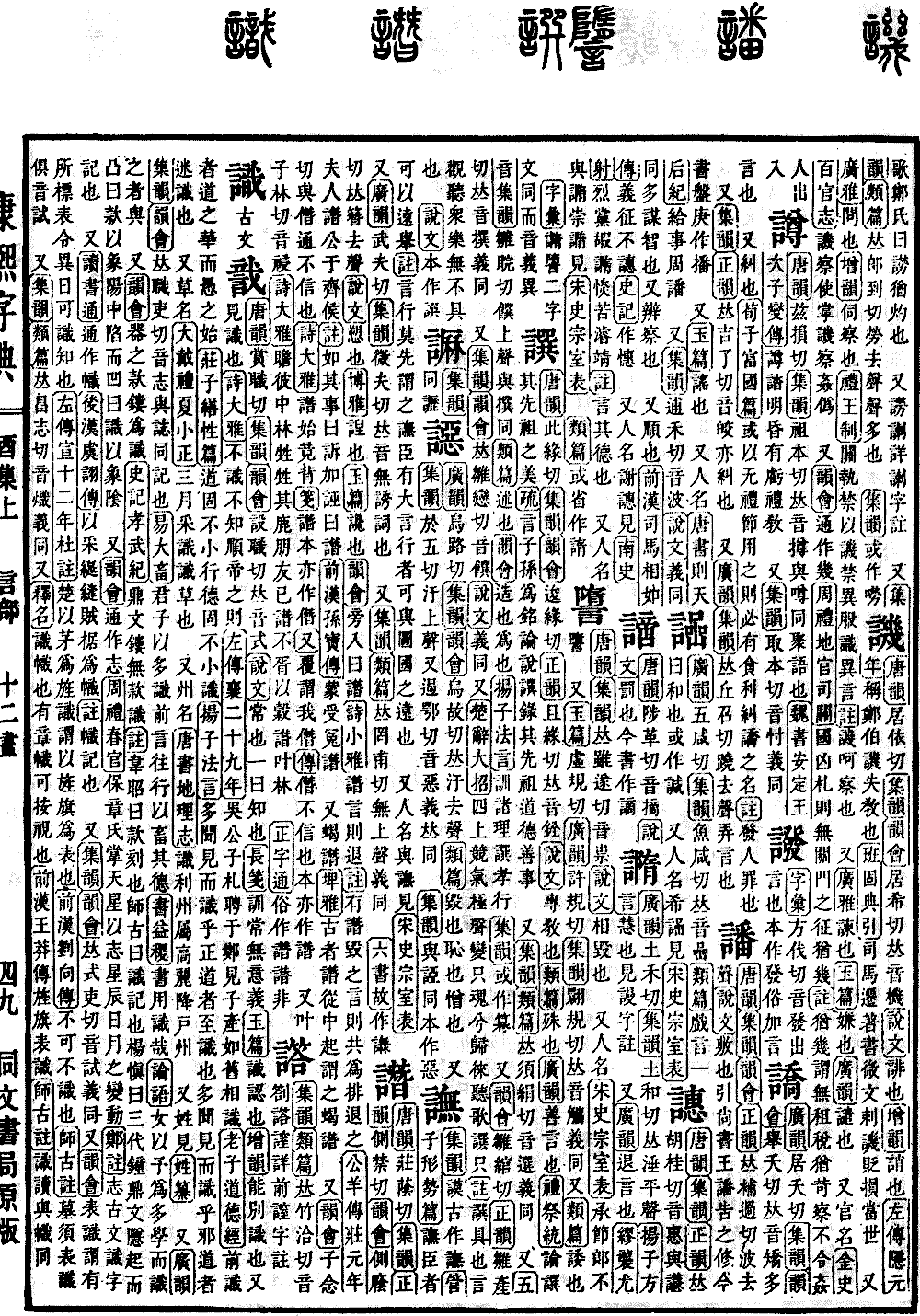
You Collection, Upper Volume
Radical: Speech (yán)
Kangxi Strokes: 19
Page 1181, Entry 03
Ancient form. Pronounced shi.
According to the Shuowen Jiezi (Explanation of Simple and Compound Characters), it means constant. Another definition is to know.
The Changjian (Long Annotations) states that the definition of constant has no significant meaning.
The Yupian (Jade Compendium) states that shi means to recognize.
The Zengyun (Expanded Rhymes) states it is the ability to distinguish and recognize. Also, to have discernment.
In the Book of Odes (Shijing), it is written: Without knowing, without discerning, following the laws of the Emperor.
In the Zuo Tradition (Zuo Zhuan), under the 29th year of Duke Xiang: Prince Zha of Wu visited Zheng and met Zichan like an old acquaintance.
In the Laozi (Tao Te Ching), it is written: Foresight is the splendor of the Way and the beginning of folly.
In the Zhuangzi (Book of Zhuangzi), under the chapter on Maintaining Nature: The Way is certainly not manifested in small deeds, and virtue is certainly not manifested in petty discernment.
In the Fayan (Model Sayings) by Yangzi: Those who hear and see much and discern the correct path are of the highest discernment. Those who hear and see much and discern the evil path are of confused discernment.
Also the name of a plant. In the Da Dai Liji (Record of Rites by Dai the Elder), it is written: In the third month, gather shi. Shi is a type of plant.
Also a state name. In the Book of Tang (Tangshu), Geography Record: Shilizhou belonged to the sub-prefecture for the surrendered households of Goryeo.
Also a surname. See the Surname Compilation (Xingzhuan).
Also pronounced zhi. Identical to the character zhi (to record).
In the Book of Changes (Yijing), it is written: The gentleman, by having wide knowledge of the words and deeds of the ancients, stores up his virtue.
In the Book of Documents (Shujing), it is written: Use writing to record it.
In the Analects (Lunyu), it is written: Do you think that I am one who has learned much and kept it in memory?
Also, in the Rhyme Collection (Yunhui), it refers to the inscriptions on vessels. In the Records of the Grand Historian (Shiji), Chronicle of Emperor Wu: The patterns and carvings on the tripod have no inscriptions (kuanshi). The annotation by Wei Zhao states that kuan means to engrave. Yan Shigu states that shi means to record. Yang Shen states that in the bronze inscriptions of the Three Dynasties, raised or convex characters are called kuan, representing yang, while sunken or concave characters are called shi, representing yin.
Also, in the Rhyme Collection, it is used interchangeably with the character zhi (to record). In the Rites of Zhou (Zhouli), Ministry of Spring: The official in charge of astronomical observations manages the stars, recording the movements of the celestial bodies, sun, and moon. The annotation by Zheng Xuan states that zhi is an ancient form of the character shi, meaning to record.
Also, according to the Reading Guide (Dushutong), it is used interchangeably with the character zhi (a flag or marker). In the Book of the Later Han (Hou Hanshu), Biography of Yu Xu: Used colorful silk thread to sew onto the robbers' hems as markers. The annotation states that zhi means a sign.
Also pronounced shi. Same meaning.
Also, in the Rhyme Collection, it refers to a mark or label, meaning something has been marked so it can be identified later. In the Zuo Tradition (Zuo Zhuan), 12th year of Duke Xuan, annotation by Du Yu: Chu used reeds as a flag marker, meaning they used banners as signs. In the Book of the Former Han (Hanshu), Biography of Liu Xiang: It must be marked. The annotation by Yan Shigu states that a grave must have a marker. Both are pronounced shi.
Also pronounced chi. Same meaning.
Also, according to the Shiming (Explanation of Names), shi means a marker. It has a distinctive mark so that it can be inspected. In the Book of the Former Han (Hanshu), Biography of Wang Mang: Banners and markers. The annotation by Yan Shigu states that shi is read the same as zhi.
Also rhyming with shi, pronounced shua. In the Da Zhi (Comprehensive Expositions) by Cui Yin: Transmitting and ordering the succession of eras, the rise and fall of the Three Dynasties. The era of Datang is ancient, and Hexu had no discernment.
Also rhyming with shuo, pronounced shuo. In the poem by Su Shi for Chief Mao: In my official travels, I encountered years of famine; when the locusts came, half the sky turned black. I envy you in your territory, where the rice is like clouds; the locusts recognize the people, but the people do not recognize the locusts.
In the Rhyme Collection, it is sometimes written as a variant form.