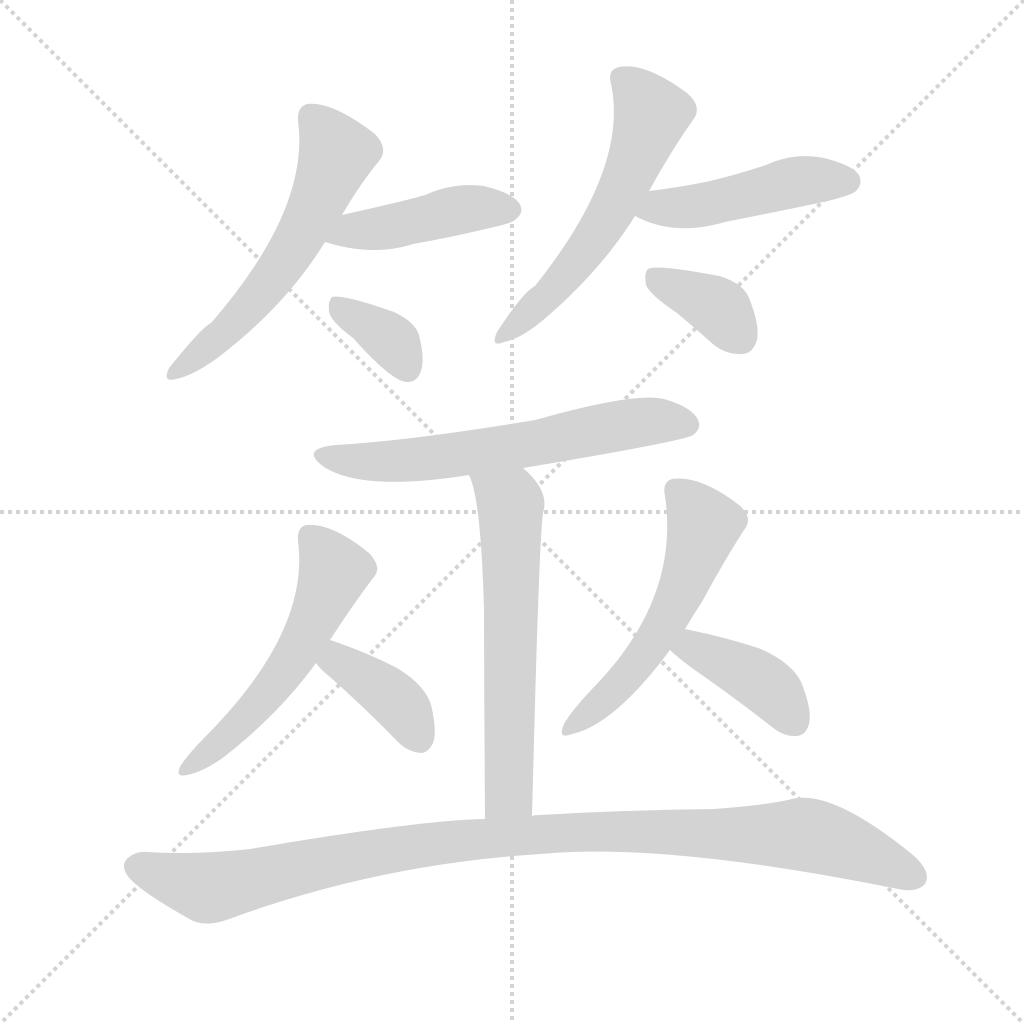
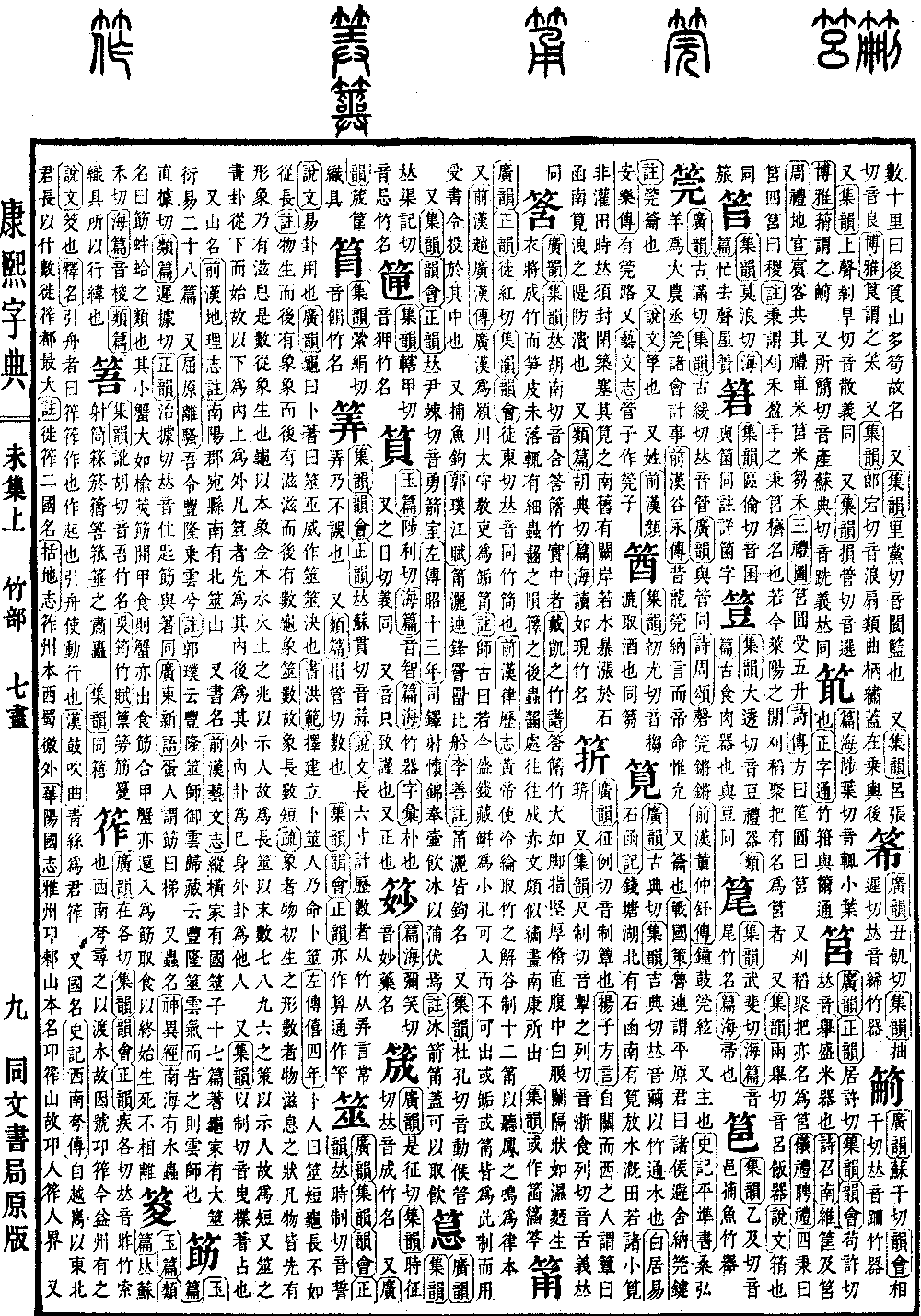
Wei Collection, Upper Volume
Radical: Bamboo (zhú)
Kangxi Strokes: 13
Page 885, Entry 23
Guangyun (Expanded Rhymes), Jiyun (Collected Rhymes), Yunhui (Compendium of Rhymes), Zhengyun (Correct Rhymes): Pronounced shi (falling tone).
Shuowen (Explaining Graphs and Analyzing Characters): The use of divination hexagrams in the Book of Changes (Yijing).
Guangyun (Expanded Rhymes): Divination using tortoise shells is called bu, and divination using yarrow stalks is called shi. Wuxian created the method of shi. Shi means to make a decision.
Book of Documents (Shujing), Great Plan (Hongfan): Select and appoint officials in charge of tortoise and yarrow divination, then command them to perform divination.
Zuo Tradition (Zuo Zhuan), Fourth Year of Duke Xi: The diviner said, The efficacy of yarrow divination is short, while the efficacy of tortoise divination is long; it is better to follow the long one. Commentary: All things must have a form after they grow, and after they have a form, they multiply; only after they multiply are there numbers. Tortoise divination relies on form. Yarrow divination relies on number. Thus it is said that form is long, and number is short. Sub-commentary: Form refers to the shape of things when they first emerge. Number refers to the state of things after they have multiplied. All things first have a form, and then they multiply, so numbers are produced from forms. Tortoise divination uses the root form (such as the omens of metal, wood, water, fire, and earth) to reveal things, so its efficacy is long. Yarrow divination uses the detailed numbers (such as the yarrow stalk counts of seven, eight, nine, and six) to reveal things, so its efficacy is short. Furthermore, when drawing a hexagram using the shi method, one begins from the bottom, so the bottom is considered the interior and the top is considered the exterior. Anyone performing divination first asks about internal matters and then external matters; the inner hexagram represents oneself, and the outer hexagram represents others.
Also Jiyun (Collected Rhymes): Pronounced ye (falling tone). To spread out yarrow stalks to perform divination.
Also a mountain name. Book of Han (Hanshu), Geographical Gazetteer Commentary: There is Mount Beishi to the south of Wan County in Nanyang Prefecture.
Also a book title. Book of Han (Hanshu), Treatise on Literature and Arts: Among the School of Diplomacy (Zonghengjia) there is the Guoshizi in seventeen chapters; in the category of yarrow and tortoise divination there is the Dashengyanyi in twenty-eight volumes.
Also in Qu Yuan, Encountering Sorrow (Lisao): I command Fenglong to ride the clouds. Commentary: Guo Pu says, Fenglong is a diviner who drives the clouds. The Guicang says Fenglong divines cloud vapors to announce good or bad fortune, so he is the cloud master.
Editorial Notes:
Guangyun (Expanded Rhymes) states: Tortoise is called bu, yarrow is called shi, and Wuxian created shi. Following the original text, Wuwei has been corrected to Wuxian.
Book of Han (Hanshu), Treatise on Literature and Arts: Among the yarrow and tortoise practitioners there is the Dashengyanyi in twenty-eight volumes. According to the original book, it is twenty-eight volumes, so chapters has been corrected to volumes.