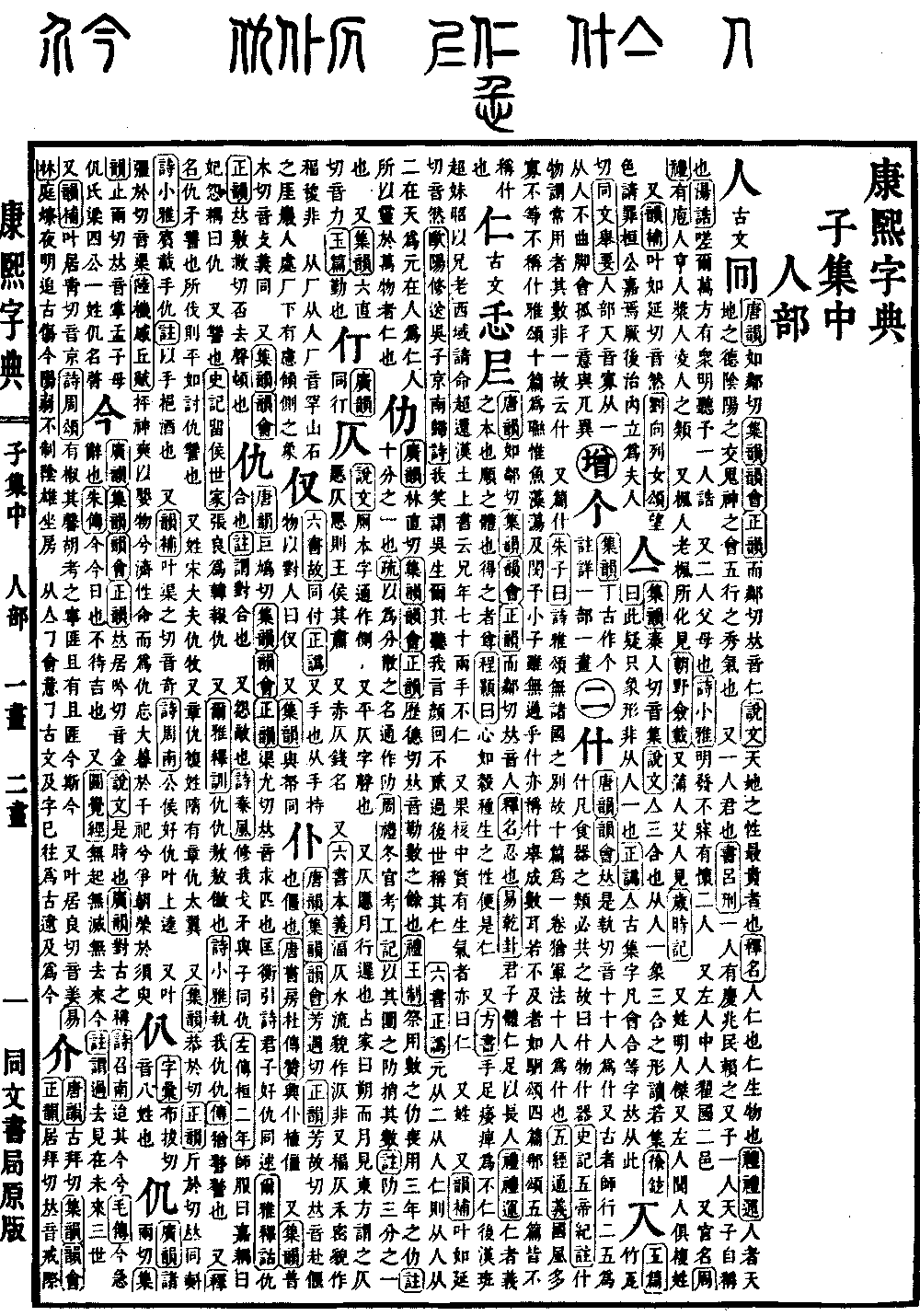
Zi Collection, Middle Volume
Radical: Person (rén)
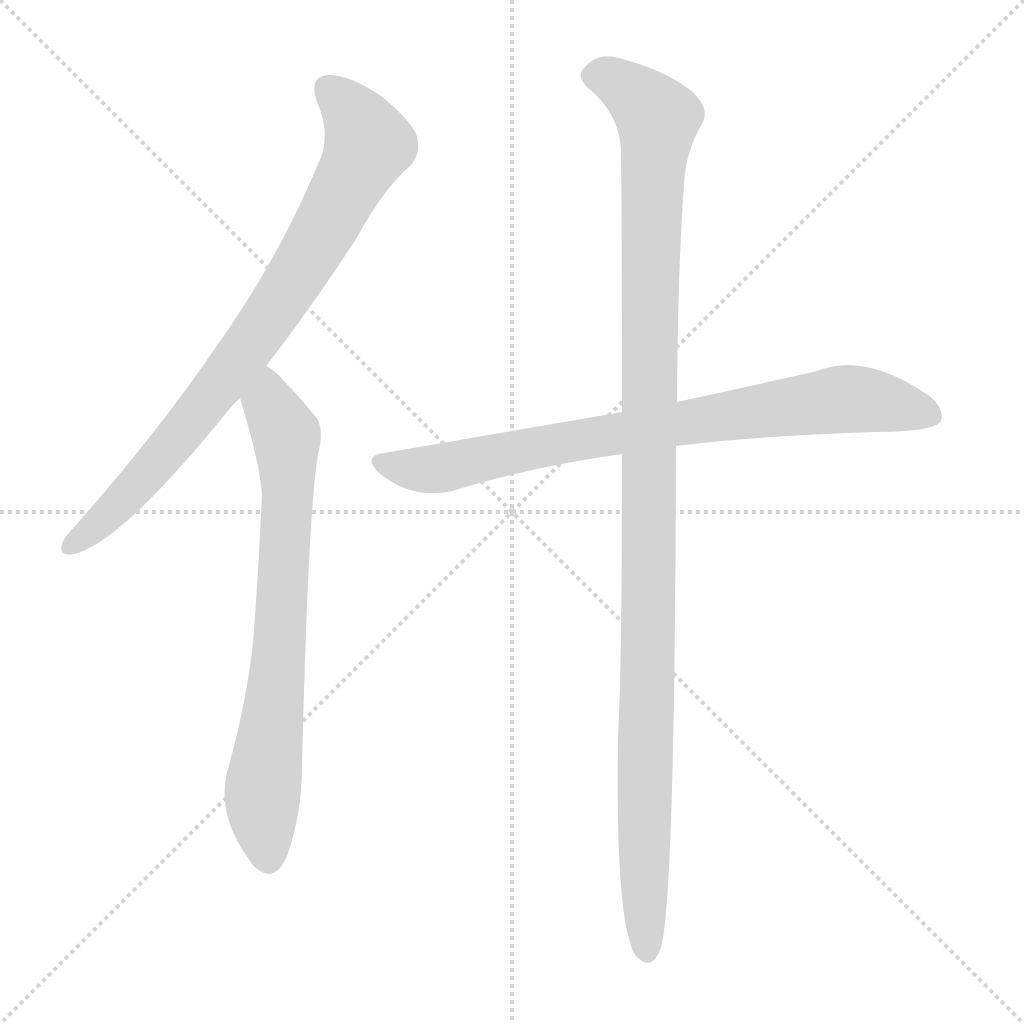
Character: Shen
Kangxi stroke count: 4
Page number: Page 91, entry 06
According to Tang Rhymes (Tangyun) and Rhyme Collection (Yunhui), the pronunciation is shi (level tone).
Ten people constitute a group (shi). Also, in ancient military marches, twenty-five men were organized into one group (shi). Because items such as eating utensils were necessarily shared, they are referred to as miscellaneous goods (shiwu) or miscellaneous utensils (shiqi).
Records of the Grand Historian (Shiji), Commentary on the Annals of the Five Emperors (Wudi Ji Zhu) states: Miscellaneous goods (shiwu) refers to items used in daily life; because their quantity is not limited to a single piece, they are collectively called shi.
It also refers to sections of poetry or prose.
According to the commentaries of Master Zhu (Zhuzi Shuo), in the Book of Odes (Shijing), the sections of Ya and Song do not distinguish between the various states, so ten pieces are compiled into one scroll, just as the military organization uses ten men to form one group (shi).
According to the General Meaning of the Five Classics (Wujing Tongyi), the sections of Airs of the States (Guofeng) vary in the number of pieces and are not called shi. In the Ya and Song sections, ten pieces are compiled into one set. Although pieces such as Yu Zao, Dang, and Min Yu Xiao Zi do not exceed ten in number, they are still called shi; this is a case of citing the round number. If there are fewer than ten, such as the four pieces in Jiong Song or the five pieces in Song, they are not called shi.