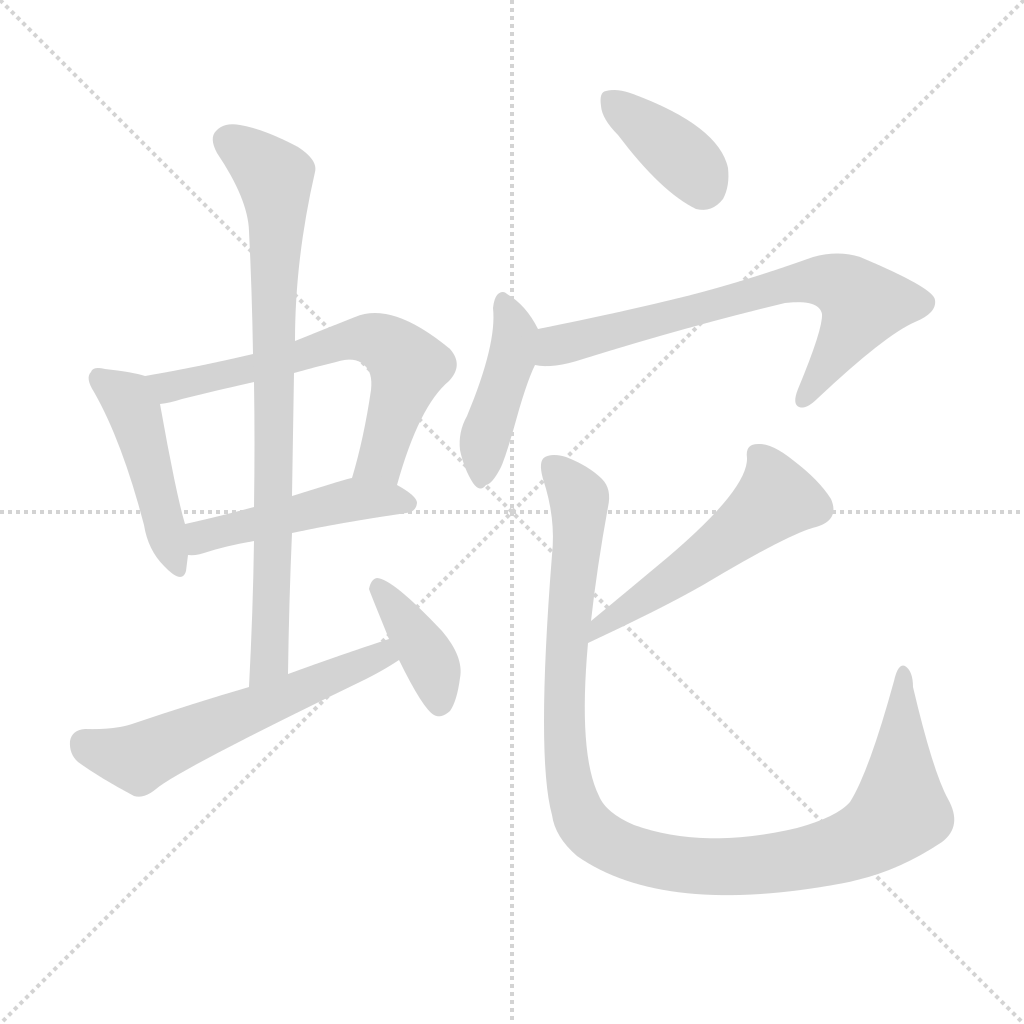
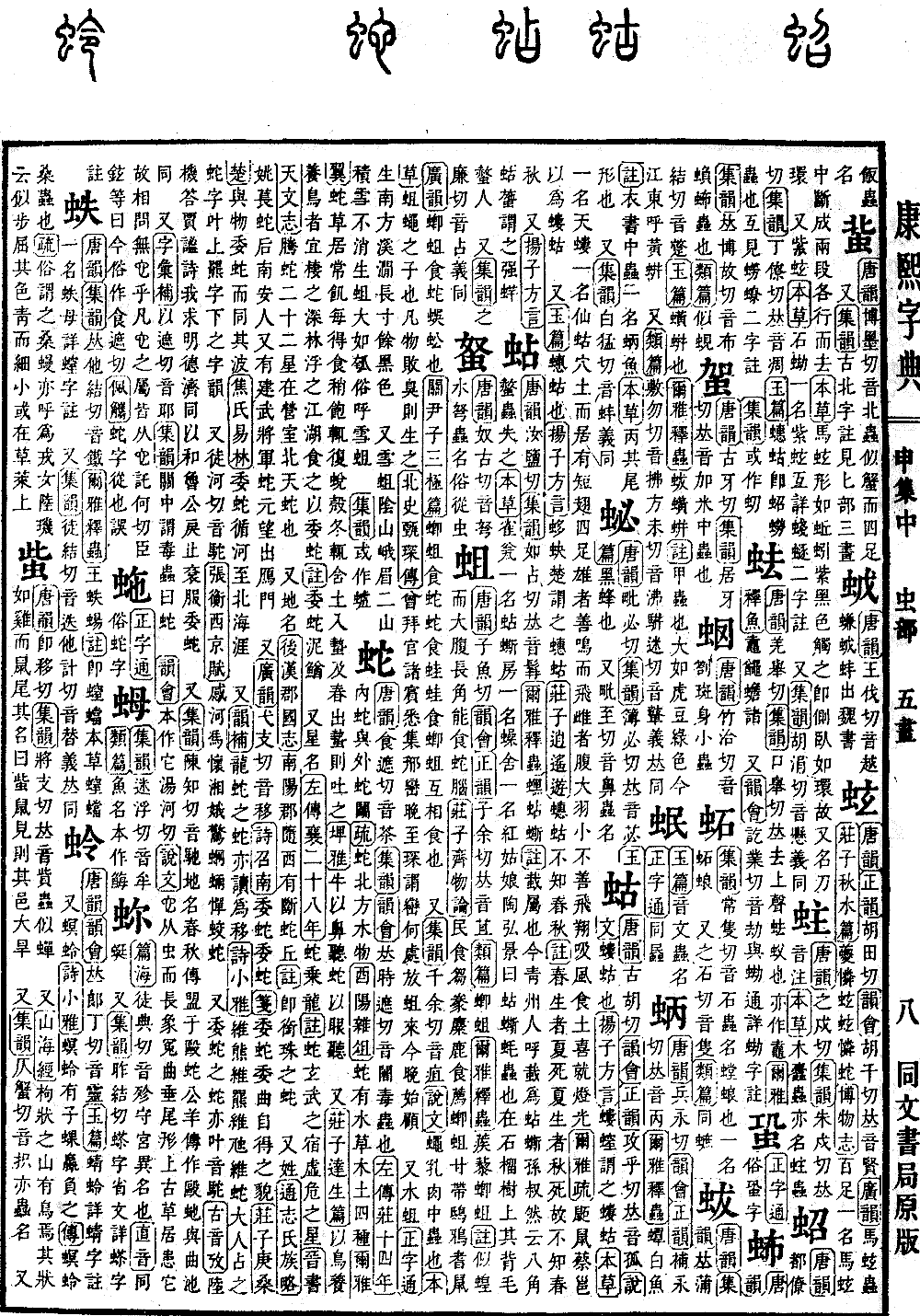
Shen Collection, Middle Volume. Radical: Insect (chóng). Kangxi strokes: 11. Page 1080, Entry 20.
Tang Rhyme (Tangyun): Pronounced she. Pronounced the same as cha. Collected Rhymes (Jiyun), Rhyme Compilation (Yunhui): Pronounced shi. Pronounced the same as she. It is a type of venomous insect.
Zuo Commentary (Zuozhuan), 14th year of Duke Zhuang, records the struggle between snakes inside the palace and snakes outside the palace. The Sub-commentary (Shu) states: The snake is a water-dwelling creature of the north. Miscellaneous Morsels from Youyang (Youyang Zazu) states: Snakes are divided into four types: water, grass, wood, and earth. Wings of the Erya (Eryayi) states: The snake lives in the grass and is often hungry. Each time it eats enough to be slightly full, it molts again. In winter, it holds mud in its mouth to hibernate and spits the mud out when it wakes in spring. Expanded Anecdotes (Piya) states: Cattle use their noses to hear sounds; snakes use their eyes to hear sounds.
Also, Zhuangzi, Chapter on the Mastery of Life (Dasheng), states: To raise a bird, one should let it perch in deep forests, swim in rivers and lakes, and feed it weiyi. The Commentary (Zhu) states: Weiyi refers to a loach.
Also the name of a celestial mansion. Zuo Commentary, 28th year of Duke Xiang: The snake rides the dragon. The Commentary (Zhu) states: The snake is the star of the Black Tortoise, referring to the Xu and Wei mansions. Book of Jin (Jinshu), Treatise on Astronomy, states: The Soaring Snake (Tengshe) constellation consists of 22 stars; it is located north of the Encampment (Yingshi) star and is a celestial snake star.
Also a place name. Book of the Later Han (Houhanshu), Treatise on Geography, states: West of Sui County in Nanyang Commandery is the Snake-Severing Mound (Duansheqiu). The Commentary (Zhu) states: This is the location where the legend of the snake holding a pearl took place.
Also a surname. Comprehensive Record (Tongzhi), Treatise on Clans, states: The Empress of Yao Chang (Emperor of Later Qin) was surnamed She and was a native of Nanan. There was also a General Jianwu named She Yuan, whose ancestral home was in Yanmen.
Also, Broad Rhymes (Guangyun): Pronounced yi. Pronounced the same as yi. Book of Odes (Shijing), Shao Nan section, mentions weiyi. The Annotation (Jian) states: Weiyi describes a graceful and relaxed manner. Zhuangzi, Gengsang Chu section: Follow the changes of external things and align with their fluctuations. Master Jiao's Forest of Changes (Jiaoshi Yilin): Winding and curving along the Yellow River, reaching all the way to the North Sea.
Also, in Rhyme Supplement (Yunbu), the snake in the term dragon-snake can also be pronounced yi. Book of Odes (Shijing), Xiao Ya section: There are bears, there are brown bears, there are vipers, and there are snakes. The Great Diviner came to divine them. The word snake rhymes with the preceding brown bear and the following zhi.
Also pronounced tuo. Pronounced the same as tuo. Zhang Heng, Rhapsody on the Western Capital (Xijing Fu): Moved the River God Feng Yi, longed for the Xiang River Goddess, startled the demons, and feared the dragons and long snakes. Also, the snake in weiyi can also be rhymed as tuo. Examination of Ancient Sounds (Guyin Kao): Lu Ji, Poem in Response to Jia Mi: I seek bright virtue and assist with the way of harmony. The Duke of Lu arrived here, wearing the ritual robes and acting with ease.
Also, Collected Rhymes (Jiyun): Pronounced chi. Pronounced the same as chi. It is a place name. The Spring and Autumn Commentary (Chunqiu Zhuan) records a pact at Oushe; the Gongyang Commentary (Gongyang Zhuan) writes it as Oushe, which is the same as Quchi.
Also, Supplement to the Dictionary (Zihuibu): Pronounced ye. Pronounced the same as ye. Collected Rhymes (Jiyun): In the Guanzhong region, venomous insects are called she.
Rhyme Compilation (Yunhui): It was originally written as ta, pronounced tu. Explained Characters and Writing (Shuowen Jiezi): The character ta is formed by insect but has a long body, resembling a curved tail. In ancient times, people living in the wilderness feared encountering it, so they greeted one another by asking, Have you encountered no ta (snake)? All characters under the ta radical follow this form. Pronounced tuo. Official Xu Xuan and others say: The current common pronunciation is she. Peiqi states: Writing the character she with the ya component is incorrect.