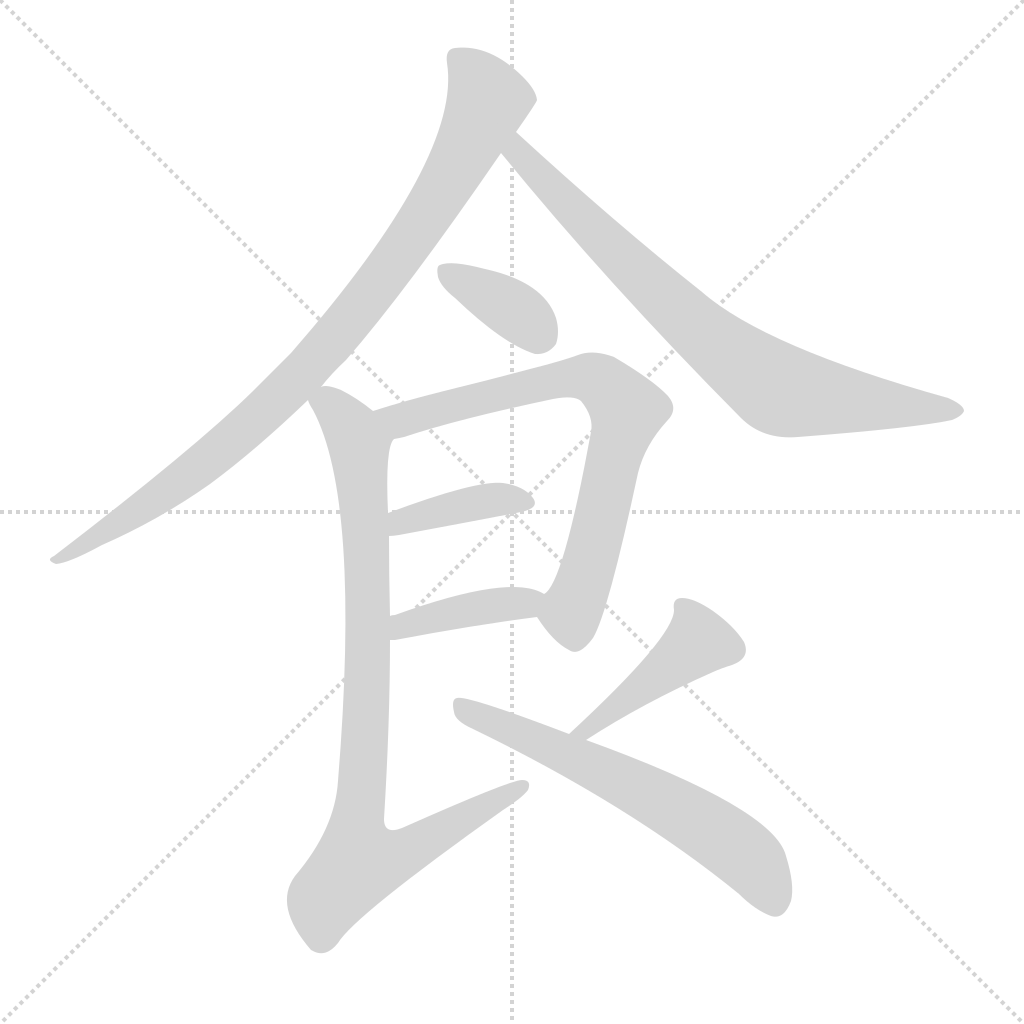
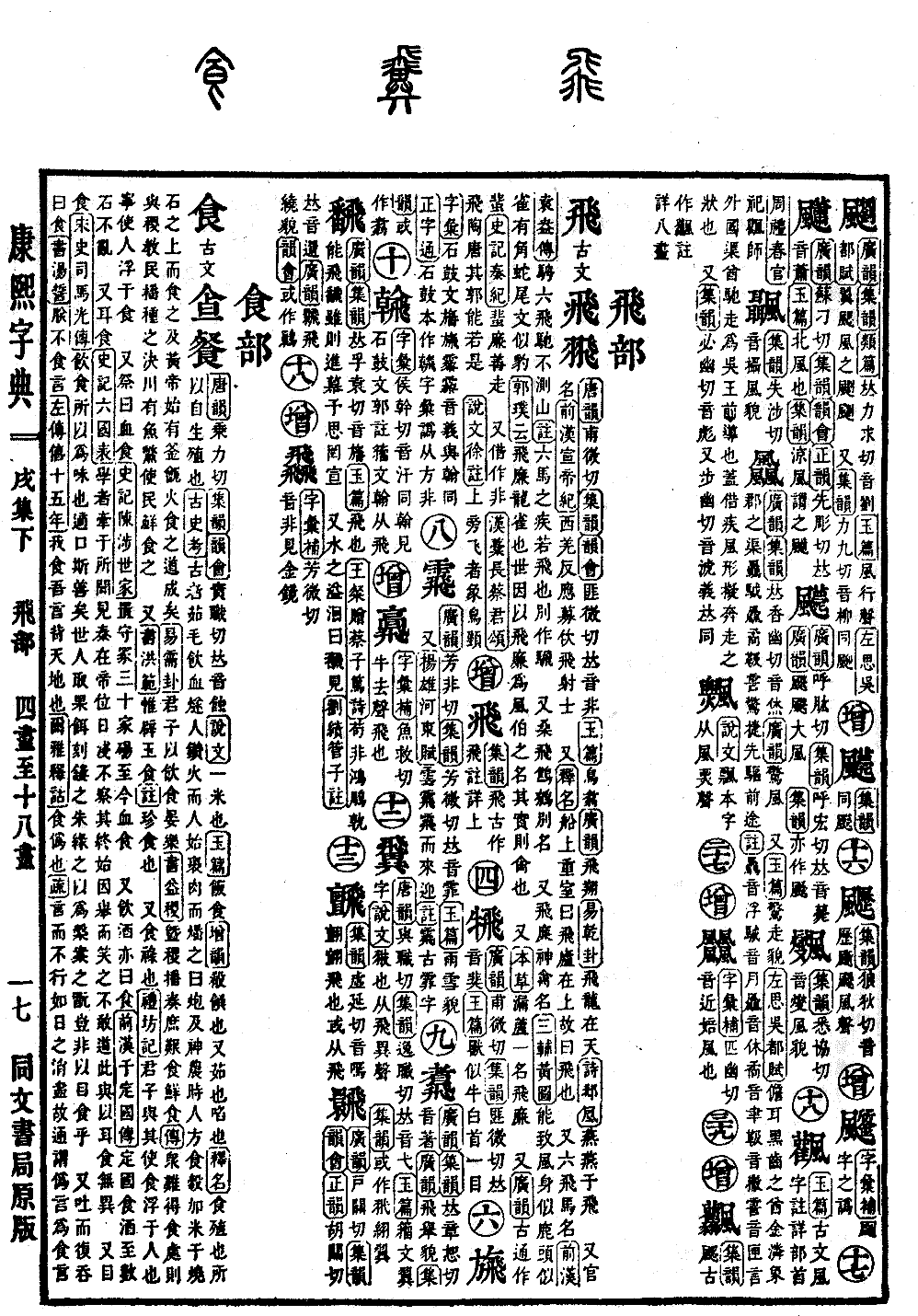
Xu Collection, Lower Volume
Radical: Food (shí)
Page 1415, Entry 29
Ancient form of the character for meal (cān).
Pronounced chéng.
Pronounced shí. Pronounced the same as the character for eclipse (shí).
Explains as one unit of rice.
Refers to cooked meals.
Refers to dishes and meals. Also refers to eating, consuming, or devouring.
To eat is to cultivate; it is that which is used to foster one's own growth and reproduction.
In ancient times, people ate birds and beasts raw, hair and blood included. After the Suiren era discovered fire through wood-drilling, people began wrapping meat and roasting it, which is called pào. By the time of the Shennong era, people began to consume grains, roasting rice on heated stones. By the time of the Yellow Emperor, pots and steamers were created, perfecting the method of cooking food with fire.
The superior person uses this to eat, drink, and feast — Book of Changes (Yijing), Xu Hexagram.
Sowing together with Ji to resolve the people's difficulty in obtaining food and providing fresh fish and turtles — Book of Documents (Shujing), Yiji chapter. Commentary: Where the people have difficulty obtaining food, teach them to sow together with Ji and dredge the rivers to provide fish and turtles for the people to eat.
Only the ruler may enjoy jade-like food — Book of Documents (Shujing), Hongfan chapter. Commentary: Refers to precious and exquisite food. Also refers to salary (fènglù).
The superior person would rather let an individual's talent exceed their salary than let their salary exceed their talent — Book of Rites (Liji), Fangji chapter.
Sacrificial offerings are called blood-eating.
Thirty households were established in Dang to guard the tomb, and they still enjoy sacrificial offerings to this day — Records of the Grand Historian (Shiji), Chen She Family Biography.
Drinking wine is also called eating.
Yu Dingguo would drink up to several stone without becoming intoxicated — History of the Former Han (Qianhan), Biography of Yu Dingguo.
Ear-eating (a metaphor for blindly believing rumors).
Scholars are limited by their own experiences; seeing that the Qin dynasty held the imperial throne for a short time, they do not examine the full sequence of events but mock it and dare not praise it; this is no different from eating with one's ears — Records of the Grand Historian (Shiji), Chronological Table of the Six States.
Eye-eating (a metaphor for valuing only appearance).
Food is for tasting; if it suits the palate, that is sufficient. People in the world carve fruits and cakes, painting them in red and green colors as table ornaments; is this not eating with one's eyes? — History of Song (Songshi), Biography of Sima Guang.
To spit something out and swallow it back is called eating (refers to breaking one's word).
I will not eat my words — Book of Documents (Shujing), Tangshi chapter.
If I swallow my words, I am abandoning heaven and earth — Zuo Tradition (Zuozhuan), 15th Year of Duke Xi.
Eating means falsehood — Er Ya (Liji). Commentary: Saying something but not doing it is like food being fully digested, so false words are commonly called eating words; thus, here eating is explained as false.
To bewitch is called eating.
When a sagacious ruler is in power, favored subordinates cannot bewitch his will — Guanzi, Monarch and Subject chapter.
To dissolve or eliminate.
Wu Yuan said: Even if one regrets it later, it cannot be eliminated — Zuo Tradition (Zuozhuan), 1st Year of Duke Ai. Commentary: Eating here means to dissolve.
Therefore, divination was performed east of the Jian river and west of the Chan river, and only the site of Luo provided a response — Book of Documents (Shujing), Luogao chapter. Commentary: Divination must first involve marking the tortoise shell with ink and then burning it; the crack patterns following the ink lines are called eating the ink.
Solar eclipse, lunar eclipse.
When the moon is full, it will wane (a lunar eclipse occurs) — Book of Changes (Yijing), Feng Hexagram.
A solar eclipse occurred — Spring and Autumn Annals (Chunqiu), 3rd Year of Duke Yin.
Duke Jin of Jin asked Shi Ruo: I heard that a fire occurred in the State of Song, and only then did people know of the heavenly way; why is that? Shi Ruo replied: In ancient times, the officials in charge of fire would sacrifice to the Heart constellation or the Willow constellation to regulate the releasing and storing of fire according to the seasons — Zuo Tradition (Zuozhuan), 9th Year of Duke Xiang.
When I die, choose land that cannot be farmed to bury me — Book of Rites (Liji), Tanjong chapter. Commentary: Not eating refers to land that cannot be cultivated.
Fang and Gong engaged in mutual-eating — History of the Former Han (Qianhan), Biography of External Relatives. Commentary: Ying Shao says: Palace maids would pair up as husband and wife, which is called mutual-eating. Fang and Gong are the names of two individuals.
Shí yán means to persuade — Dialect Dictionary (Fangyan). In the Southern Chu region, whenever someone does not want to be happy but others make them happy, or does not want to be angry but others make them angry, it is called shí yán.
Cold food, the name of a festival.
One hundred and five days after the winter solstice, there will be strong winds and heavy rain, which is called the Cold Food Festival — Jingchu Record of Seasonal Customs (Jingchu Suishiji).
Dashi, the name of a country located west of the Persian Empire in the Western Regions, with its capital in the Brahman lands; their weapons are sharp, and they are courageous in field combat.
A type of game name; belongs to the category of board games.
A surname. There was Shi Zitong in the Han dynasty.
In the Eastern Han dynasty, there was a Shi Yu Gong — Record of Rare Surnames (Xixinglu).
Pronounced sì.
When there is wine and food, offer it to elders first — Analects (Lunyu).
Food is placed on the left side of a person — Book of Rites (Liji), Quli chapter. Commentary: Food refers to items like rice.
Also grain.
Responsible for distributing, providing relief for, rewarding, and issuing monthly food rations as mandated by the government — Rites of Zhou (Zhouli), Earth Officials, Granary Officer.
To provide food for someone to eat.
Give him to drink, give him to eat — Book of Odes (Shijing), Xiaoya chapter.
When the eldest son of a ruler is born, divination is used to select the wife of a scholar or the concubine of a high official to nurse him — Book of Rites (Liji), Neize chapter. Commentary: To eat refers to breastfeeding and nursing.
Gu (a person's name) feeds you — Zuo Tradition (Zuozhuan), 1st Year of Duke Wen. Commentary: To eat means to raise/support.
Used for personal names. In the Han dynasty, there were Shen Shiqi and Li Shiqi.
Written as Yìjī — Han History (Hanji).
Pronounced shuò.
Three rivers merge together, the water surging and rushing. My royal house is ruined, the people are suffering from a lack of food — Yilin.