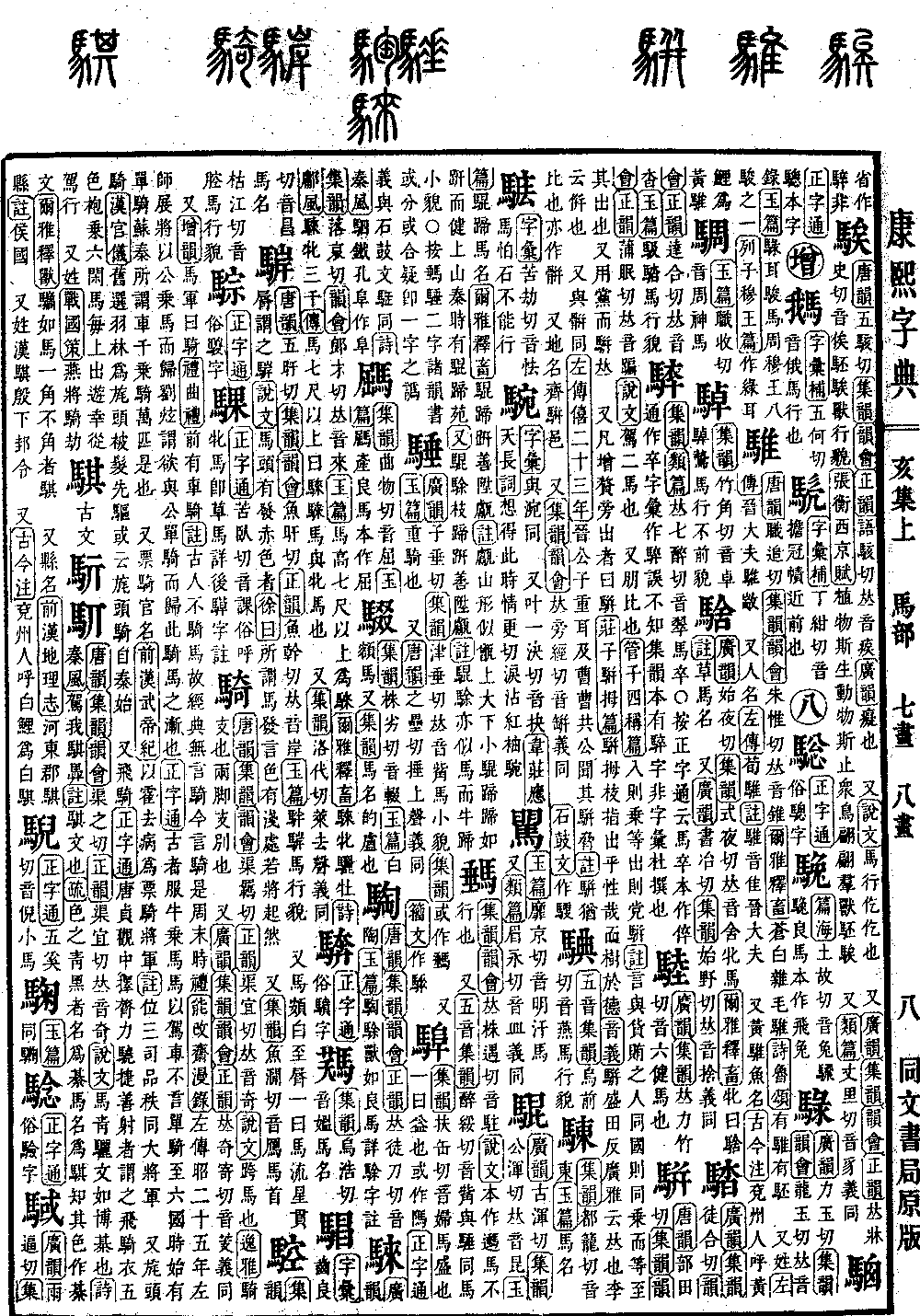
Hai Collection, Upper Volume
Radical: Horse (mǎ)
Kangxi stroke count: 18
Page 1440, Entry 01
Pronounced qi.
Shuowen Jiezi (Shuowen): To sit astride the back of a horse.
Definition: Qi means to straddle, referring to the legs being spread apart to support the body.
Also pronounced ji. The meaning is the same.
Also, cavalry is referred to as qi.
Book of Rites (Liji), Section on Qu Li: Ahead were carriages, horses, and cavalry.
Commentary: In ancient times, people did not ride horses; therefore, the classics do not mention it. The current use of the term refers to rituals from the end of the Zhou dynasty.
Nenggaizhai Manlu: The Zuo Tradition (Zuozhuan), 25th year of Duke Zhao, records that the Left Minister Zhan intended for Duke Zhao to return to his state on horseback. Liu Xuan suggests this refers to returning alone on horseback, marking the beginning of the practice.
Zhengzitong: In ancient times, cattle and horses were used to pull carriages; horses were for drawing vehicles, and riding alone was not practiced. It was not until the Warring States period that solo riding began. Su Qin’s reference to a thousand chariots and ten thousand cavalry refers to this.
Also, Piaoji, a title of office.
History of the Former Han Dynasty (Qian Han Shu), Biography of Emperor Wu: Appointed Huo Qubing as General of the Flying Cavalry.
Note: The position ranked among the Three Excellencies, with a status and salary equivalent to the General-in-Chief.
Also, Maotouqi (Yaks-tail cavalry).
Hanguanyi: Historically, the Yulin guards were selected to serve as Maotou, wearing their hair loose to serve as the vanguard. Some say the Maotou cavalry began during the Qin dynasty.
Also, Feiqi (Flying cavalry).
Zhengzitong: During the Zhenguan era of the Tang dynasty, men who were physically strong, courageous, agile, and skilled in archery were selected and called Feiqi. They wore five-colored robes and rode horses from the imperial stables, accompanying and guarding the Emperor whenever he went on excursions.
Also, a surname.
Strategies of the Warring States (Zhanguoce): The Yan general Qijie.
Textual research: Yiya states that qi means to straddle. Following the original text, Yiya has been corrected to Definition.
Book of Rites (Liji), Section on Qu Li: Ahead were carriages, horses, and cavalry.
Commentary: In ancient times, people did not ride horses. Following the original text, the Note has been corrected to Commentary.