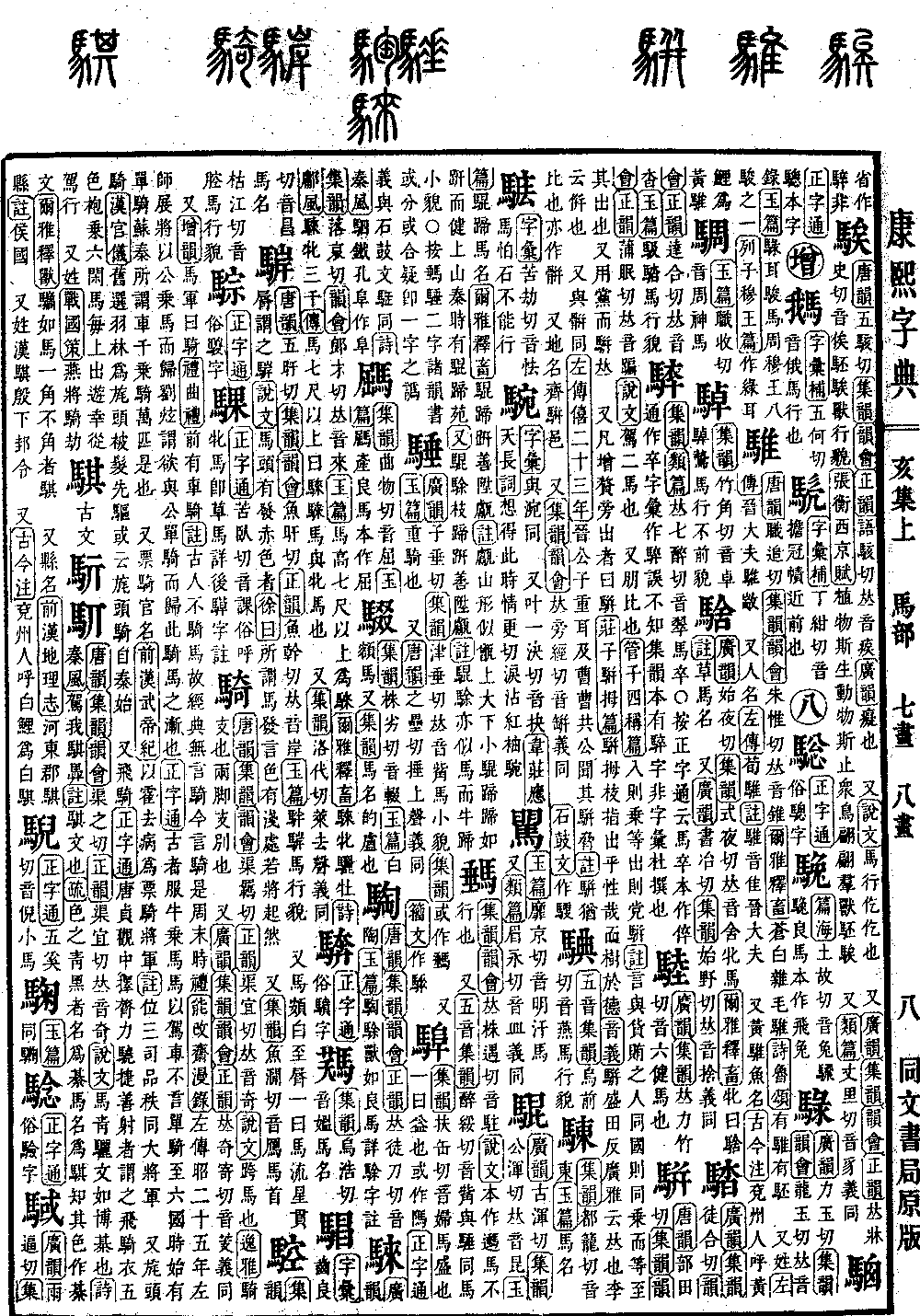
Hai Collection, Upper Volume
Radical: Horse (mǎ)
Kangxi Strokes: 18
Page 1440, Entry 36
Pronounced qí. According to the Shuowen Jiezi (Explanation of Simple and Compound Characters), it means to straddle a horse. According to the Ming (Definitions of Terms), it means to branch out, as in two legs branching apart.
Pronounced jì. The meaning is the same as above.
Additionally, according to the Zengyun (Expanded Rhymes), cavalry units are called qí. According to the Book of Rites (Liji), "In front are the chariots and cavalry." The commentary notes that the ancients did not ride horses, and therefore the classics do not speak of riding. The mention here signifies customs from the end of the Zhou dynasty. The Nenggaizhai Manlu (Record of Miscellaneous Observations) notes that in the twenty-fifth year of Duke Zhao in the Zuo Commentary (Zuozhuan), it states that Zuo Shizhan intended to take the Duke's horse and return alone; Liu Xuan interpreted this as wishing to return with the Duke on a single horse, marking the gradual emergence of horse riding. The Zhengzitong (Correction of Characters) states that in antiquity, people used oxen and rode in carriages; horses were used for drawing carriages and there was no mention of riding single horses. By the time of the Warring States period, single-rider cavalry appeared, such as Su Qin's reference to a thousand chariots and ten thousand cavalry.
Furthermore, Piaoji, an official title. According to the Annals of Emperor Wu in the Former Han (Hanshu), Huo Qubing was appointed General of Piaoji. The commentary notes that his rank was equal to the Three Excellencies, with a status equivalent to the General-in-Chief.
Also, Maotouqi (Cavalry with Yak-tail Standards). According to the Hanguanyi (Ceremonies of the Han Officials), the Yulin guards were selected to be Maotou, wearing their hair loose and acting as the vanguard. Some say Maotou cavalry originated in the Qin dynasty.
Also, Feiqi (Flying Cavalry). The Zhengzitong states that during the Zhenguan era of the Tang dynasty, soldiers with physical strength, agility, and archery skills were selected and called Feiqi. They wore robes of five colors and rode horses from the imperial stables, accompanying the emperor during his excursions.
Also, a surname. As in the Yan general Qijie from the Strategies of the Warring States (Zhanguo Ce).
Textual verification: The Yiya (Lost Definitions) states that to ride is to branch out. Note: The original book text has been corrected from Yiya to Ming. In the Book of Rites (Liji), the phrase is "In front are the chariots and cavalry." The original text has been corrected from note to commentary.