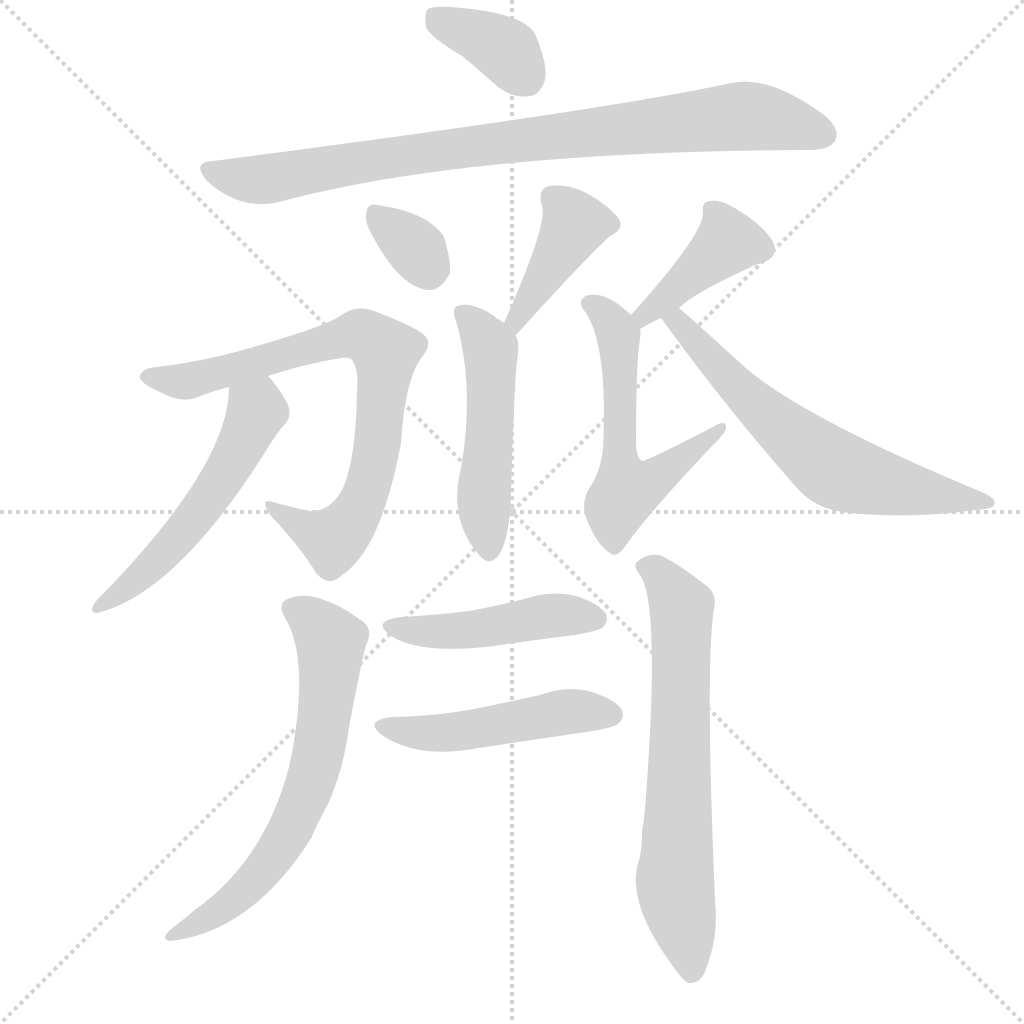
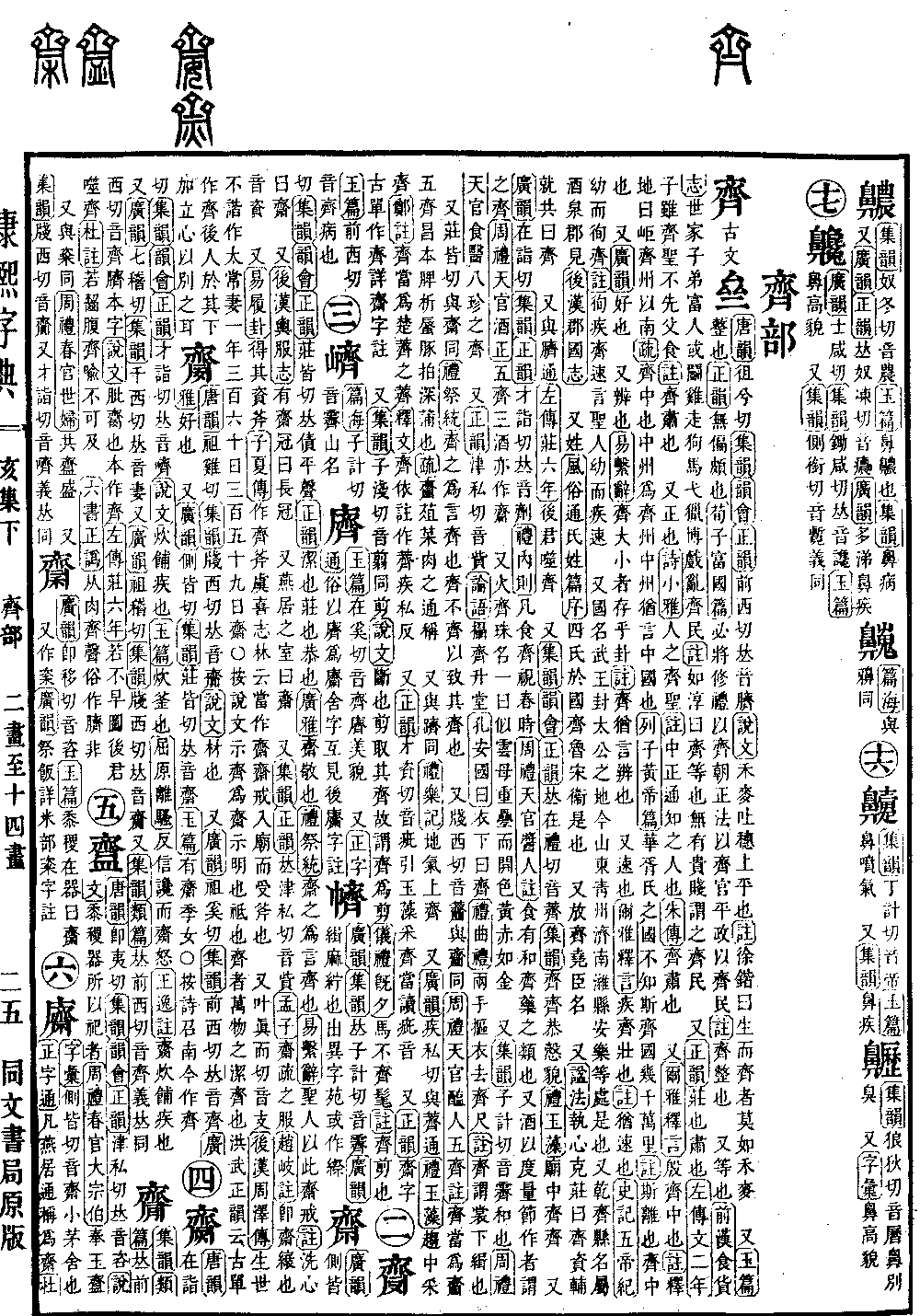
Hai Collection, Lower Volume
Radical: Grain (hé)
Qi; Kangxi strokes: 14; Page 1531, Entry 06
Ancient form: A variant form (zi)
Pronounced qi
Shuowen Jiezi (Explanation of Characters and Analysis of Scripts): Grain and wheat rising to form a level top. Commentary: Xu Kai says, nothing is more level than grain and wheat when they grow.
Also, Yu Pian (Jade Chapter): To put in order.
Zheng Yun (Correct Rhymes): Without partiality.
Xunzi, Chapter on Wealth and Governance: Must cultivate rites to regulate the court, rectify laws to regulate officials, and equalize governance to regulate the common people. Commentary: Qi means to regulate or put in order.
Also, equality. Han Dynasty, Book of Han (Hanshu), Treatise on Food and Money: Children of wealthy families sometimes fight chickens, race dogs and horses, or hunt and gamble, disturbing the equal common people. Commentary: Ru Chun says, Qi means equal. There is no distinction between noble and lowly, which is called equal common people.
Also, grave or solemn. Zuo Zhuan (Commentary on the Spring and Autumn Annals), Year 2 of Duke Wen: Although you are solemn and sage, do not eat before your father. Commentary: Qi means solemn.
Also, correct. Book of Odes (Shijing), Lesser Odes: A man who is solemn and sage. Commentary: A person who is balanced, correct, and intelligent. Zhu Xi’s Commentary: Qi means solemn.
Also, Er Ya (Approaching Elegance), Interpretation of Words: Yin-Qi means the center. Commentary: The interpretation of locations states: Proceeding from Qi Prefecture southward. Sub-commentary: Qi means the center. The central prefecture is called Qi Prefecture. Central prefecture is equivalent to saying the Middle Kingdom.
Liezi, Chapter on the Yellow Emperor: The country of Huaxu, I do not know how many thousands of miles it is from this middle country. Commentary: Si means distant. Qi means the center.
Also, Guang Yun (Broad Rhymes): Beautiful.
Also, to distinguish. I Ching (Book of Changes), Appended Statements: Distinguishing the small and the large depends on the hexagrams. Commentary: Qi is equivalent to saying distinguish.
Also, fast. Er Ya, Interpretation of Words: Swift-Qi means strong. Commentary: This means fast.
Records of the Grand Historian (Shiji), Annals of the Five Emperors: Young and quick-witted. Commentary: Xun means fast, Qi means swift. It says the sage was quick and swift from youth.
Also, name of a state. The land enfeoffed to Grand Duke Wang by King Wu, today located in areas such as Qing Prefecture, Jinan, Wei County, and Anle in Shandong.
Also, Qianqi, name of a county. Belonged to Jiuquan Commandery. See Book of the Later Han (Hou Hanshu), Treatise on Administrative Geography.
Also, a surname. Fengsu Tong (Comprehensive Meaning of Customs), Preface to the Chapter on Surnames: The four clans, referring to the states of Qi, Lu, Song, and Wei, are examples.
Also, Fangqi, name of an official under Emperor Yao.
Also, post-mortem title (shi): Holding one’s heart with the ability to be grave is called Qi. Assisting and being cooperative is called Qi.
Also, interchangeable with navel (qi). Zuo Zhuan, Year 6 of Duke Zhuang: The later ruler bit his navel.
Pronounced ji
Jiyun (Collection of Rhymes): Qi-qi, the appearance of being respectful and cautious.
Book of Rites (Liji), Jade Beads: In the temple, respectful and cautious.
Pronounced ji
Book of Rites, Inner Requisites: For all food condiments, follow the seasonal timing.
Rites of Zhou (Zhouli), Officers of Heaven, Notes on the Sauce-Maker: Food has seasonings and condiments; these are things like medicine.
Also, wine regulated by measurement and adjustment is called a condiment.
Rites of Zhou, Officers of Heaven, Wine Official: Five condiments and three wines; also written as a variant form (ji).
Also, Huoqi, name of a pearl. Another source says it resembles mica. It opens in layers, yellow and red in color like gold.
Pronounced ji
To harmonize. Rites of Zhou, Officers of Heaven, Food Physician: The condiments for the eight delicacies.
Pronounced zi
Analects of Confucius (Lunyu): Gather the hems of the robe and ascend the hall. Kong Anguo says: The bottom hem of a garment is called Qi.
Book of Rites, Qu Li: Use both hands to hold the clothes and move one foot away from the hem. Commentary: Qi refers to the embroidery at the bottom of the skirt.
Pronounced zhai
Same as zhai (fast/abstinence). Book of Rites, Record of Sacrifices: To speak of fasting is to speak of becoming level; leveling the unequal to arrive at a state of oneness.
Pronounced ji
Same as ji (pickled relish). Rites of Zhou, Officers of Heaven, Notes on the Meat-Sauce Maker: Qi should be written as ji.
Sub-commentary: Ji is the general term for pickled vegetables and meats.
Also, interchangeable with ji (to ascend). Book of Rites, Record of Music: Earthly energy rises and levels.
Pronounced ji
Interchangeable with ji (caltrop). Book of Rites, Jade Beads: Fast-paced central gathering. Zheng’s Commentary: Qi should be written as the ji of caltrop. Explanation of Characters: Qi, based on the commentary, is written as ji.
Pronounced ci
Zheng Yun (Correct Rhymes) cites that the Qi in the Jade Beads should be read with the pronunciation ci.
Zhai (fast), anciently written simply as Qi. See the entry for Zhai.
Pronounced jian
Same as jian (to cut). Shuowen Jiezi: To break. To cut until it is level, therefore Qi is called jian.
Book of Etiquette and Ceremonial (Yili), Day of the Funeral: Cut the horse’s mane. Commentary: Qi means to cut.