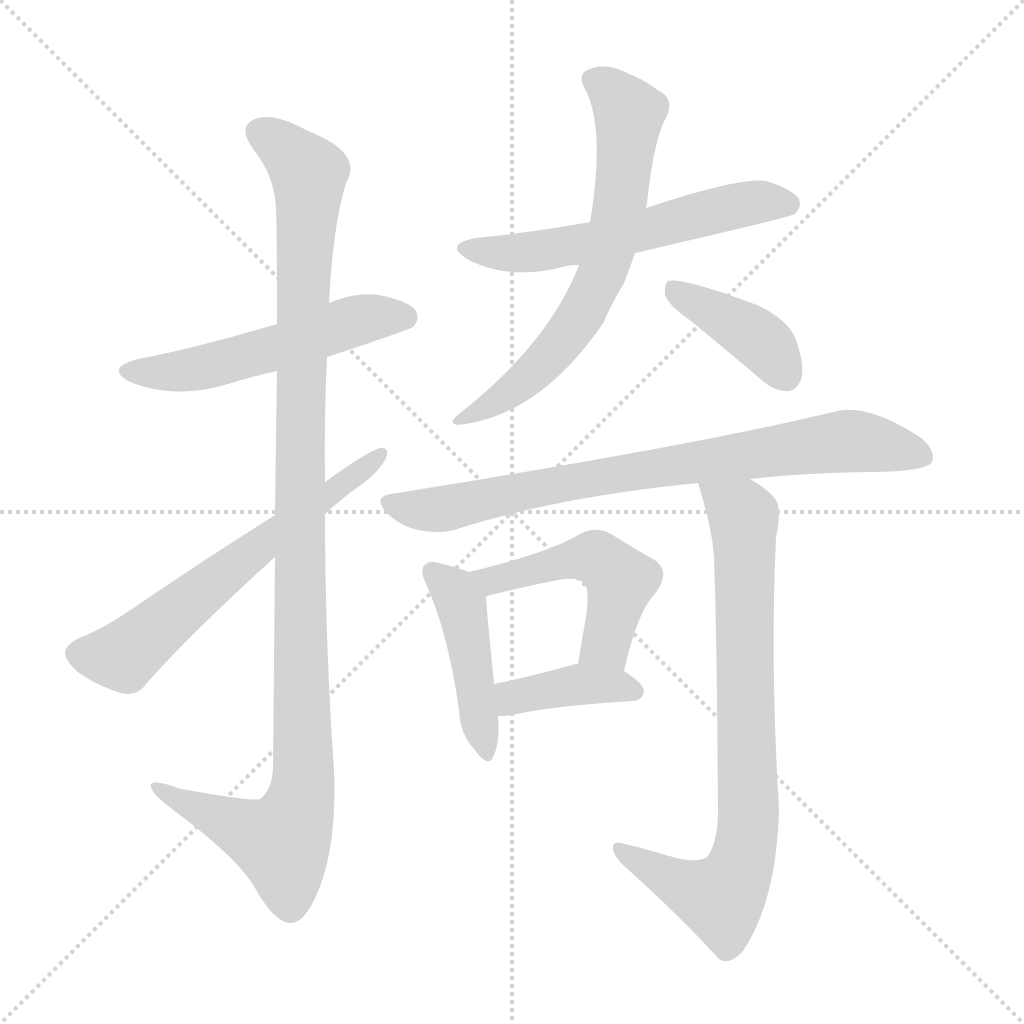
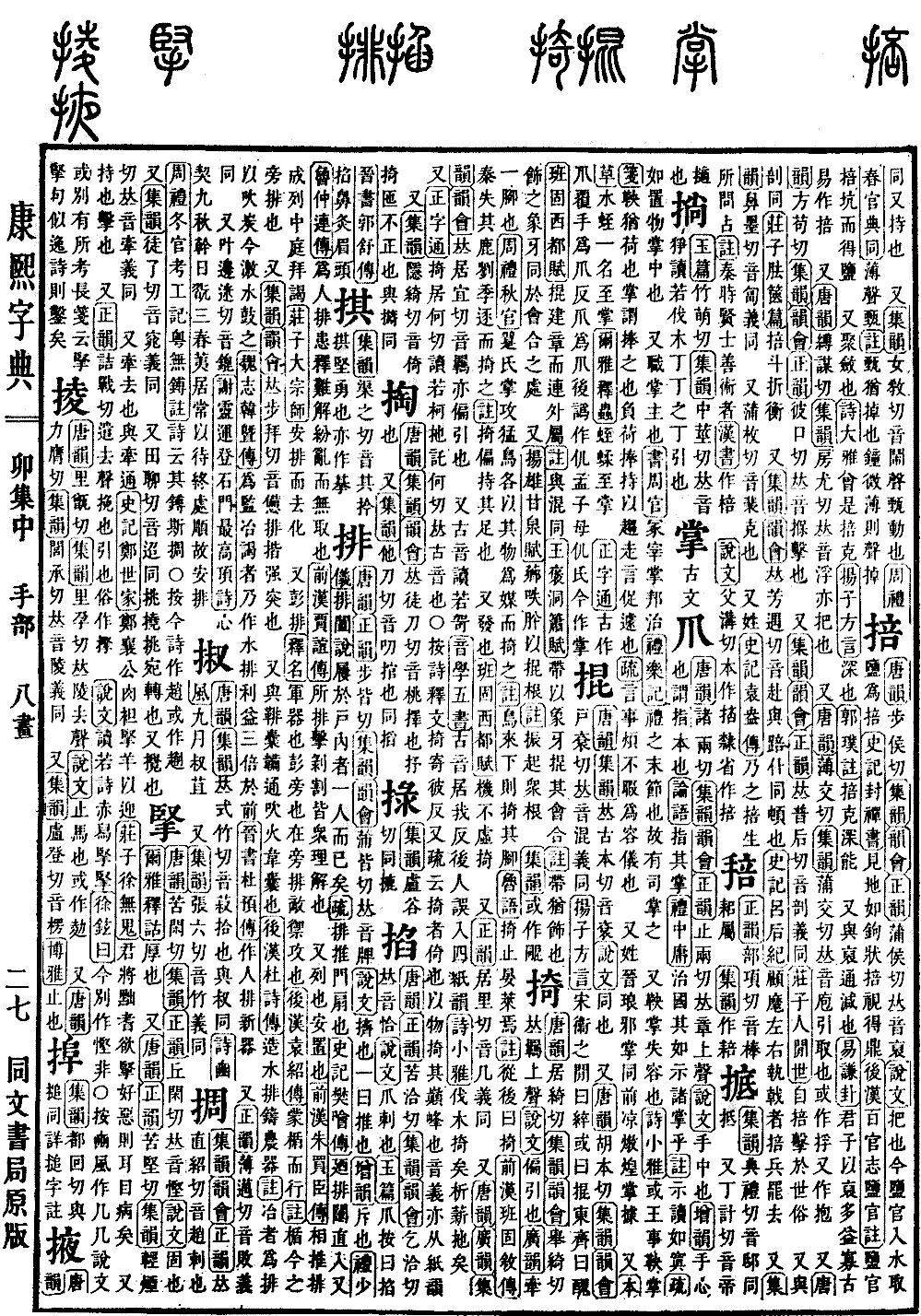
Mao Collection, Middle Volume. Radical: Hand (shǒu). Kangxi strokes: 12. Page 437, Entry 08.
Pronounced ji. In the Tang Dynasty Pronunciation Guide (Tangyun), it is pronounced ji (rising tone). In the Collection of Rhymes (Jiyun) and the Compendium of Rhymes (Yunhui), it is pronounced ji (rising tone). According to the Explaining Graphs and Analyzing Characters (Shuowen), it means to pull to one side. According to the Broad Rhymes (Guangyun), it means to pull at one leg. In the Book of Rites (Zhouli), Autumn Official: The officer of the Gentry of Wings is responsible for attacking fierce birds, using their respective lures to seize them. The commentary states: When a bird descends, one seizes its feet. In the Discourses of Lu (Luyu): It was seized and brought to a halt at Yanlai. The commentary states: To follow from behind is called ji. In the History of the Former Han (Qianhan), Biography of Ban Gu: The Qin Dynasty lost its deer, and Liu Ji chased and pulled it by its legs. The commentary states: Ji means to grasp one foot to the side. It also means to trigger. In the Western Capital Rhapsody (Xi Du Fu) by Ban Gu: The mechanism does not trigger in vain.
Additionally, according to the Correct Rhymes (Zhengyun), it is pronounced ji (level tone), with the same meaning.
Also, in the Tang Dynasty Pronunciation Guide (Tangyun), the Broad Rhymes (Guangyun), the Collection of Rhymes (Jiyun), and the Compendium of Rhymes (Yunhui), it is pronounced ji. It also means to pull to one side.
It was also read as ge in ancient times. According to the Five Books on Phonology (Yinxue Wushu), the ancient pronunciation was ju-wo, which later scholars mistakenly categorized into the fourth zhi rhyme group. In the Book of Odes (Shijing), Lesser Odes (Xiao Ya): Cutting wood is like this, splitting firewood is like that.
According to the Correct Character Guide (Zhengzitong), ji is pronounced he, and read like the word ke. The character tuo is pronounced he, which is an ancient pronunciation. The Explanation of the Odes (Shi Shiwen) states that ji is pronounced ji. The sub-commentary states: Ji means to lean, using an object to support its peak. The phonology and meaning also follow the zhi rhyme group.
According to the Collection of Rhymes (Jiyun), it is pronounced yi. The term jiyi refers to something that is not straight. It is the same as the character yi.