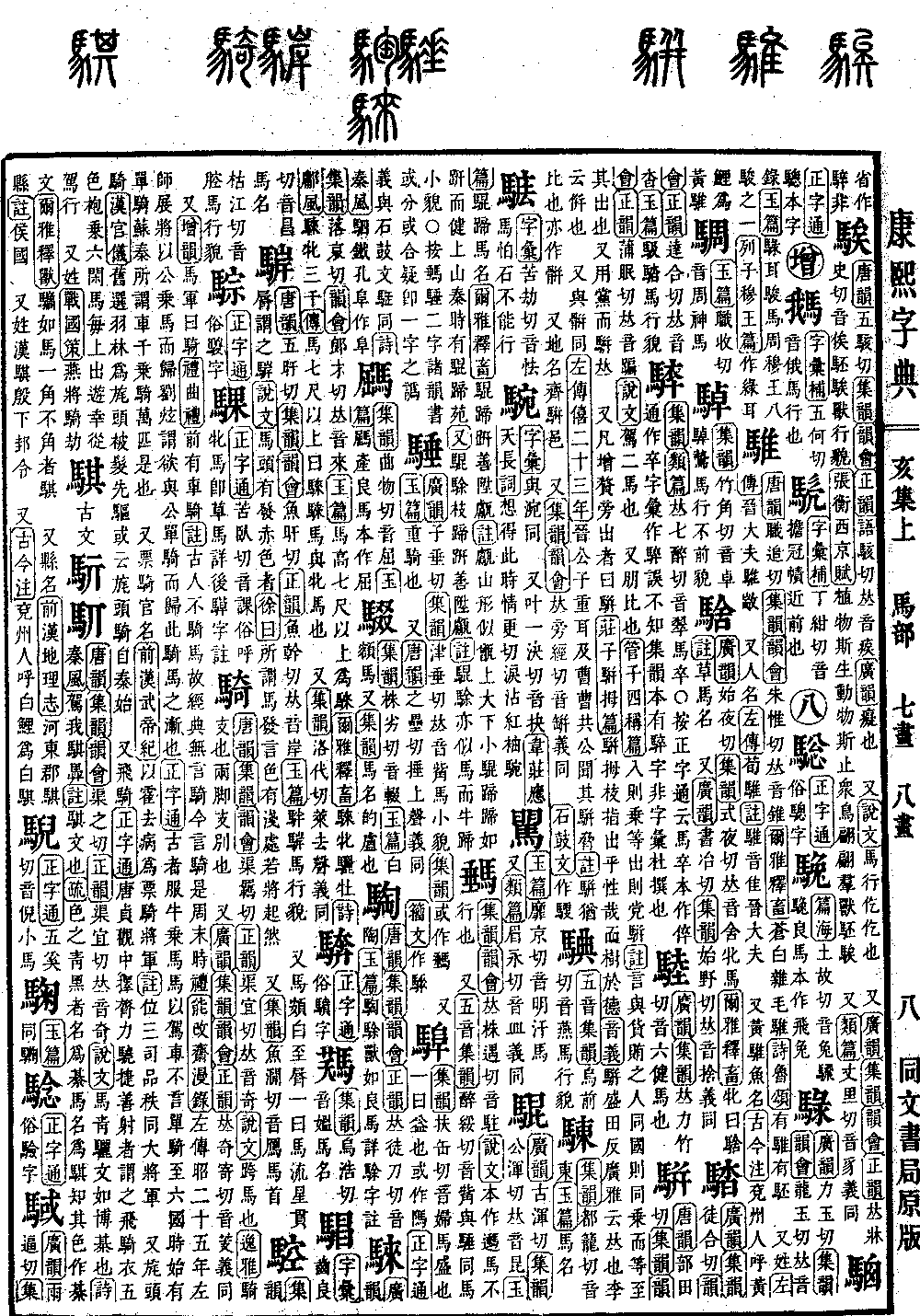
Hai Collection, Upper Volume
Radical: Carriage (chē)
Qi
Kangxi stroke count: 18
Page 1440, Entry 37
According to historical records: The Tang Rhyme (Tangyun), Collection of Rhymes (Jiyun), and Rhyme Compilation (Yunhui) note the pronunciation as qi; the Correct Rhymes (Zhengyun) notes the pronunciation as qi; the sound is similar to qi. The Explaining Graphs and Analyzing Characters (Shuowen Jiezi) defines it as: A horse with a blue-black coat and patterns resembling a chessboard grid. The Book of Odes (Shijing), Odes of Qin, contains the line: Driving my dappled horse. The commentary explains that the character refers to having patterns. The sub-commentary further explains: A blue-black color is called qi. Since the horse is named qi, it is understood that its coat forms qi-like patterns. The Literary Expositor (Erya), Explanation of Beasts, records: There is a beast that resembles a horse but has only one horn; one without a horn is called qi. It is also the name of a county. The History of the Former Han (Qian Hanshu), Treatise on Geography, records: Hedong Commandery had a Qi County. The commentary explains it was a marquisate. It is also a surname. During the Han Dynasty, there was a person named Qi Yin who served as the magistrate of Xiagui County. Additionally, the Records of Ancient and Modern Times (Gujin Zhu) records: People of Yanzhou call white carp white qi.