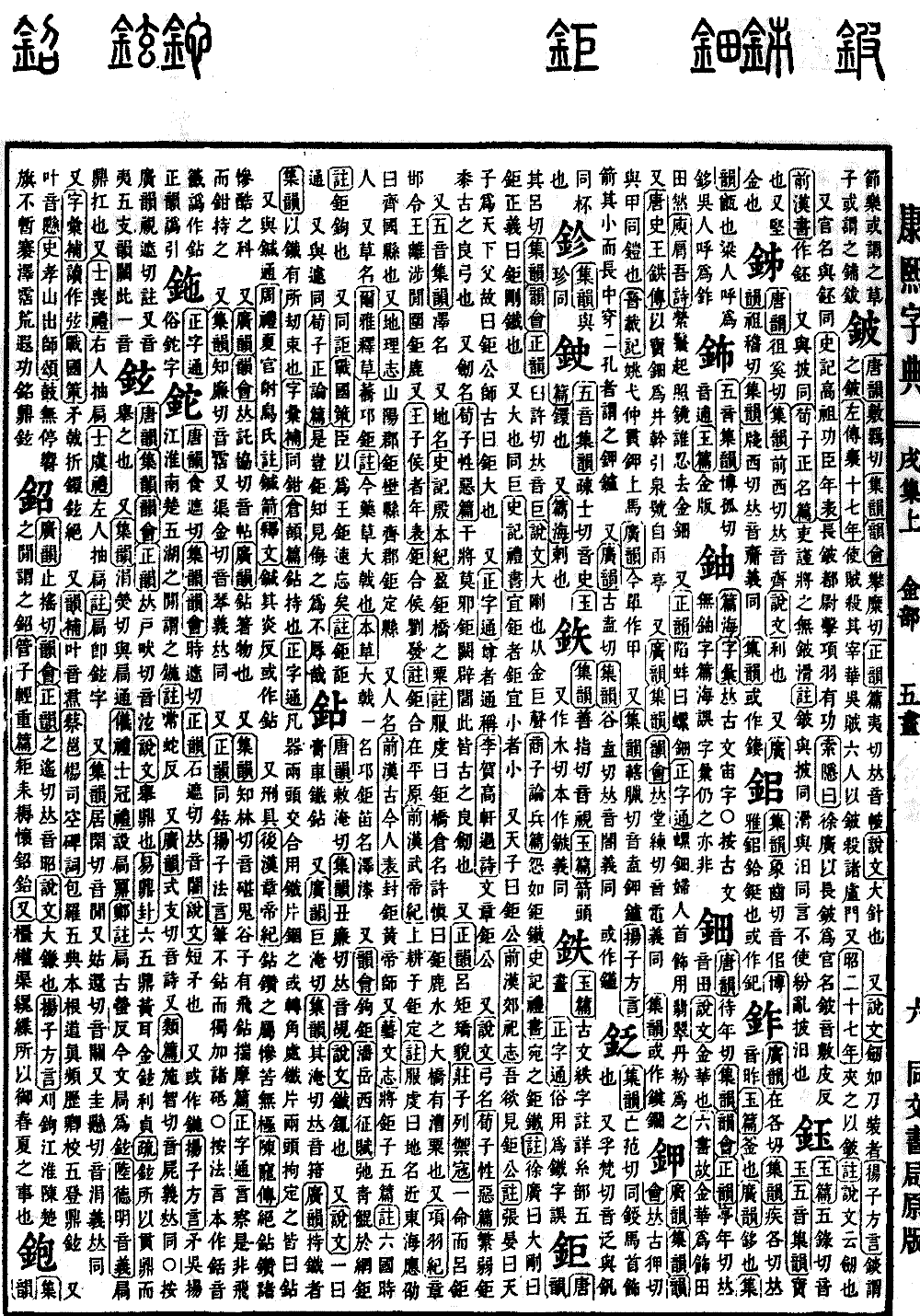
Xu Collection, Upper Volume
Radical: Metal (jīn)
Kangxi Strokes: 13
Page 1300, Entry 02
Pronounced pi (falling tone).
According to the Explaining Graphs and Analyzing Characters (Shuowen Jiezi), it refers to a large needle. It also refers to a sword shaped like a blade.
According to the Regional Languages (Fangyan) by Yang Xiong, a tam is called a pi.
According to the Commentary on the Spring and Autumn Annals (Zuo Zhuan), in the seventeenth year of Duke Xiang, an assassin was sent to kill the governor Hua Wu; six thieves killed him at the Lu Gate with a pi.
In the twenty-seventh year of Duke Zhao, it is mentioned that he was flanked by a pi. The commentary notes that according to the Explaining Graphs and Analyzing Characters (Shuowen Jiezi), this refers to a sword.
It also refers to an official title, written the same as another character (pi).
According to the Records of the Grand Historian (Shiji), in the table of meritorious officials of Emperor Gaozu, the Commander of the Long Pi attacked Xiang Yu and achieved merit. The Suoyin commentary states that Xu Guang considered Long Pi to be an official title, and that pi is pronounced like a combination of the sounds fu and pi. It is written as a different character in the Book of Han (Qian Hanshu).
It is also synonymous with the word pi (to disperse/uncover).
According to the Rectification of Names chapter in the Xunzi, officials should manage things carefully so as not to cause confusion or disorder. The commentary notes that this pi is synonymous with pi (to disperse), and that the word for sliding is synonymous with the word for turbulent, meaning do not allow things to become messy, confused, or turbulent.