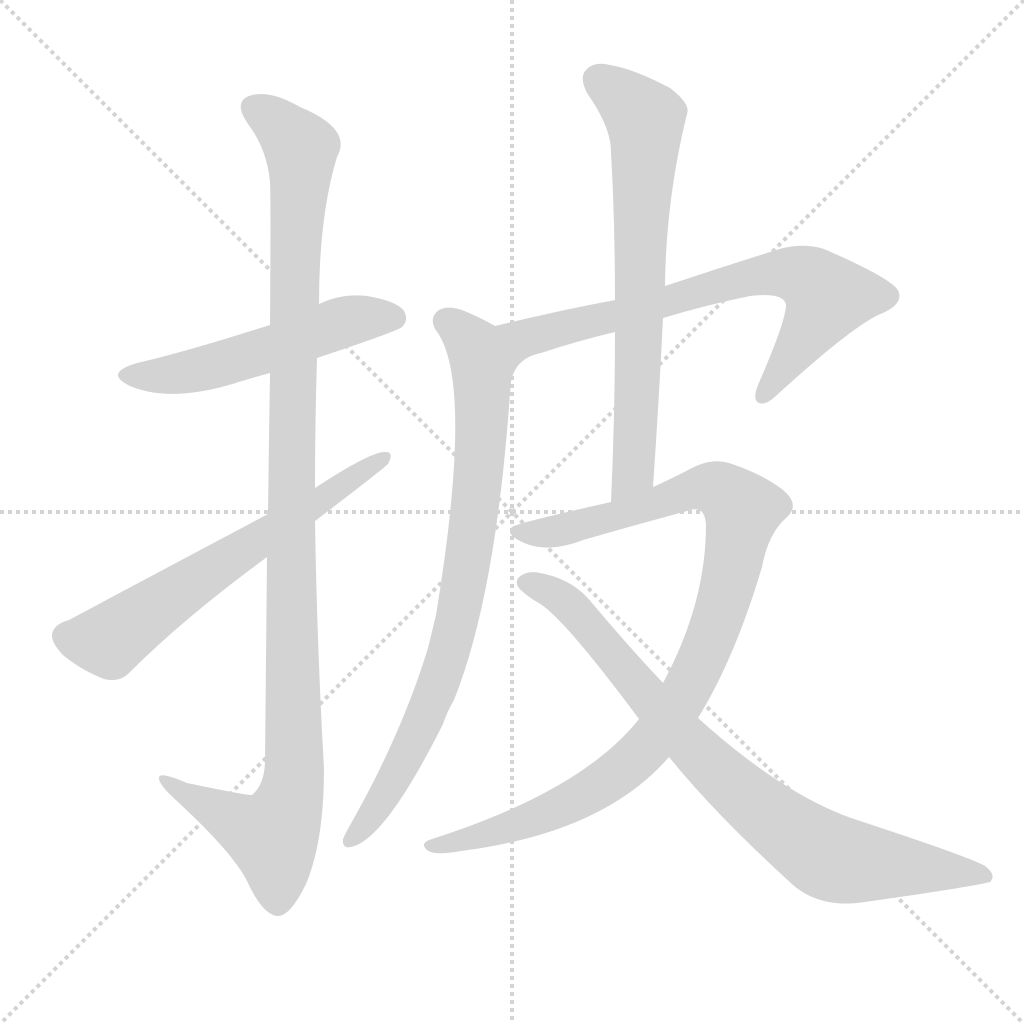
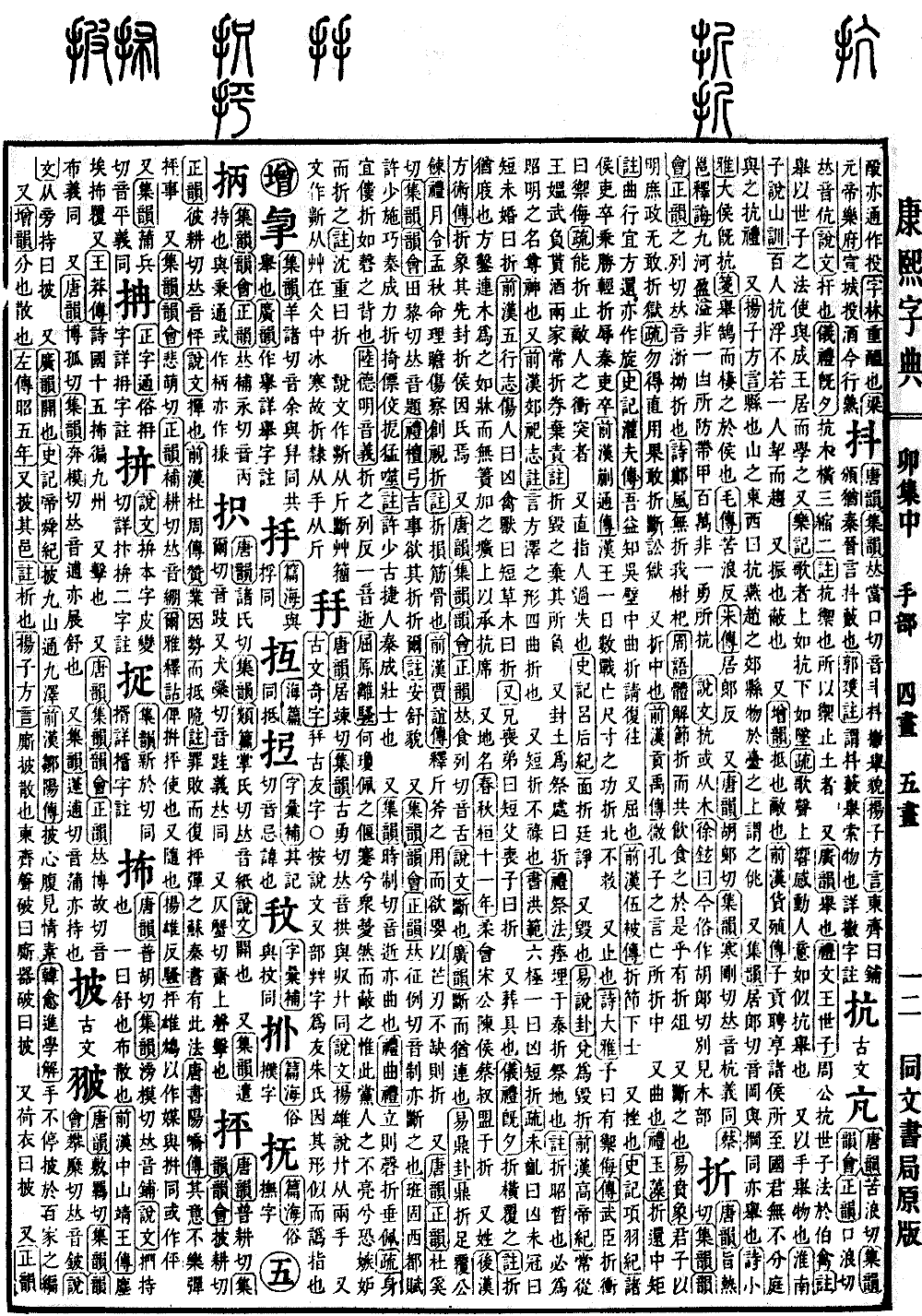
Mao Collection, Middle Volume. Radical: Hand (shǒu). Kangxi stroke count: 9. Page 422, Entry 20.
Ancient form is written as a variant. Pronounced pi. According to the Shuowen Jiezi (Explanation of Writing), to hold something from the side is called pi. Also, according to the Guangyun (Broad Rhymes), it means to open. According to the Records of the Grand Historian (Shiji), "To clear away the nine mountains and open the nine marshes." According to the History of the Former Han (Hanshu), "To open one's heart and expose one's true feelings." According to Han Yu's Advancement to Learning, "Hands never stop turning the pages of the works of the hundred schools." Also, according to the Zengyun (Expanded Rhymes), it means to divide or to scatter. According to the Zuo Commentary (Zuozhuan), "Also to divide its city." The commentary states this means to partition. According to the Yangzi Fangyan (Regional Speech), "Si pi means to scatter. In Eastern Qi, the breaking of sound is called si, and the breaking of vessels is called pi." Also, a lotus leaf garment is called a pi.
Also, pronounced pi. The meaning is the same.
Also, pronounced pi. It means to crack or split. According to the Records of the Grand Historian, "Those with heavy fruits split their branches." According to the Biography of Guan Fu, "If the branches are larger than the trunk, or the shins larger than the thighs, if it does not break, it must split." The commentary states that pi means to divide or disassemble.
Also, pi-mi refers to being shaken or subdued. According to the History of the Former Han, "Xiang Yu shouted loudly and charged down, and the Han army was all scattered and beaten."
Also, pronounced pi. The meaning is the same.
Also, pronounced ben. According to the Book of Rites (Liji), "At the funeral of Confucius, the pi was set up." The commentary states that the pi is what is used by those walking at the sides of the coffin to steady it. The sub-commentary states that it is set up at the sides to prevent tilting. According to the Rites of Zhou (Zhouli), "Direct the soldiers of the six armies to hold the pi." The sub-commentary states that the pi are things held by people at the sides of a carriage, like the six reins of a four-horse chariot.
Also, pronounced mi. The meaning is the same.
Also, pronounced bei. It also means to scatter.
Also, pronounced pa. It also means to open.
Also, rhyming with po. According to Liu Shao's Rhapsody on the Capital of Zhao, "Spreading through the forest, following the slopes of the hills. Rising with the wind, the clouds scatter."