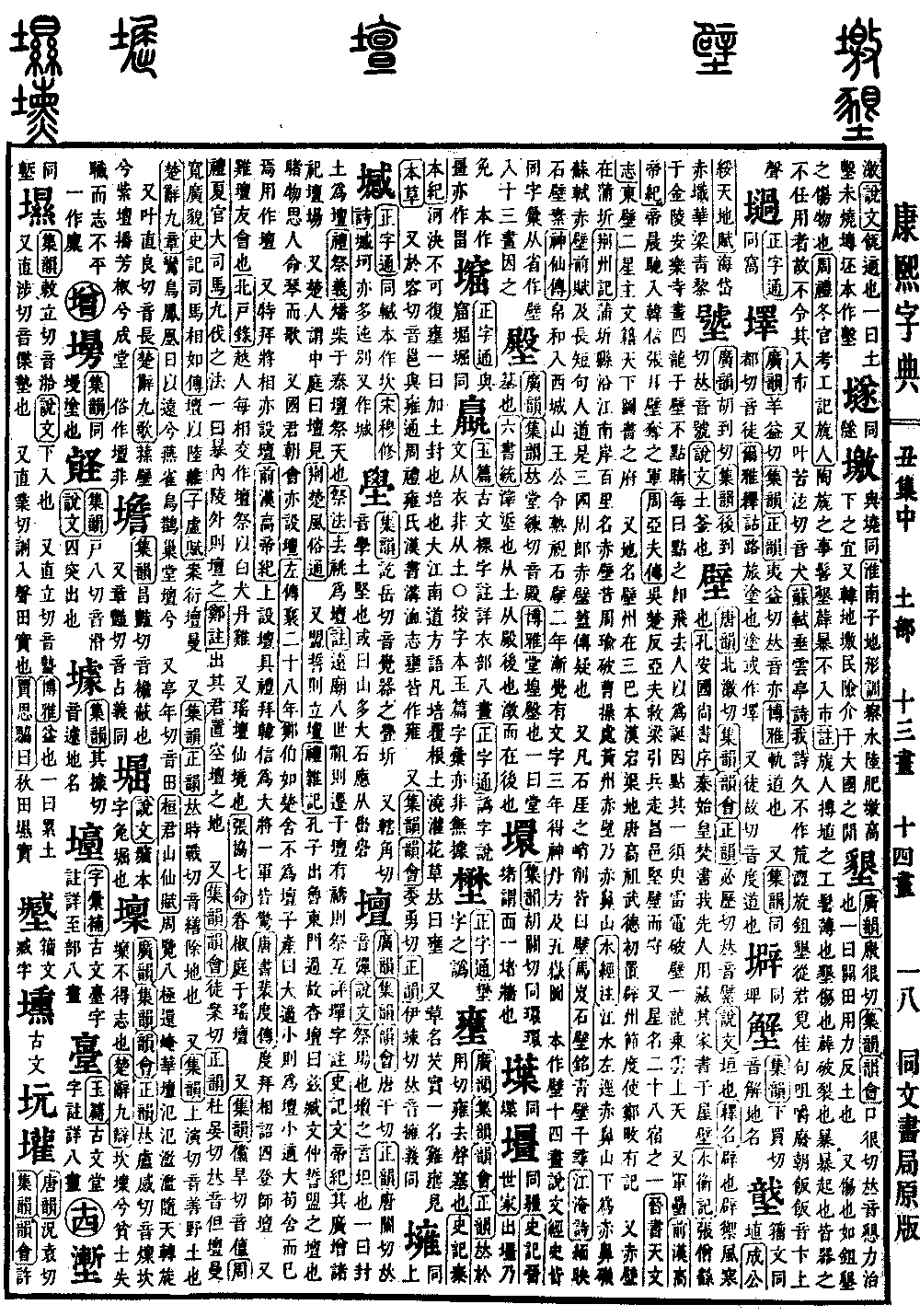
Chou Collection, Middle Volume. Radical: Earth (tǔ). Kangxi stroke count: 16. Page 240, Entry 10.
Pronounced bi.
Shuowen Jiezi says it means a wall. Explanations of Names (Shiming) states it means to block, specifically to block or defend against wind and cold. Kong Anguo's Preface to the Book of Documents (Shangshu) states that when Qin Shi Huang burned the books, our ancestors hid their family books in the walls of the house.
Records of Water Balances (Shuihengji) states that Zhang Sengyou painted four dragons on the walls of Anle Temple in Jinling without painting their eyes, often saying that if he painted them, they would fly away. People thought this was absurd, so he painted the eyes of one; in an instant, lightning and thunder shattered the wall, and one dragon ascended to heaven on a cloud.
Also refers to a military fort. The Annals of Emperor Gaozu in the History of the Former Han (Qianhan) states that the Emperor galloped into the forts of Han Xin and Zhang Er at dawn and seized their troops. The Biography of Zhou Yafu states that when the states of Wu and Chu rebelled, Yafu went to rescue Liang, led his troops to Changyi, and held the fort firmly to defend it.
Also the name of a star. One of the Twenty-eight Mansions. The Treatise on Astronomy in the Book of Jin (Jinshu) states that the two stars of the Eastern Wall govern written records and serve as the repository for all books under heaven.
Also a place name. Bizhou was located in Sanba, originally the territory of Dangqu during the Han dynasty, established early in the Wude period of the Tang dynasty; Zheng Tian, the regional commander of Pizhou, left a record of it.
Also Red Cliff (Chibi), located in Puqi. The Jingzhou Record states that one hundred li along the southern bank of the Yangtze River in Puqi County is called Red Cliff, the place where Zhou Yu once defeated Cao Cao. The Red Cliff in Huangzhou is actually Red Nose Mountain. The Commentary on the Water Classic (Shuijingzhu) states that the river passes the left side of Red Nose Mountain, which forms the Red Nose Promontory. Su Shi's Red Cliff Rhapsody and his lyric poetry suggest it is the Red Cliff of Zhou Yu of the Three Kingdoms period, but this is a suspected error.
Also, any steep stone cliff is called a wall. Ma Ji's Inscription on the Stone Wall says, A blue wall a thousand fathoms high. Jiang Yan's poem says, Gazing afar at the white stone wall. Biographies of Immortals (Shenxian Zhuan) states that Bo He entered West City Mountain, and the King of the Immortals ordered him to stare intently at the stone wall; after two years he gradually perceived writing, and after three years he obtained the divine elixir formula and the Map of the Five Peaks.
Originally written as the 14-stroke variant. The Shuowen Jiezi and historical records all use this form. The Comprehensive Collection of Characters (Zihui) uses the simplified 13-stroke form and follows that convention. The character is derived from the work form.