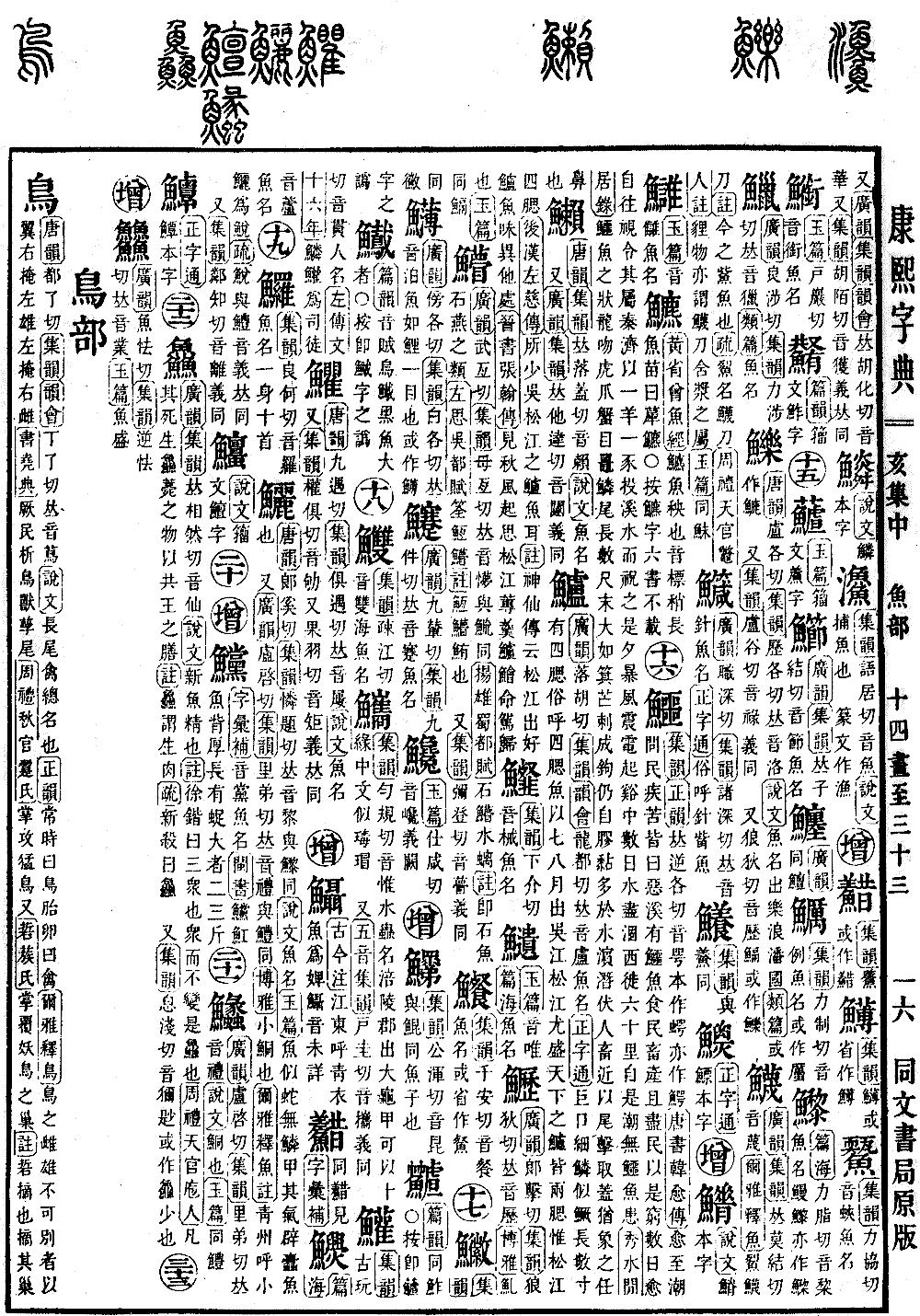
Hai Collection, Middle Volume
Radical: Bird (niǎo)
Kangxi Strokes: 11
Page 1480, Entry 52
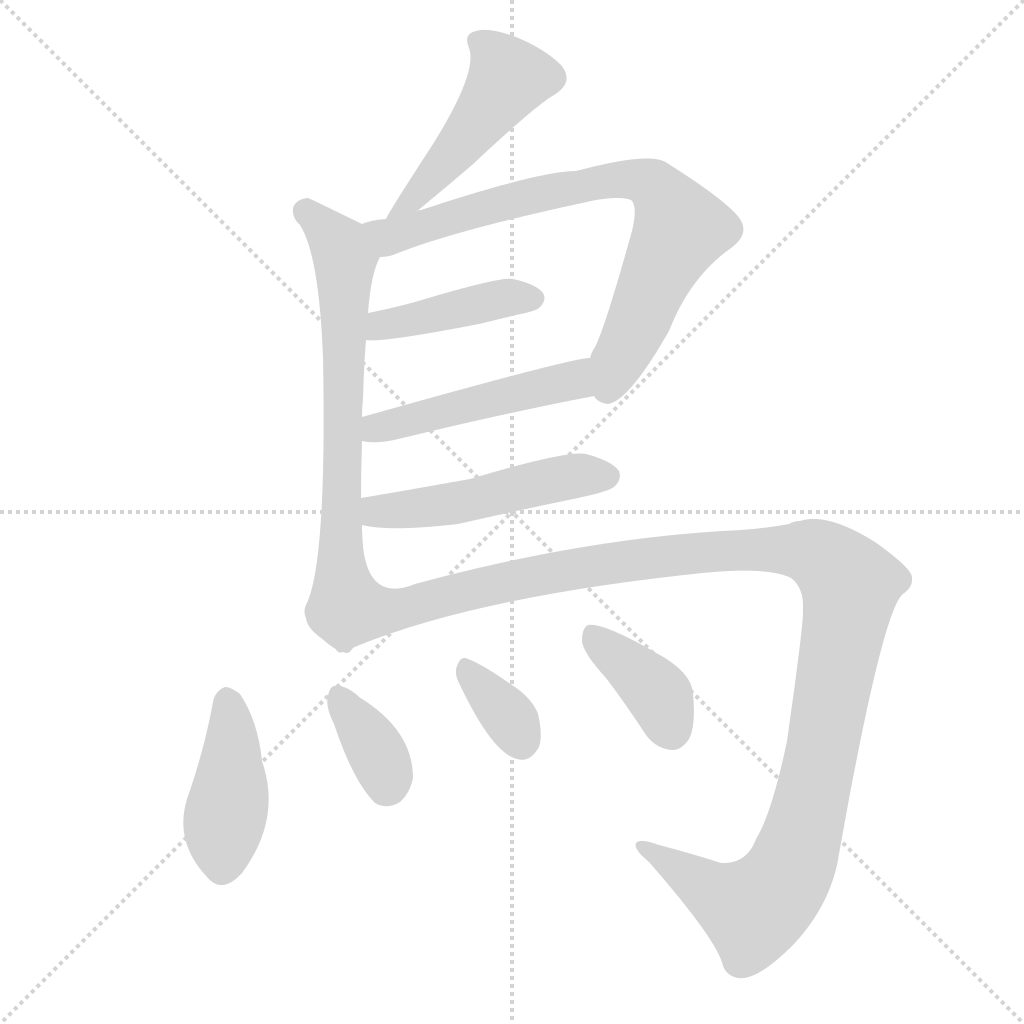
Pronounced niǎo.
According to the Shuo Wen Jiezi (Shuo Wen): A general term for long-tailed birds.
According to the Zheng Zi Tong: Creatures that are typically referred to as birds are those that give birth via eggs. Those that are viviparous or oviparous are called qin (birds and beasts).
According to the Erya: When the sex of a bird is difficult to distinguish, one should look at its wings; if the right wing covers the left, it is male, and if the left wing covers the right, it is female.
Book of Documents (Shangshu), Canon of Yao: At that time, the people lived in scattered settlements, and birds and beasts multiplied.
Rites of Zhou (Zhouli), Autumn Offices: The Zhi-shi official is in charge of driving away birds of prey. Also, the Zhe-cu-shi official is in charge of destroying the nests of ominous birds. Annotation: Zhe means to pick or remove; remove their nests so they leave.
According to the Zheng Zi Tong: Creatures with two feet and feathers are called qin. Some say a bird's beak is called zhu or hui, its talons are called ju, its tail is called cui (also written as cu), and another name for it is weiying. The stomach and spleen are called ao, the throat is called kang or yuanguan, the pouch in the neck for storing food is called sunang, the wings are called he or ling, and the feathers on the neck are called weng. Birds with short feet mostly crouch, those with long feet mostly stand, those with feet near the tail like to walk, and those with feet near the chest like to hop.
According to the Shi Kuang Qin Jing: There are three hundred and sixty types of feathered animals, their feathers corresponding to the four seasons and their colors corresponding to the five directions.
Also the name of a constellation. The Vermilion Bird is the collective name for the seven mansions of the south.
Book of Documents (Shangshu), Canon of Yao: At the spring equinox at dusk, the Bird Star appears in the due south position.
Also the name of a country. Classic of Mountains and Seas (Shanhaijing): In the Yanchang Kingdom, there are people with the heads of birds, called the Bird Clan.
Also the name of a mountain. Bird Mountain. Geography Record: Located southwest of Shouyang County in Longxi Prefecture; the Tribute of Yu (Yu Gong) records that the Zhongnan Mountains and Dunwu Mountains extend as far as Bird Mountain.
Also, Classic of Mountains and Seas: Bird-Danger Mountain, from which the Bird-Danger River originates.
Also an official title. Rites of Zhou (Zhouli), Summer Offices: The She-niao-shi official is in charge of hunting birds.
Zuo Tradition (Zuo Zhuan), Seventeenth Year of Duke Zhao: When the leader of the Shaohao clan, Zhi, ascended the throne, he used birds to record events, established bird-related official titles, and named offices after birds.
Also, the ancestors of the Qin state had the Bird-Custom Clan. Records of the Grand Historian (Shiji), Annals of Qin: Da Fei had two sons; one was named Da Lian, who was the Bird-Custom Clan. The Suoyin annotation states: Because Zhongyan had the body of a bird but spoke human language, he was called the Bird-Custom Clan.
Also, Dan-niao (red bird) and Bai-niao (white bird) are both names for insects. Xia Xiao Zheng: Dan-niao is a firefly; Bai-niao is a mosquito.
Also, the Kalavinka (a bird with a wonderful voice). Lotus Sutra (Fahuajing) Verses: The holy lord and king among gods has a voice like the Kalavinka. Annotation: Kalavinka is the Wonderful Voice Bird. Before this bird even makes a sound, it produces a subtle tone that surpasses the voices of all gods and men, and only the Buddha's voice is comparable to it, hence it is used as a metaphor.
Pronounced niǎo. Same meaning as above.
Also pronounced dǎo. Book of Documents (Shangshu), Tribute of Yu (Yu Gong): The Dao-yi tribes used animal skins for clothing. Records of the Grand Historian (Shiji), Annals of Xia, and the Former Han Geography Record write this as Bird-Yi. Kong Anguo reads the character as dao.
Pronounced jué. Former Han Geography Record: There is a Luan-niao County in Wuwei Prefecture. History of the Later Han (Hou Hanshu), Biography of Duan Jiong: Intending to attack Wuwei, Duan Jiong pursued the enemy as far as Luan-niao. Annotation: The character is pronounced jue.
Also rhyming with the sound of nü. Records of the Grand Historian (Shiji), Autobiographical Preface: Duke Mu of Qin yearned for the way of righteousness and mourned for the army of the Battle of Xiao. He used living people as human sacrifices; the Book of Odes (Shijing) sings the "Yellow Bird" (Huangniao) to criticize this.
Also rhyming with the sound of dǒu. Former Han Narrative Records: Bathing in the corpse village, facing north to offer the severed head. Travelers admire this and wish to be buried with the dead; the morality exceeds the compassion found in the "Yellow Bird" poem.