Hai Collection, Middle Volume
Radical: Bird (niǎo)
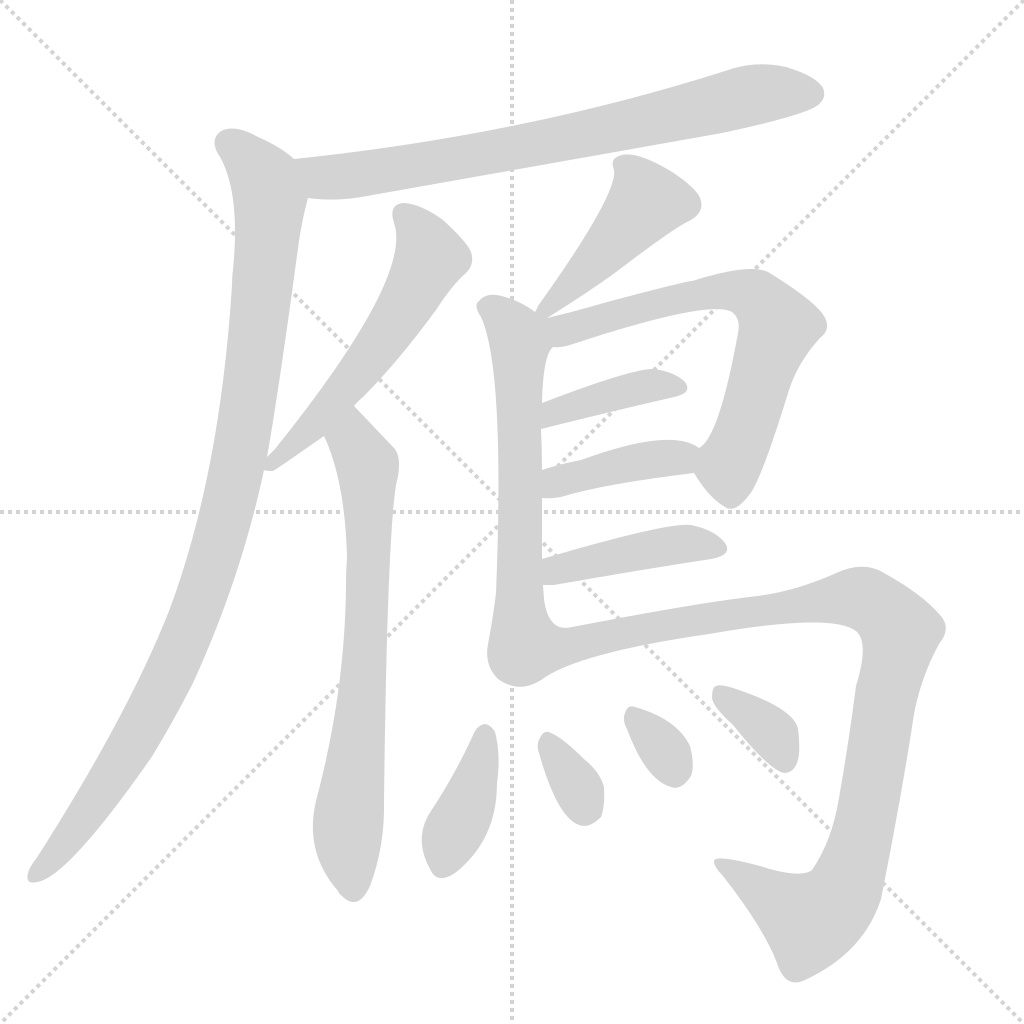
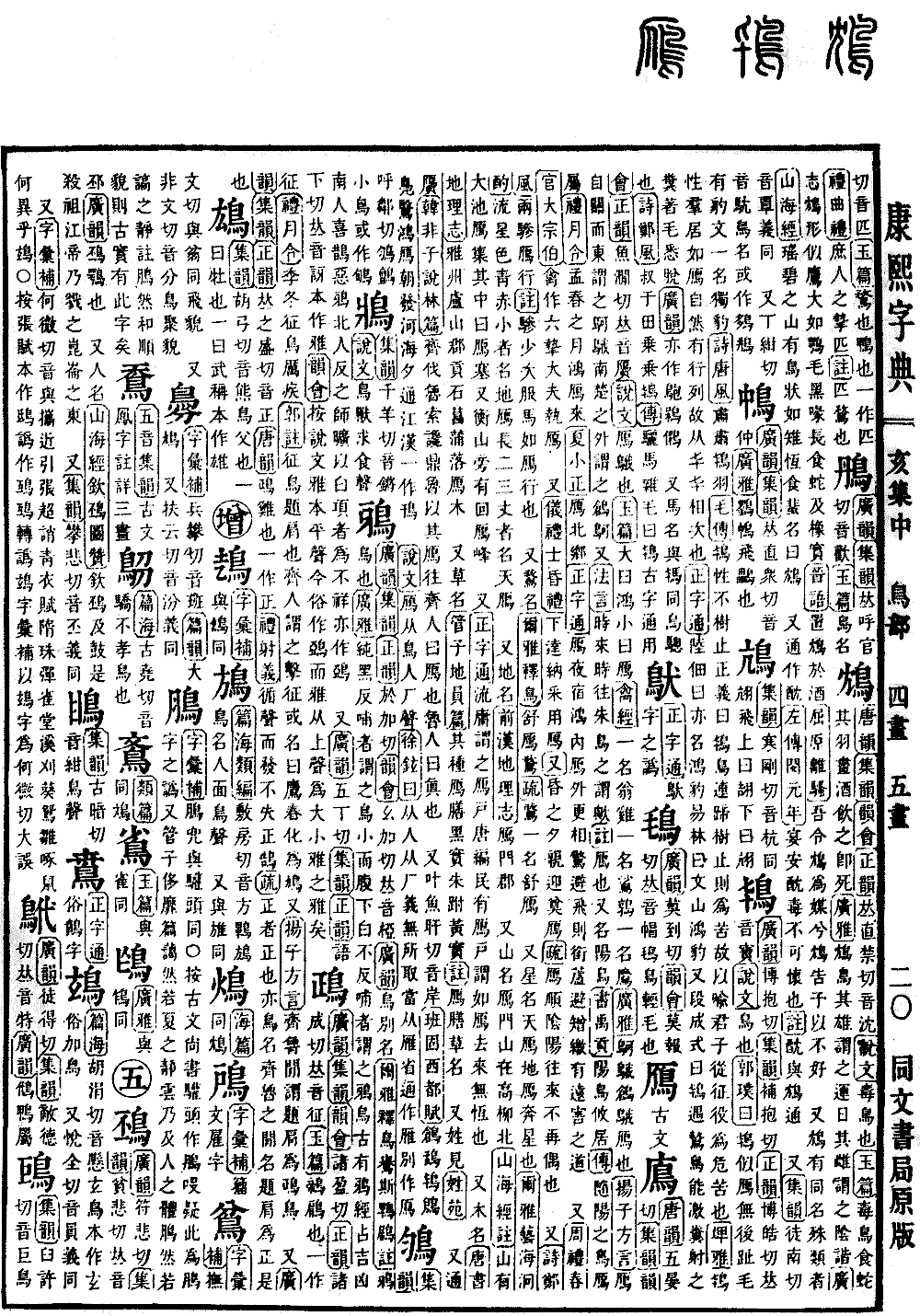
鴈
Kangxi strokes: 15
Page 1484, Entry 08
Ancient form. Pronounced yan (falling tone).
According to the Shuo Wen Jiezi (Shuowen), a type of bird.
According to the Yu Pian (Yupian), the large ones are called hong, the small ones are called yan.
According to the Qin Jing (Qinjing), also called wengji, sha chun, and ying.
According to the Guang Ya (Guangya), the ge and the cang are both types of yan.
According to the Yangzi Fangyan (Fangyan), in regions east of the pass, the bird is called ge; in regions south of Chu, it is called cang ge.
According to the Fa Yan (Fayan), referring to birds that come and go with the seasons; the commentary identifies these as the yan, also called the sun bird.
According to the Book of Documents (Shangshu), specifically the Tribute of Yu (Yu Gong) section, it refers to the habitats of the sun bird; the commentary states these are birds that migrate following the solar energy.
According to the Book of Rites (Liji), in the first month of spring, the wild geese arrive.
According to the Xia Xiao Zheng (Xiaxiaozheng), the wild geese fly north.
According to the Zheng Zi Tong (Zhengzitong), when geese roost at night, the hong stay in the inner circle while the yan stay in the outer circle to stand guard; when in flight, they hold reeds in their beaks to avoid arrows, demonstrating a habit of distancing themselves from harm.
According to the Rites of Zhou (Zhouli), under the Ministry of Spring, specifically the section on the Grand Master, birds are used as one of the six ritual gifts, with officials using the yan as a gift.
According to the Book of Etiquette and Ceremonial (Yili), in the section on the rites of marriage for officials, a suitor uses the yan as a gift upon the initial proposal. Furthermore, during the evening of the wedding, the groom presents a yan upon receiving the bride. The commentary explains that the yan is chosen because it follows the yin and yang in its migrations and maintains a constant mate.
According to the Book of Odes (Shijing), in the Zheng Feng section, it describes the side horses arranged like a flying formation of wild geese; the commentary notes that the side horses, being slightly behind the center horses, resemble the formation of geese in flight.
It also refers to the goose. According to the Erya (Erya), in the section on birds, the shu yan is the goose; the commentary notes that the goose is another name for the shu yan.
It also refers to the names of stars. The celestial yan and the terrestrial yan are both types of meteors. According to the Erya, in the Yihai Jiongzhuo section, smaller meteors with blue or red colors are called terrestrial yan, while those two or three zhang long are called celestial yan.
It also refers to a place name. According to the History of the Former Han (Hanshu), in the section on geography, there is Yanmen Commandery.
It also refers to a mountain name. Yanmen Mountain is located north of Gaoliu. According to the commentary on the Classic of Mountains and Seas (Shanhaijing), there is a large pool on the mountain where geese gather, known as Yan Sai. Additionally, near Mount Heng is Huiyan Peak.
According to the Zheng Zi Tong (Zhengzitong), displaced laborers are called yan households. In the Tang dynasty, civilian households registered in such a manner were called yan households, implying they came and went as unpredictably as wild geese.
It also refers to a tree name. According to the Old Book of Tang (Tangshu), in the section on geography, the Yazhou Lushan commandery offered stone calamus and luoyan wood as tribute.
It also refers to a plant name. According to the Guanzi (Guanzi), in the section on the earth and its produce, its seeds are called yan shan, with black fruits, red calyxes, and yellow kernels; the commentary identifies yan shan as a type of grass.
It also refers to a surname, found in the Xing Yuan (Xingyuan).
It is also used interchangeably with the character for fake or counterfeit (yan). According to the Han Feizi (Hanfeizi), in the section on illustrative examples, when the state of Qi attacked Lu demanding a precious tripod, Lu sent a fake one. When the people of Qi claimed it was fake, the people of Lu replied that it was real.
It is also pronounced an (falling tone), rhyming with the word for fish. According to the Western Capital Rhapsody (Xidu Fu) by Ban Gu, it mentions various birds and wild geese, taking flight in the morning from the rivers and seas and arriving by evening at the Yangtze and Han rivers.
It is sometimes written as a variant form (yǐn).
According to the Shuo Wen Jiezi (Shuowen), the character is composed of the radical for bird and the sound component indicating a cliff; Xu Xuan notes that the composition involving a person and a cliff is difficult to explain, and it is likely an abbreviated form of the character for wild goose (yàn). It is commonly used as a variant of the wild goose character, and is also written as a variant (gēng).