Hai Collection, Middle Volume
Radical: Bird (niǎo)
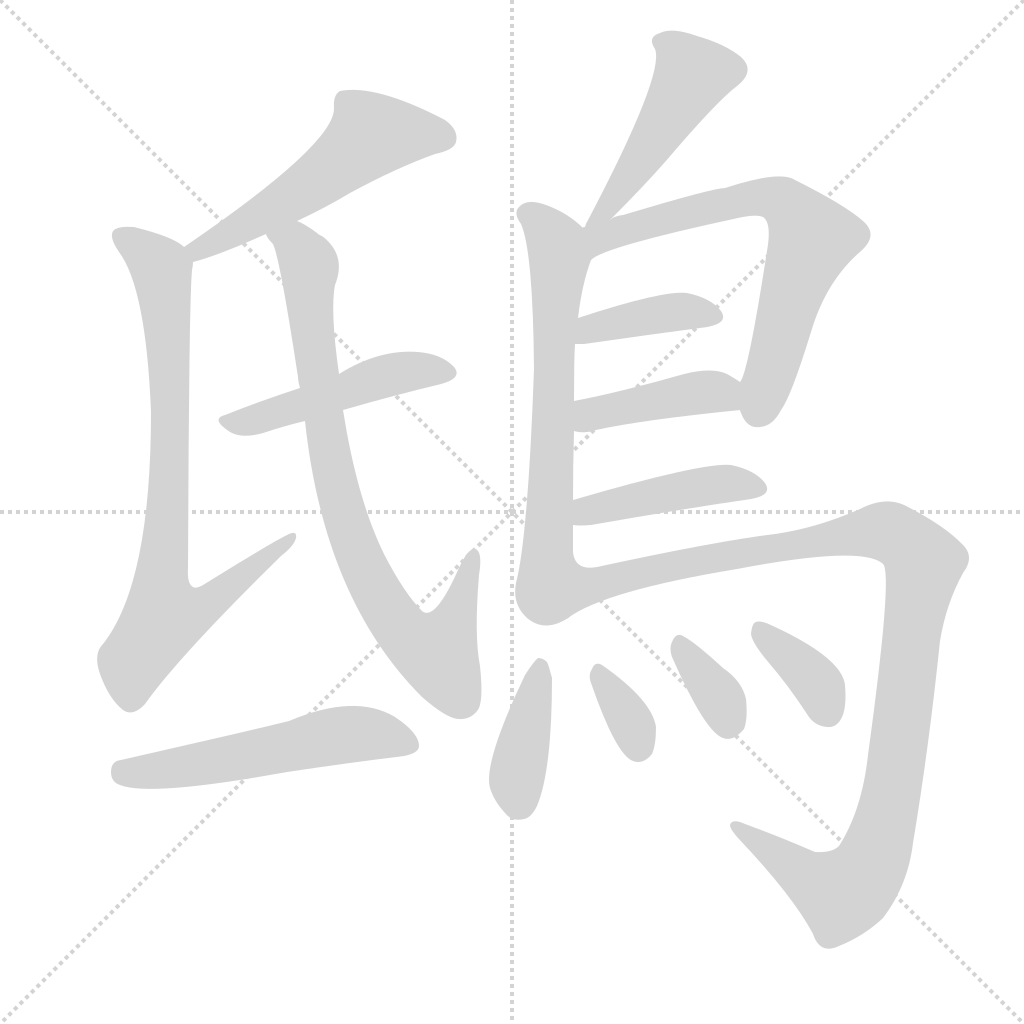
Chi
Kangxi stroke count: 16
Page 1486, Entry 10
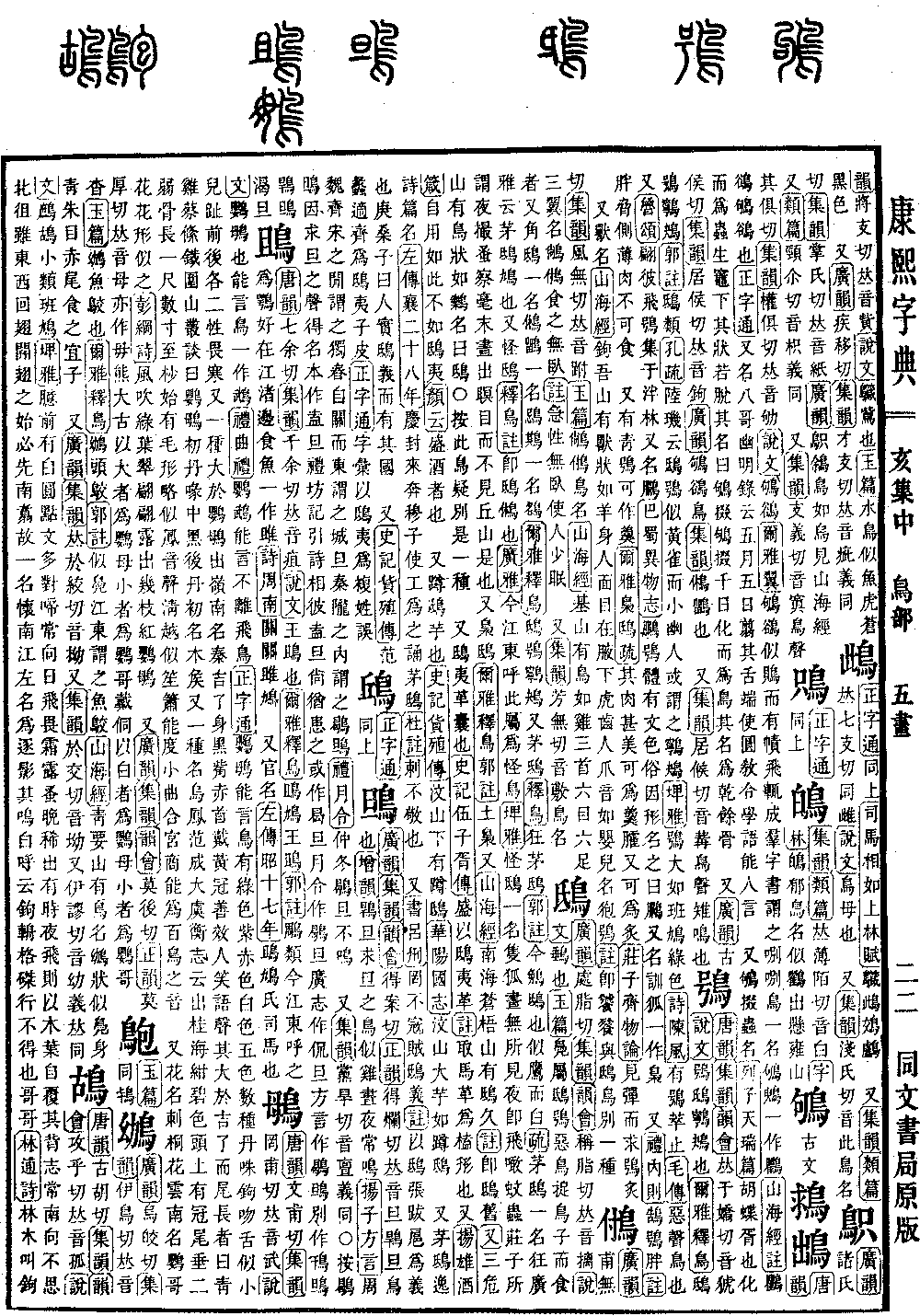
Pronounced chi. According to the Explaining Graphs and Analyzing Characters (Shuowen Jiezi), it is a bird. According to the Jade Chapters (Yupian), it belongs to the duck family. The owl is an evil bird that captures and eats the young of other birds. There is also the horned owl, also known as the owlet, also known as the night owl, and also known as the horned bird.
According to the Erya (Approaching Elegance), section on birds, the owl is also known as the niao-jue. There is also the mao-chi owl. The Erya says the kuang is the mao-chi. The commentary by Guo says it is the present-day tu-chi, resembling a hawk but white. The sub-commentary states that the mao-chi is also called kuang. The Guangya (Broad Elegant) says the mao-chi is a type of duck.
There is also the guai-chi. The commentary to the Erya, section on birds, states it is the owl. The Guangya notes that in the Jiangdong region, people call this type a strange bird. The Piya (Amplified Elegance) states the guai-chi is also called a solitary fox; it is not seen during the day, but flies at night to eat mosquitoes and insects. This is what the Zhuangzi refers to when it says it can grasp fleas at night and examine the tip of a hair, but during the day it closes its eyes and cannot see a mountain. There is also the xiao-chi. The commentary by Guo to the Erya, section on birds, refers to the earth owl.
According to the Classic of Mountains and Seas (Shan Hai Jing), there is a chi-jiu in the Cangwu Mountains of the South Sea. The commentary notes it is the chi-jiu. In the Sanwei Mountains, there is a bird shaped like an owl, named the chi. It is suspected that this bird is a separate species.
Chi-yi refers to a leather bag. In the Records of the Grand Historian (Shiji), Biography of Wu Zixu, it mentions being contained in a chi-yi leather bag. The commentary explains it is a horsehide container shaped like a flask. In the Alcohol Admonition by Yang Xiong, it says that to act according to one's own will is worse than a chi-yi. Yan Shigu notes this is for holding wine.
Cun-chi refers to taro. In the Records of the Grand Historian, Biography of Money-makers, it mentions there are cun-chi at the foot of Mount Wen. The Huayang Kingdom Chronicle states that the large taros of Mount Wen are like a crouching owl.
Mao-chi is the title of a lost poem. In the Zuo Tradition (Zuozhuan), 28th Year of Duke Xiang, Qing Feng came to seek refuge, and Muzi ordered the musicians to chant the Mao-chi for him. The commentary by Du says this was to criticize his lack of reverence.
In the Classic of History (Shujing), Counsels of Lu, it mentions chi-yi and villainy. The commentary explains that chi-yi refers to acting in an overbearing and aggressive manner. Gengsangzi says that when a person is truly overbearing like an owl and possesses a state, they are lost.
In the Records of the Grand Historian, Biography of Money-makers, Fan Li went to Qi and became Chi-yi Zipi. The Zhengzitong notes that the Zihui mistakenly treats Chi-yi as a double-character surname.
Textual collation: The Classic of History, Counsels of Lu, reads none but villains and the overbearing. The commentary explains this by referring to overbearing and aggressive behavior. According to the original text, we have corrected the reading to follow the passage on overbearing behavior.