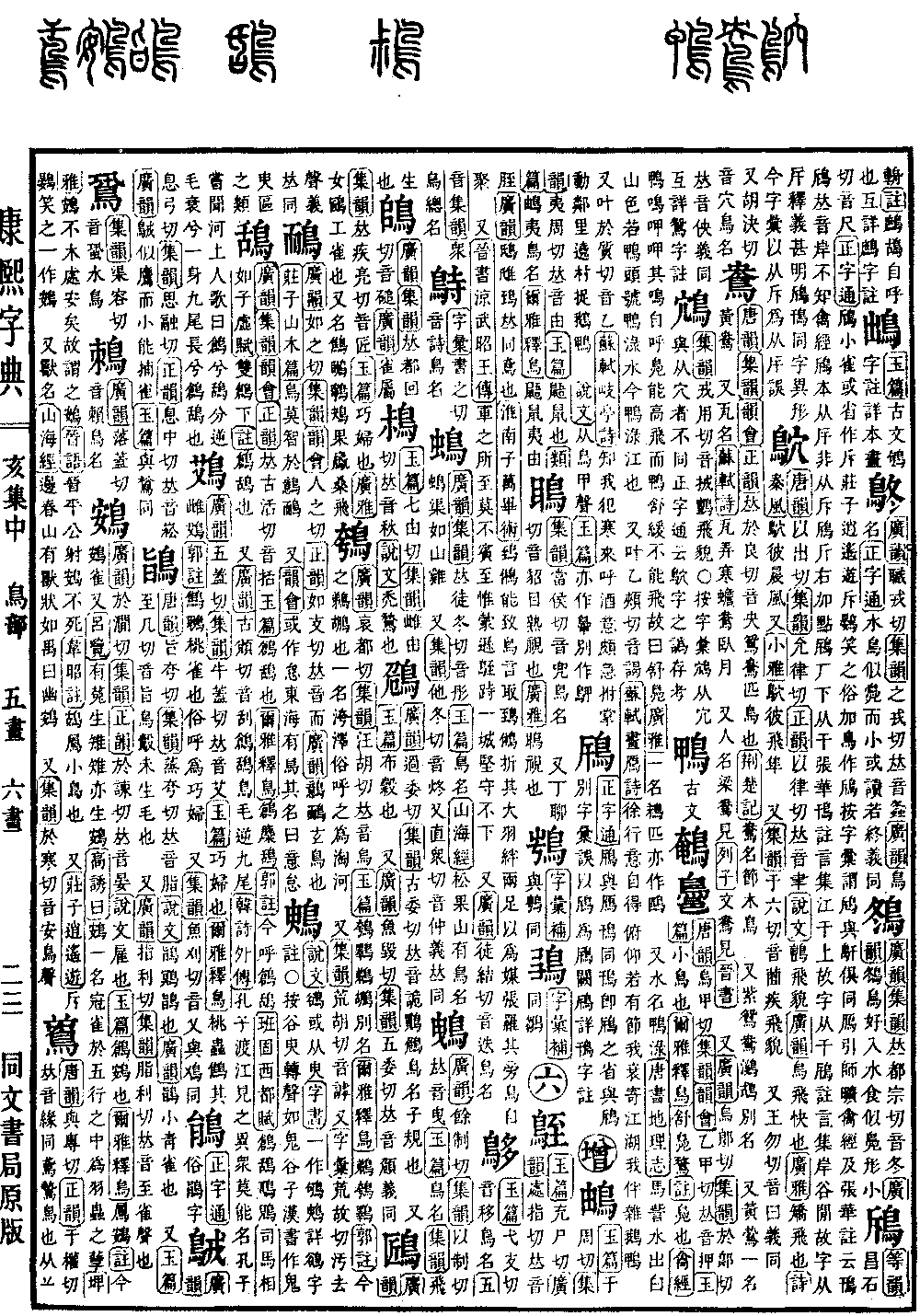
Hai Collection, Middle Volume
Radical: Bird (niǎo)
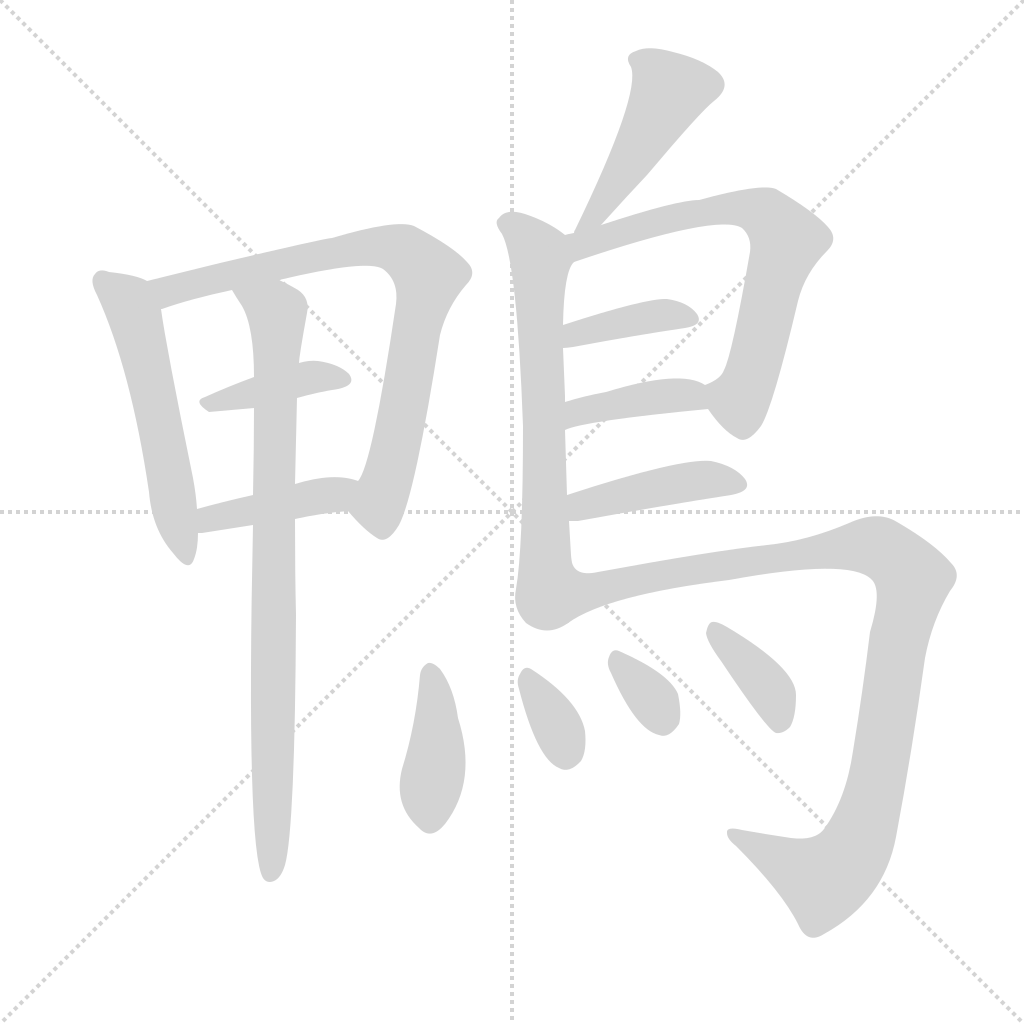
鴨
Kangxi stroke count: 16
Page 1487, Entry 08
Ancient form: An.
Pronounced ya.
According to the Jade Chapters (Yupian), it is a small bird.
According to the Er Ya (Erya), a chapter on the interpretation of birds, it is known as a Shu Fu (tame mallard) or a Wu (wild duck). The commentary states it is a type of wild duck.
According to the Classic of Birds (Qin Jing), the duck makes a quacking sound, essentially calling its own name. The wild duck is capable of high flight, while the domestic duck is sluggish and unable to fly, which is why it is called a Shu Fu (tame mallard).
According to the Guang Ya (Guangya), it is also known as a Pi. It is also written as a variant form (e).
Also the name of a body of water, the Yalu. According to the Old Book of Tang (Tangshu), the Geography Treatise, the Mazi River originates in the White Mountains. Its color is like the head of a duck, hence it is called the Yalu River, known today as the Yalu River.
Also rhymes with the sound ye. In a poem on painting geese by Su Shi, he writes: Moving slowly with a sense of self-contentment, looking down and up as if following a rhythm. In my old age, I live amidst the rivers and lakes, with my companions mingled among the geese and ducks.
Also rhymes with the sound yi. In a poem on Qiting by Su Shi, he writes: Knowing I have come through the cold, he calls for wine with great urgency. Clapping hands and stirring the neighborhood, circling the village to catch the geese and ducks.
According to the Shuowen Jiezi (Shuowen), it is composed of the radical for bird and the phonetic element jia.
According to the Jade Chapters (Yupian), it is also written in a variant form, and another variant form exists.