Hai Collection, Upper Volume
Radical: Horse (mǎ)
Kangxi Strokes: 10
Page 1433, Entry 01
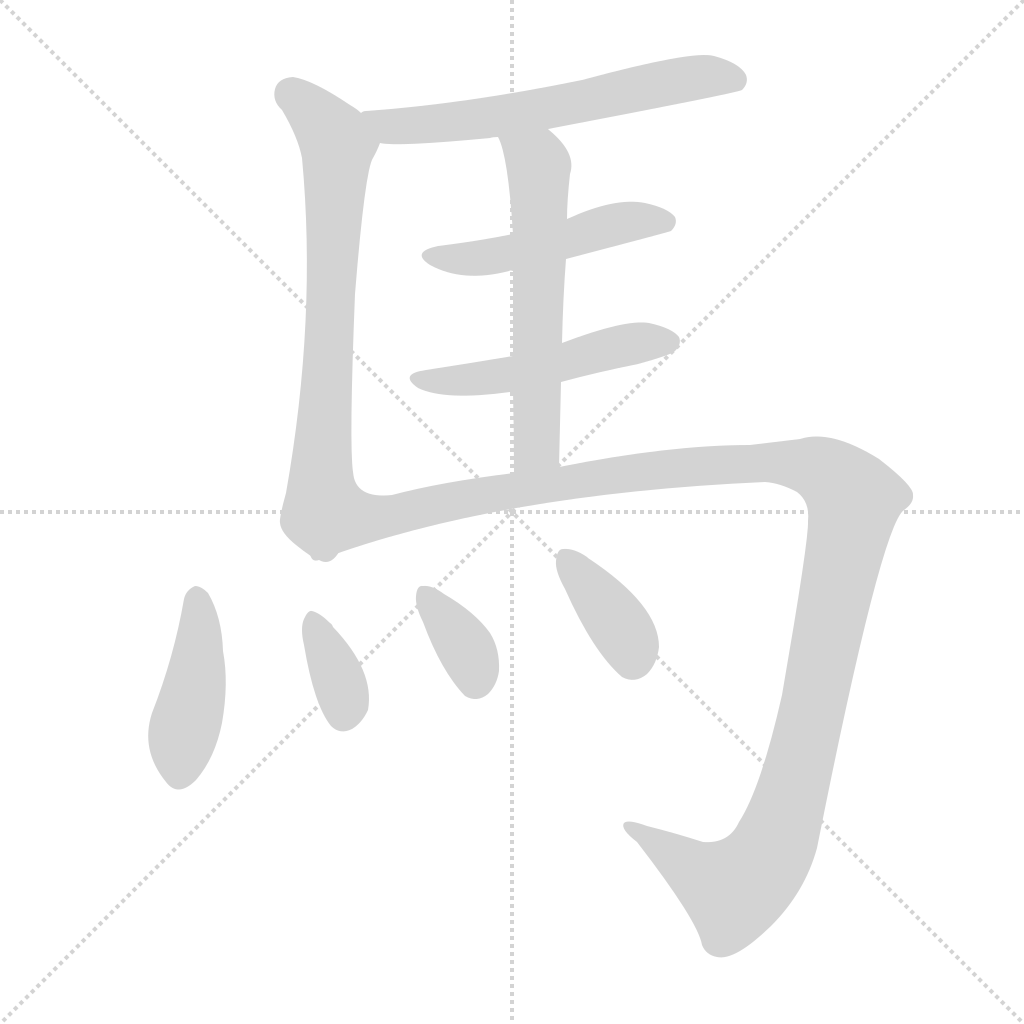
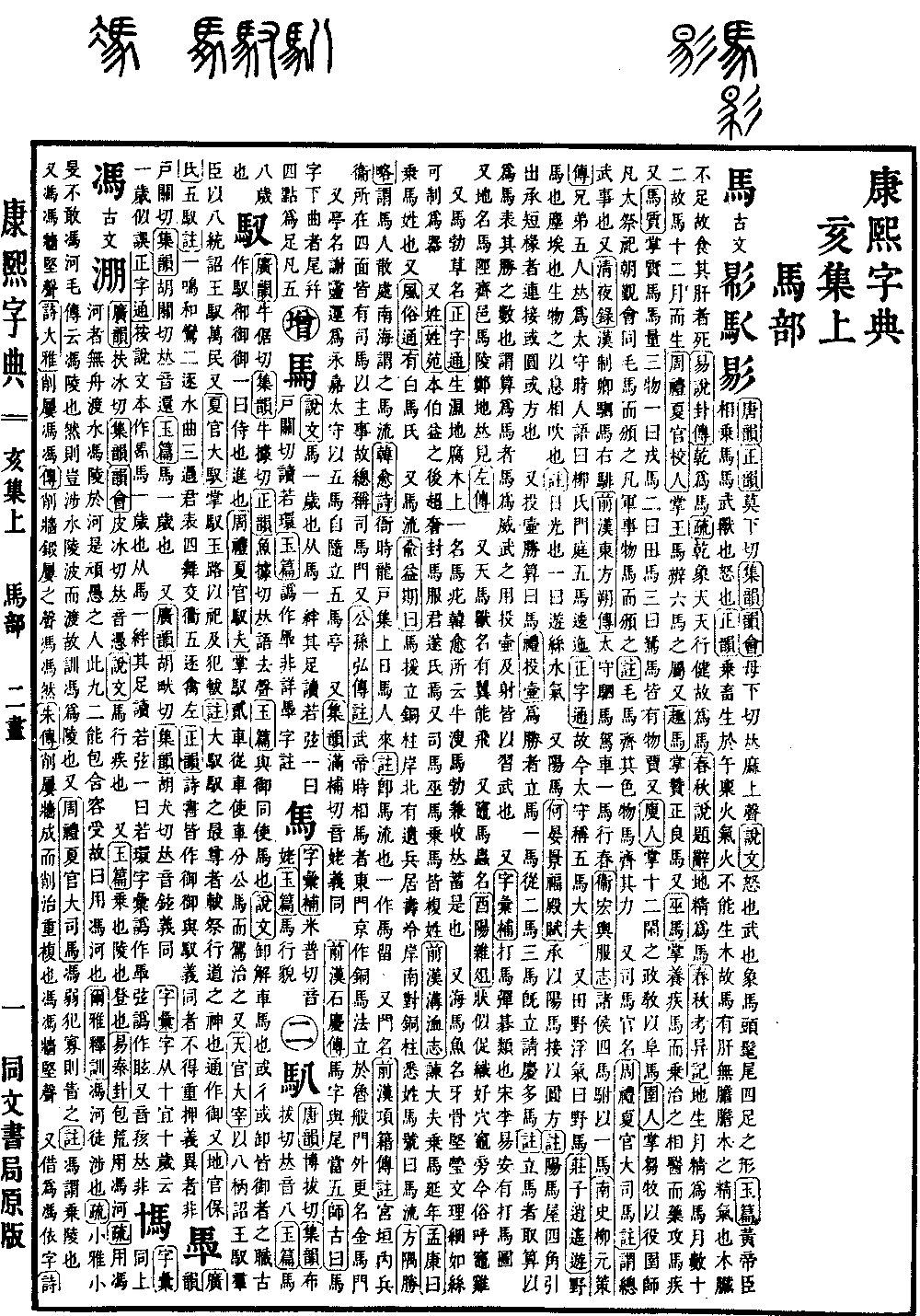
In ancient texts, pronounced ma (rising tone) according to Tangyun (Tang Rhymes) and Zhengyun (Correct Rhymes), and pronounced ma (rising tone) according to Jiyun (Collected Rhymes) and Yunhui (Collection of Rhymes). According to Shuowen Jiezi (Explaining Graphs and Analyzing Characters), it implies anger and martial vigor. It resembles the form of a horse's head, mane, tail, and four legs. According to Yupian (Jade Compendium), it was a horse ridden by the ministers of the Yellow Emperor. A horse is a martial beast, representing anger. According to Zhengyun (Correct Rhymes), it is a beast of burden. It is born in the hour of the horse, possessing the fire element. Fire cannot generate wood; therefore, a horse has a liver but no gallbladder. The gallbladder is the essence of wood. Because the wood organ is insufficient, those who eat its liver will die. According to the I Ching (Book of Changes), in the Treatise on the Hexagrams, the Qian hexagram represents the horse. The commentary states that Qian represents heaven, and as heaven is firm and constant, it is represented by the horse. According to the Chunqiu Shuotici (Explications of the Spring and Autumn Annals), the essence of the earth becomes the horse. According to the Chunqiu Kaoyiji (Records of the Verification of the Spring and Autumn Annals), the earth produces the essence of the moon, which becomes the horse. The moon has twelve cycles, so the horse is born after twelve months. According to the Zhou Li (Rites of Zhou), specifically the Summer Official, the Horse Controller (Mazhi) manages the appraisal of horses. Horses are measured by three criteria: first, war horses; second, field horses; and third, pack horses; all have specific physical traits and monetary values. Also, the Equine Overseer (Xiaoren) manages the king's horses and categorizes the six types of horses. During great sacrifices, audiences, and assemblies, he distributes them based on coat color. During military affairs, he distributes them based on strength. Note: Coat color relates to physical consistency. Strength relates to physical power. Furthermore, the Quick Horse Official (Quma) assists in managing fine horses. The Shaman Horse Official (Wuma) manages the care of sick horses and treats them, acting as a physician to attack horse illnesses. The Lean Horse Official (Shouren) manages the twelve stables and teaches how to increase the horse population. The Groom Official (Yuren) manages the fodder and grazing for the army. There is also the Minister of War (Sima), a title of office. According to the commentary on the Summer Official of the Zhou Li (Rites of Zhou), this refers to the management of all military affairs. According to the Qingye Lu (Records of the Clear Night), during the Han dynasty, the carriages of high ministers were drawn by four horses, with a horse on the right as an outrider. According to the Biography of Dongfang Shuo in the Book of the Former Han (Hanshu), a grand administrator traveled in a carriage drawn by four horses, with one extra horse leading for the spring season. According to the Records of Carriages and Clothing by Wei Hong, nobles used four horses, with one extra horse attached as a sidecar. According to the Biography of Liu Yuance in the History of the Southern Dynasties (Nan Shi), five brothers were all grand administrators. People at the time said, The gate of the Liu family is elegant with five horses. According to the Zhengzitong (Correction of Character Comprehension), for this reason, grand administrators today are referred to as Five-Horse Officials. Also, shimmering air in the fields is called wild horse. According to the Zhuangzi (Book of Master Zhuang), in the chapter on Free and Easy Wandering, it says, Wild horses, dust, and living beings blow upon one another with their breath. The commentary says this refers to sunlight, or alternatively, floating filaments or water vapor. Also, Yangma (a architectural support). According to the Rhapsody on the Jingfu Hall by He Yan, it is supported by Yangma, connecting circles and squares. The commentary states that Yangma refers to wood extending from the four corners of a roof to support short rafters, connecting circles or squares. Also, when playing the pitch-pot game, the counting markers are called horses. According to the Rites of the Pitch-pot, for the winner, place the horse marker, one horse follows two horses, and when three horses are placed, request celebration for multiple horses. The commentary states that placing a horse means taking the counting marker as a horse to signify the number of wins. Markers are called horses because horses are used for martial power; both pitch-pot and archery are ways to practice martial arts. According to the Zihuibu (Supplement to the Character Compendium), Damǎ (striking horses) is a type of board game. Li Qingzhao of the Zhu and Li period had a map for this game. Also, names of places. Maxing was a city in Qi. Maling was a place in Zheng. Both are seen in the Zuo Zhuan (Commentary of Zuo). Also, Tianma (Heavenly Horse), the name of a beast that has wings and can fly. Also, Zaoma (Stove Horse), the name of an insect. According to the Miscellaneous Morsels from Youyang (Youyang Zazu), it resembles a cricket and likes to burrow next to stoves. People today call it a stove chicken. Also, Mabo (puffball), the name of a plant. According to the Zhengzitong (Correction of Character Comprehension), it grows on wet ground and rotten wood, also known as Mafu. Han Yu mentioned both cow urine and puffballs, which are gathered together. Also, Haima (seahorse), the name of a fish. Its teeth and bones are hard and lustrous, with fine patterns like silk, and can be fashioned into tools. Also, a surname. According to the Xingyuan (Garden of Surnames), the family originates from the descendants of Boyi. Zhao She was enfeoffed as the Lord of Mafu, and the family subsequently took it as their surname. Also, Sima, Wuma, and Chengma are all compound surnames. According to the Book of the Former Han (Hanshu), in the Treatise on Waterways and Irrigation, the advisory official Chengma Yannian is mentioned. Meng Kang says Chengma is a surname. According to the Fengsutong (Comprehensive Customs), there is the White Horse clan. Also, Maliu. Yu Yiqi says that when Ma Yuan erected a bronze pillar, his remaining troops lived north of the shore, south of the bronze pillar, and were all surnamed Ma, calling themselves Maliu. The Fangyu Shenglue (Summary of Directions and Regions) states that the Ma people scattered throughout the South Seas are called Maliu. In the poems of Han Yu, it is written: At the official time, the Dragon households gather; on the auspicious day, the Ma people arrive. The commentary says this refers to the Maliu, also written as Maliu. Also, the name of a gate. According to the commentary on the Biography of Xiang Ji in the Book of the Former Han (Hanshu), it refers to the location of the guards within the palace walls; there were Sima (gate guards) on all four sides to oversee affairs, hence the collective name Sima Gate. According to the commentary on the Biography of Gongsun Hong, during the time of Emperor Wu, the horse judge Dongmen Jing created a copper horse model, which was set up outside the Luban Gate; it was renamed the Golden Horse Gate. Also, the name of a pavilion. Xie Lingyun, while serving as the grand administrator of Yongjia, traveled with five horses and built the Five-Horse Pavilion. According to Jiyun (Collected Rhymes), pronounced mu (rising tone), with the same meaning. According to the Book of the Former Han (Hanshu), in the Biography of Shi Qing, the graph for Ma (horse) matches the tail, which is five strokes. Shigui says the graph for Ma curves at the bottom for the tail, with four dots representing the feet, totaling five.