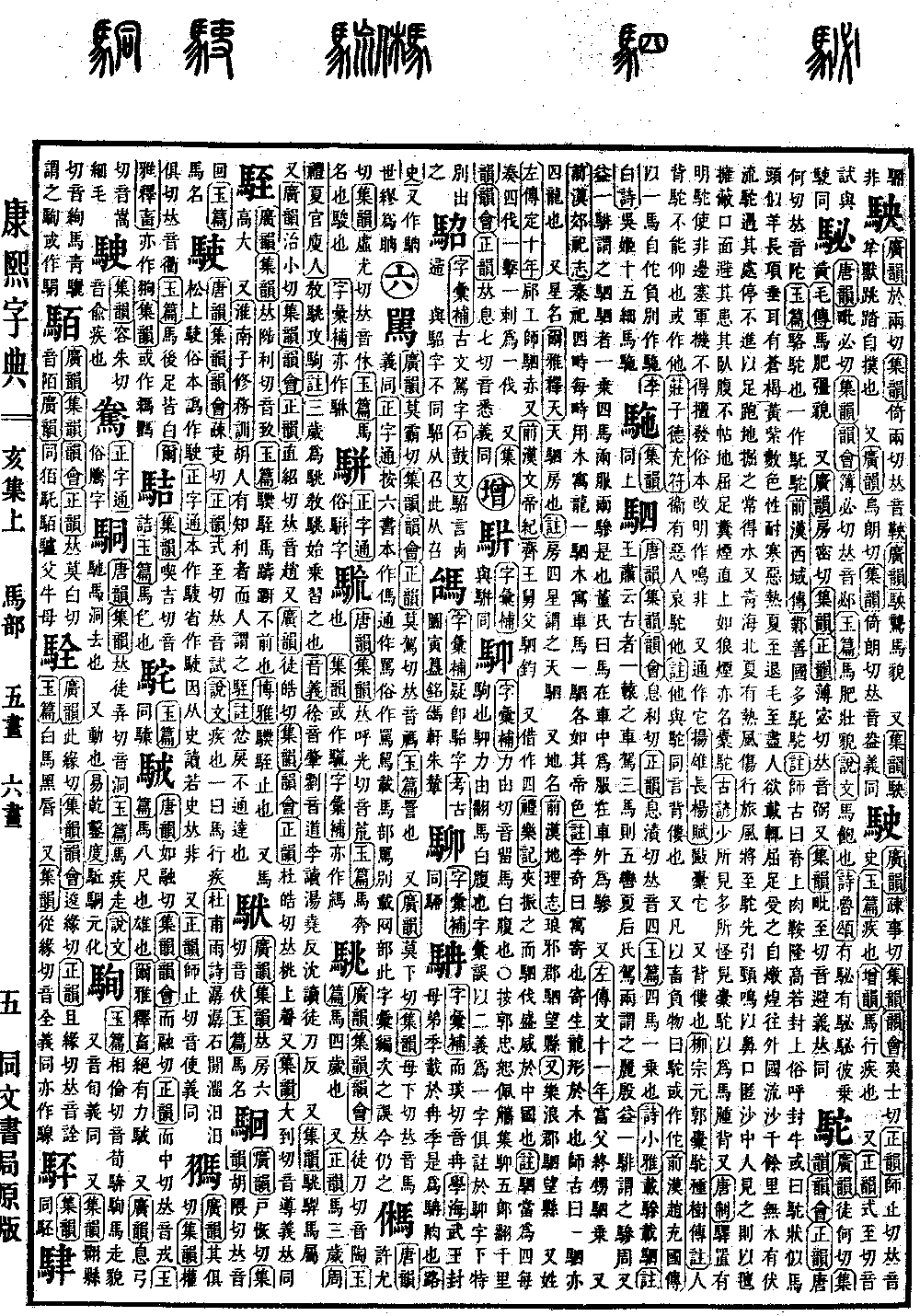
Hai Collection, Upper Volume
Radical: Horse (mǎ)
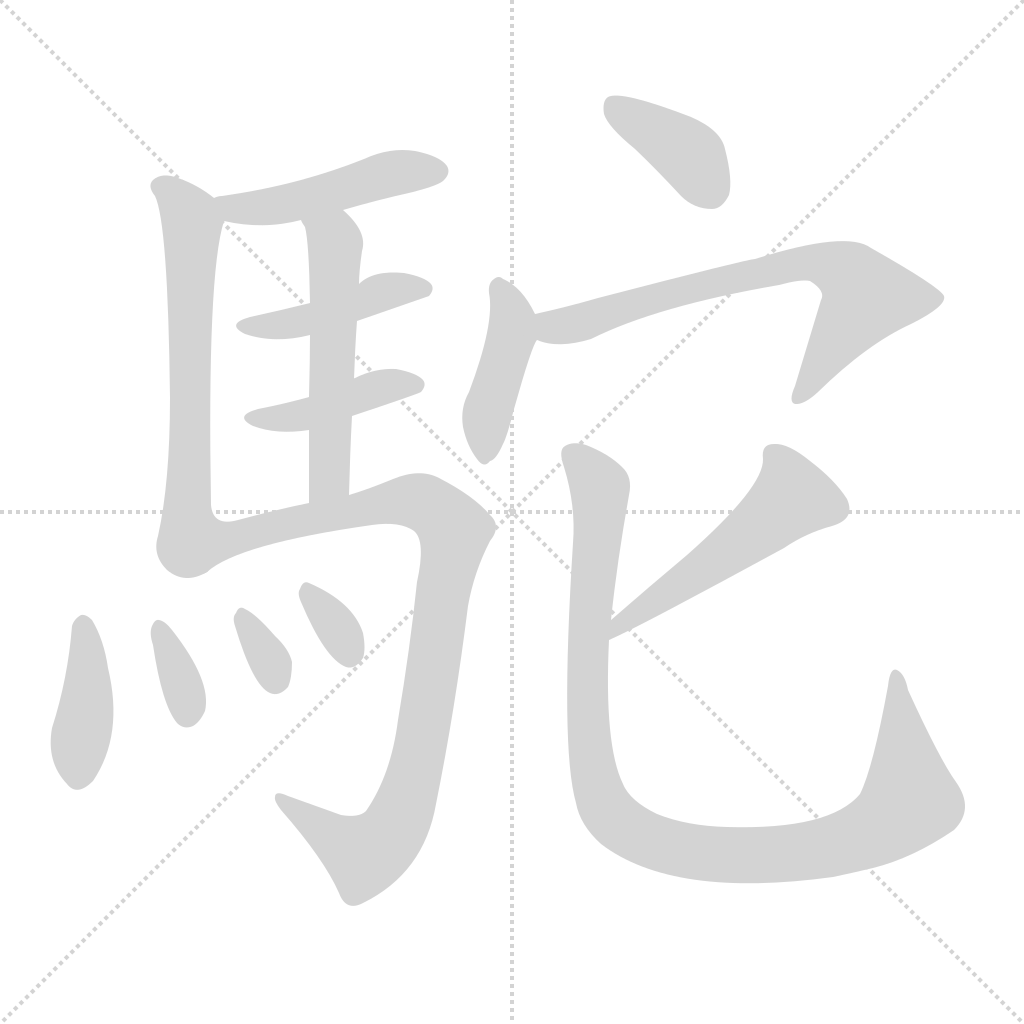
Camel. Kangxi strokes: 15. Page 1437, Entry 04
Pronounced tuo.
Jade Encyclopedia (Yupian): A camel. Also written as a variant form (luótuó).
History of the Former Han (Qian Hanshu), Record of the Western Regions: The Kingdom of Shanshan has many camels.
Commentary: Shigu states that the flesh on the back forms a saddle-like mound, high and prominent; common people call it a hump-ox. Others say the camel looks like a horse, has a head like a sheep, a long neck, and hanging ears. They come in gray, brown, yellow, and purple colors. Their nature is to endure cold and dislike heat; at the summer solstice, they shed their hair completely. When people wish to load them, they kneel to receive the burden. From Dunhuang toward foreign lands, there are over a thousand miles of shifting sands without water, though there is underground water. When a camel encounters such a place, it stops and refuses to advance; it stamps its feet on the ground and digs, usually finding water. Also, north of Qinghai, there are winds in the summer that harm travelers. When the wind is about to arrive, the camel first stretches its neck and cries, then hides its nose and mouth in the sand. When people see this, they wrap their faces with felt to avoid the danger. When it lies down, its belly does not touch the ground; it kneels, and its dung smoke rises straight up like the smoke from a wolf-dung fire. Also known as tuo tuo.
Ancient proverb: Those who have seen little find much to be strange; seeing a camel, they think it is a horse with a swollen back.
Also, according to Tang dynasty regulations, there were official post stations with fast-camel couriers; unless it involved frontier military intelligence, they could not be deployed at will. Common editions change the character for fast to the character for cry, which is incorrect.
Also commonly written as the variant form (tuo).
Yang Xiong, Rhapsody on the Longyang (Changyang fu): Driving camels.
Also, a hunched back.
Liu Zongyuan, Commentary on the Biography of Guo Tuotuo the Tree Planter: A person with a hunched back who cannot look up. Sometimes written as the variant form (tuo).
Zhuangzi, Signs of Full Virtue (Dechong fu): In the state of Wei, there was an ugly man named Aitai Tuo.
Commentary: This character is the same as camel, referring to a hunched back.
Also, to carry things on the back like an animal is called carrying (tuo). Sometimes written as the variant form (tuo).
History of the Former Han (Qian Hanshu), Biography of Zhao Chongguo: Carrying the load on one horse. Also written as the variant form (tuo).
Li Bai, Poem: The girl of Wu, fifteen, on a slender horse carrying a load.
Textual research: History of the Former Han (Qian Hanshu), Record of the Western Regions: The Kingdom of Shanshan has many camels. Adjusted the transcription of the kingdom name.
Zhuangzi, Signs of Full Virtue (Dechong fu): In the state of Wei, there was an ugly man named Aitai Tuo.
Commentary: This character is the same as camel. Adjusted the transcription of the name and the variant character in the commentary.