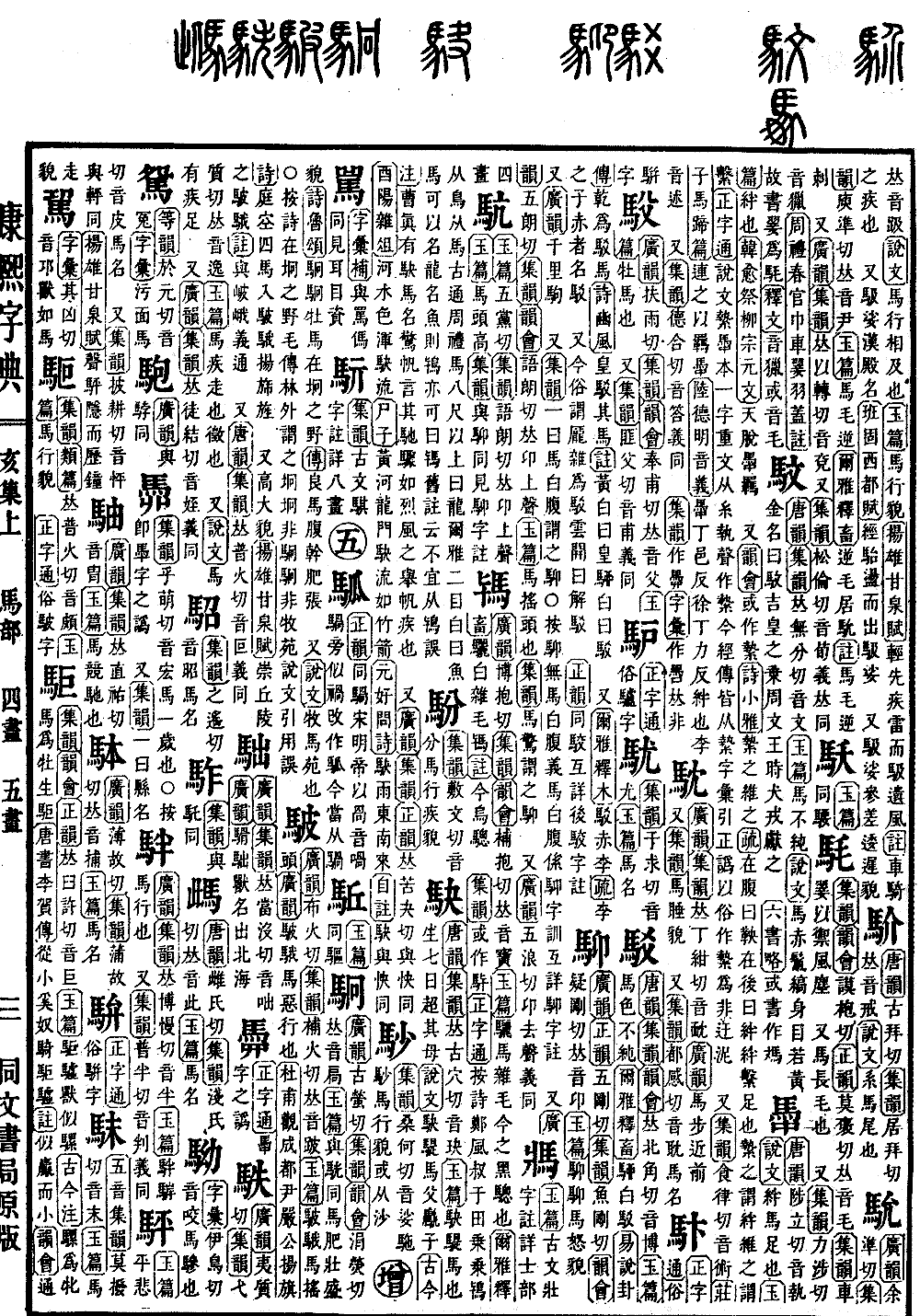
Hai Collection, Upper Volume
Radical: Horse (mǎ)
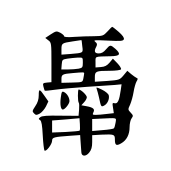
Entry: Zhi
Kangxi strokes: 14
Page 1435, Entry 06
Tang Rhymes (Tangyun): Pronounced zhi.
Analytical Dictionary of Characters (Shuowen): To hobble a horse's feet.
Comprehensive Collection of Characters (Yupian): To hobble.
Han Yu, Eulogy for Liu Zongyuan: Heaven releases the hobbles and bridle.
Rhyme Collection (Yunhui): Sometimes written in a variant form (zhi).
Book of Odes (Shijing), Lesser Odes of the Kingdom (Xiaoya): Hobble it and tie it.
Sub-commentary (Shu): What is on the belly is called an ang, and what is on the hindquarters is called a ban. Ban means to tie the feet. To zhi means to hobble, to wei means to tie.
Proper Character Comprehensive Guide (Zhengzitong): In the Analytical Dictionary of Characters, zhi and zhi were originally the same character, a duplicated form; they are derived from the thread radical with zhi acting as the phonetic, written as zhi. Today, the classics and their commentaries all use zhi. The Dictionary of Characters (Zihui) cites the Correction of Errors (Zheng'e) claiming that the common usage of zhi as zhi is incorrect, but this is pedantic and stubborn.
Also Collected Rhymes (Jiyun): Pronounced shu.
Zhuangzi, Horse Hoofs (Mati) chapter: Joined them with bridles and hobbles.
Lu Deming, Phonetics and Meanings (Yinyi): Zhi, pronounced ding yi, or according to Xu, pronounced ding li; it means to hobble. Li pronounces it shu.
Also Collected Rhymes (Jiyun): Pronounced da. The meaning is the same.
Collected Rhymes (Jiyun): Written as [variant character omitted].
Dictionary of Characters (Zihui): Written as [variant character omitted]. Incorrect.