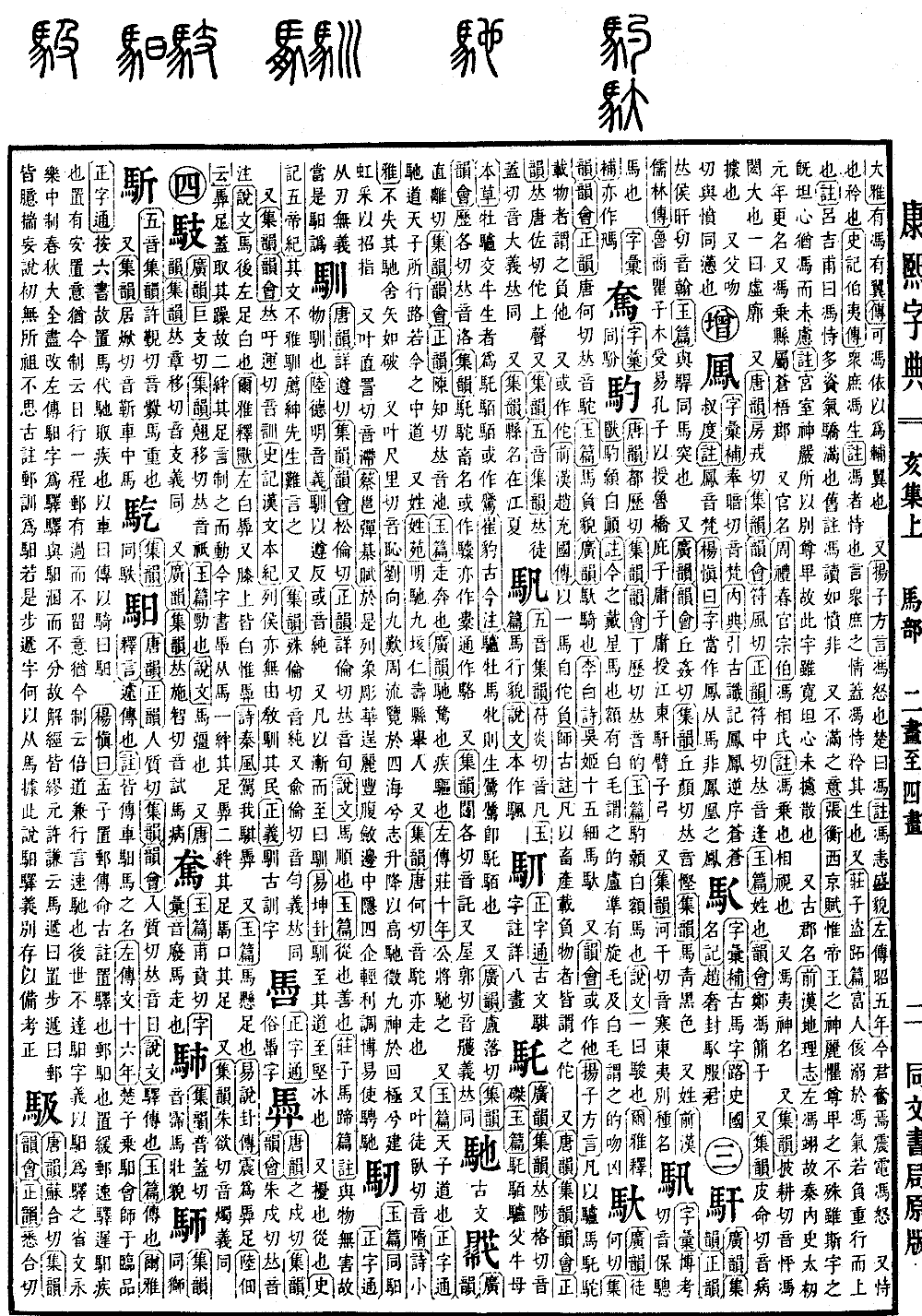
Hai Collection, Upper Volume
Radical: Horse (mǎ)
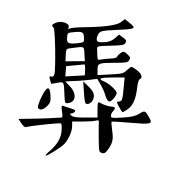
Entry: Zhu
Kangxi strokes: 13
Page 1434, Entry 16
Pronounced zhu. According to the Shuowen Jiezi, it refers to a horse with a white left hind foot. According to the Erya (Erya), a horse with a white left foot is called zhu. Furthermore, if the area above the knees is all white, it is also called zhu. In the Book of Odes (Shijing), it says to harness my dappled horse with white hind feet. According to the Yupian (Yupian), it also refers to a horse with hanging feet. In the Book of Changes (Yijing), Specifically in the Discussion of the Trigrams, it states that the Zhen trigram represents a horse with white feet. Lu Dian says that the term zhu feet refers to restlessness, thus two ropes are used to bind the feet, indicating that even when restrained, the horse moves. Modern character dictionaries reflect this: zhu uses one rope to bind the feet, zhu (with a different radical) uses two ropes to bind the feet, and zhi uses a mouth-like restrainer on the feet. Also according to the Jiyun (Jiyun), it is pronounced zhu, with the same meaning.
Textual research: In the Erya, section on beasts, it is written as left white footed horse, zhu. The original text has been corrected from animal husbandry to beasts to match the original source.