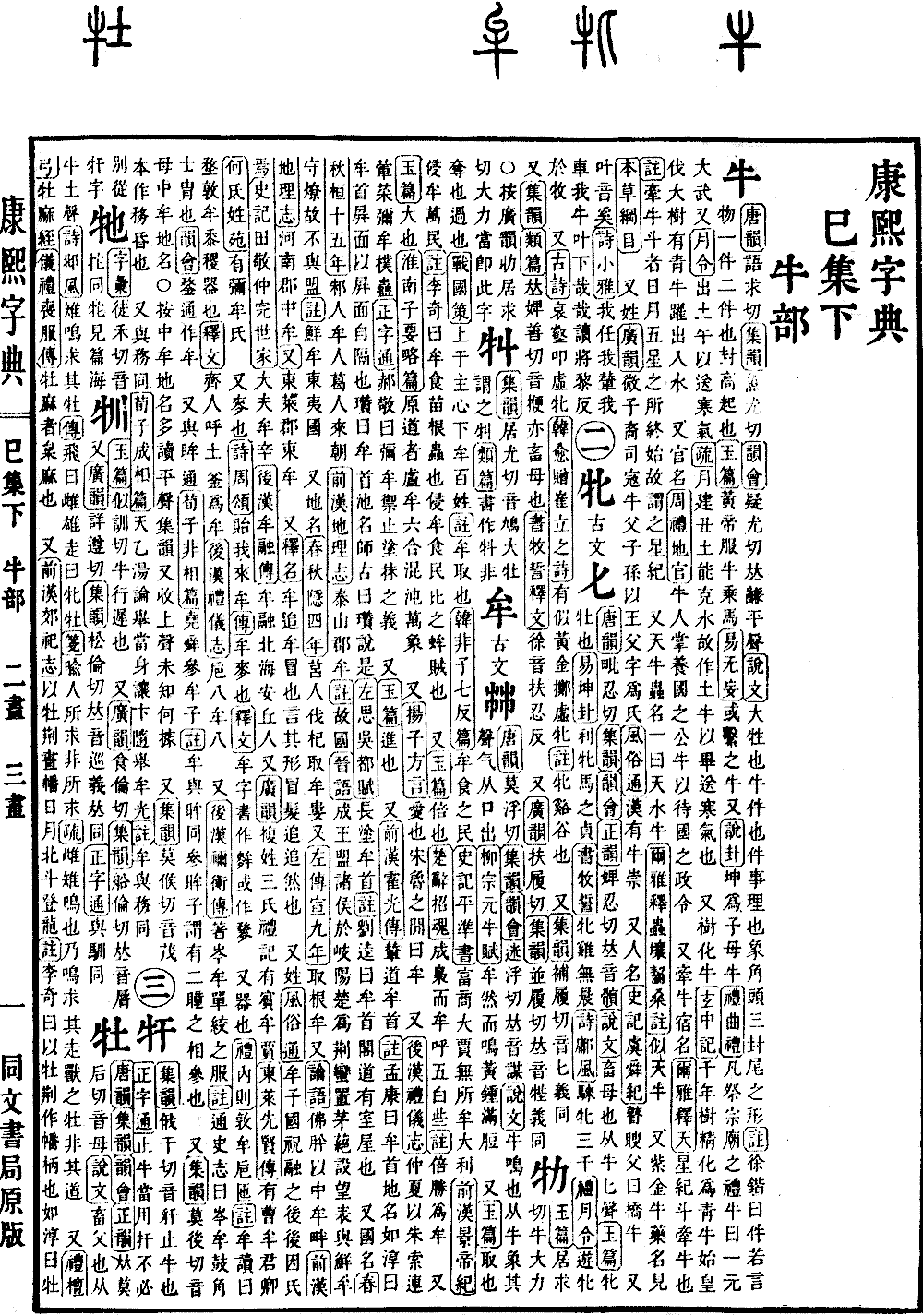
Si Collection, Lower Volume
Radical: Cow (niú)
Mǒu; Kangxi strokes: 6; Page 697, Entry 06
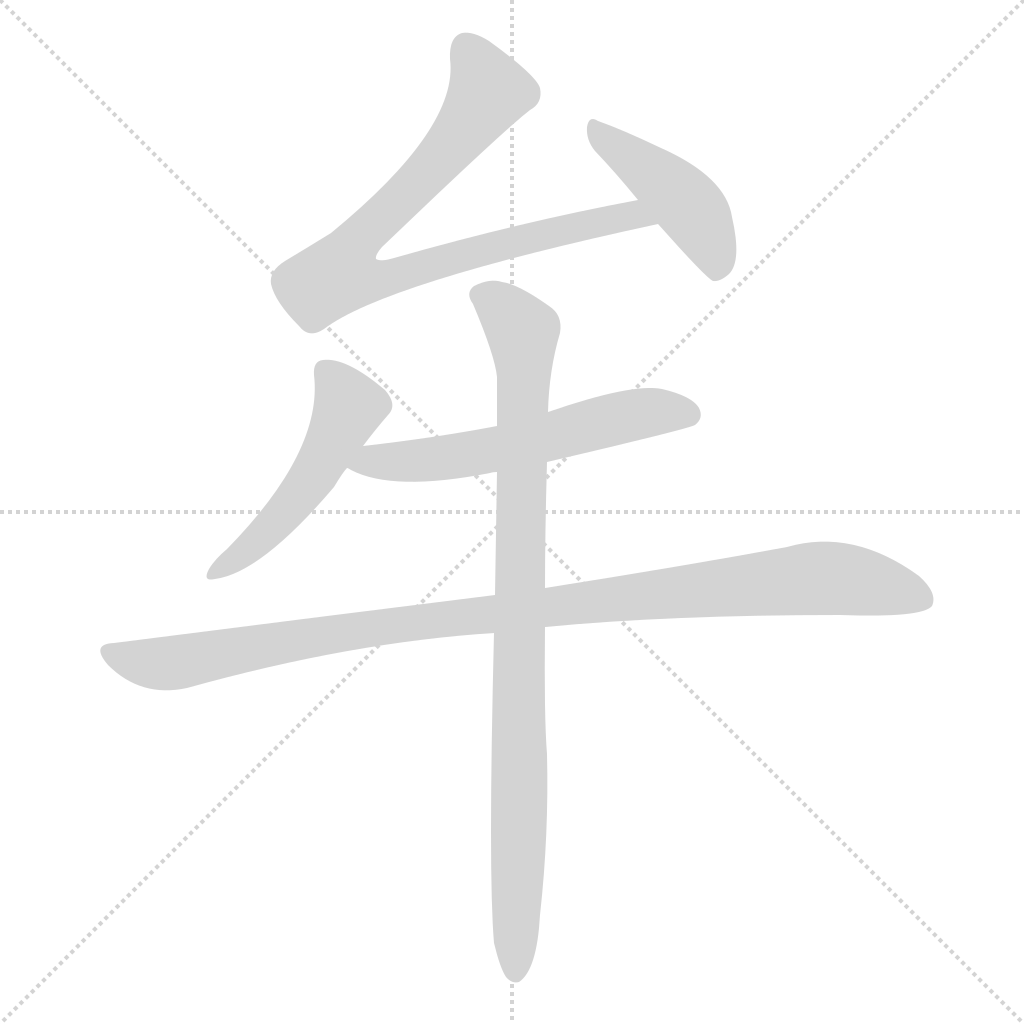
Archaic script. Pronounced mǒu.
Shuowen Jiezi (Dictionary of Explanations of Characters): The sound of a cow. Composed of the character for cow; represents the sound and breath coming out from the mouth.
Liu Zongyuan, Book of the Cow (Niu Fu): Bellowing with a mǒu sound, like a yellow bell filling the throat.
Also, according to Yupian (Jade Chapter), it means to take, to seize, or to surpass.
Strategies of the Warring States (Zhanguo Ce): To offend the ruler's heart above, and to seize from the common people below.
Commentary: Mǒu means to take.
Han Feizi, Seven Reversals (Qi Fan Pian): People who seize food.
Records of the Grand Historian (Shiji), Treatise on the Balanced Standard (Pingzhun Shu): Wealthy merchants and large traders have nothing from which to seize great profit.
History of the Former Han (Qianhan Shu), Annals of Emperor Jing: Invading and seizing from the myriad people.
Commentary: Li Qi states: Mǒu refers to insects that eat the roots of seedlings; invading and eating the people like pests.
Also, according to Yupian, it means to double.
Songs of Chu (Chuci), Summoning the Soul (Zhao Hun): Become a great owl and double it, calling out the five whites.
Commentary: Doubling or surpassing is called mǒu.
Also, according to Yupian, it means great.
Huainanzi, Essentials of the Summary (Yao Lue Pian): One who understands the Way encompasses the universe, chaotic in its myriad manifestations.
Also, according to Yang Xiong's Dialects (Fangyan): To love. In the regions of Song and Lu, it is called mǒu.
Also, History of the Later Han (Houhan Shu), Treatise on Rituals: In mid-summer, use red ropes to connect pungent herbs to ward off and dispel gu-insects.
Correct Character Synthesis (Zhengzitong): Hao Jing says: Ward off and stop, signifying the meaning of smearing or erasing.
Also, according to Yupian, it means to advance.
Also, History of the Former Han, Biography of Huo Guang: The imperial carriage at the Mound Head (mǒu shǒu).
Commentary: Meng Kang says: Mǒu shǒu is a place name. Ru Chun says: Mǒu shǒu refers to a screen surface, used for self-isolation. Zan says: Mǒu shǒu is the name of a pond. Shigu says: Zan's explanation is correct.
Zuo Si, Rhapsody on the Capital of Wu (Wu Du Fu): Long roads and mǒu shǒu.
Commentary: Liu Kui says: Mǒu shǒu refers to the rooms and houses on a pavilion corridor.
Also, a state name.
Spring and Autumn Annals (Chunqiu), 15th Year of Duke Huan: The people of Zhu, the people of Mǒu, and the people of Ge came to pay court.
History of the Former Han, Treatise on Geography: Mǒu in Mount Tai Commandery.
Commentary: An ancient state.
Discourses of the States (Jinyu): King Cheng formed an alliance with the feudal lords at Qiyang; Chu was considered a barbarian, so they placed sedge grass, set up observation posts, and kept watch fires with the Xianmǒu, and thus were not included in the alliance.
Commentary: Xianmǒu, a state of the Eastern Yi tribes.
Also, a place name.
Spring and Autumn Annals, 4th Year of Duke Yin: The people of Ju attacked Qi and took Mǒu-lou.
Also, Zuo Tradition (Zuo Zhuan), 9th Year of Duke Xuan: Took Genmǒu.
Also, Analects (Lunyu): Fo Xi rebelled using Zhongmǒu.
History of the Former Han, Treatise on Geography: Zhongmǒu in Henan Commandery.
Also: Dōngmǒu in Donglai Commandery.
Also, Interpretations of Names (Shiming): Mǒu-zhui. Mǒu means to cover; it describes a shape that covers, like hair standing up.
Also, a surname.
Comprehensive Customs (Fengsu Tong): State of Mǒu, descendants of Zhurong, later adopted it as a clan name.
Records of the Grand Historian, Genealogy of Tian Jingzhong Wan: Grand Master Mǒu Xin.
History of the Later Han, Biography of Mǒu Rong: Mǒu Rong, a man from Anqiu, Beihai.
Also, according to Guangyun (Broad Rhymes), a compound surname. Three clans; the Book of Rites (Liji) mentions Binmǒu Jia.
Biographies of Worthies of the Eastern Capital (Donglai Xianxian Zhuan): Mentions Cao Mǒu Junqing.
He Clan's Garden of Surnames (He Shi Xingyuan): Mentions the Mǒumǔ clan.
Also, wheat.
Book of Odes (Shijing), Eulogies of Zhou (Zhou Song): Bestowed upon us wheat (mǒu).
Commentary: Mǒu is wheat.
Explanations of Characters (Shuowen): In dictionaries, written as mǒu (wheat radical), or as mǒu (another wheat variant).
Also, a vessel.
Book of Rites, Inner Treatises (Neize): Dùnmǒu, goblet, and ewer.
Commentary: Mǒu is read as mú. Dùnmǒu is a vessel for millet.
Explanations of Characters: People of Qi call an earthenware pot a mǒu.
History of the Later Han, Treatise on Rituals: Eight goblets, eight mǒu vessels.
Also, History of the Later Han, Biography of Mi Heng: Wearing a cen-mǒu cap and single-layered robes.
Commentary: Common Histories and Treatises state: Cen-mǒu is the helmet of a drummer or horn player.
Rhyme Collection (Yunhui): The character for helmet (móu) is interchangeable with mǒu.
Also, interchangeable with pupil.
Xunzi, Against Physiognomy (Fei Xiang Pian): Yao and Shun had participating pupils (mǒu).
Commentary: Mǒu is the same as pupil. Participating pupils means having two pupils that appear to coincide.
Also, pronounced mǔ (rising tone). Zhongmǒu, a place name. Note: Place names for Zhongmǒu are mostly read in the level tone. The Rhyme Collection also includes a rising tone, though the source is unknown.
Also, pronounced mào. Originally written as the character for duty/effort. Means dim or confused.
Also, interchangeable with effort.
Xunzi, On the Shaping of the State (Cheng Xiang Pian): Emperor Tang, whose discussions and selections were appropriate. Personally deferred to Bian Sui and selected Mùguāng.
Commentary: Mǒu is the same as effort.