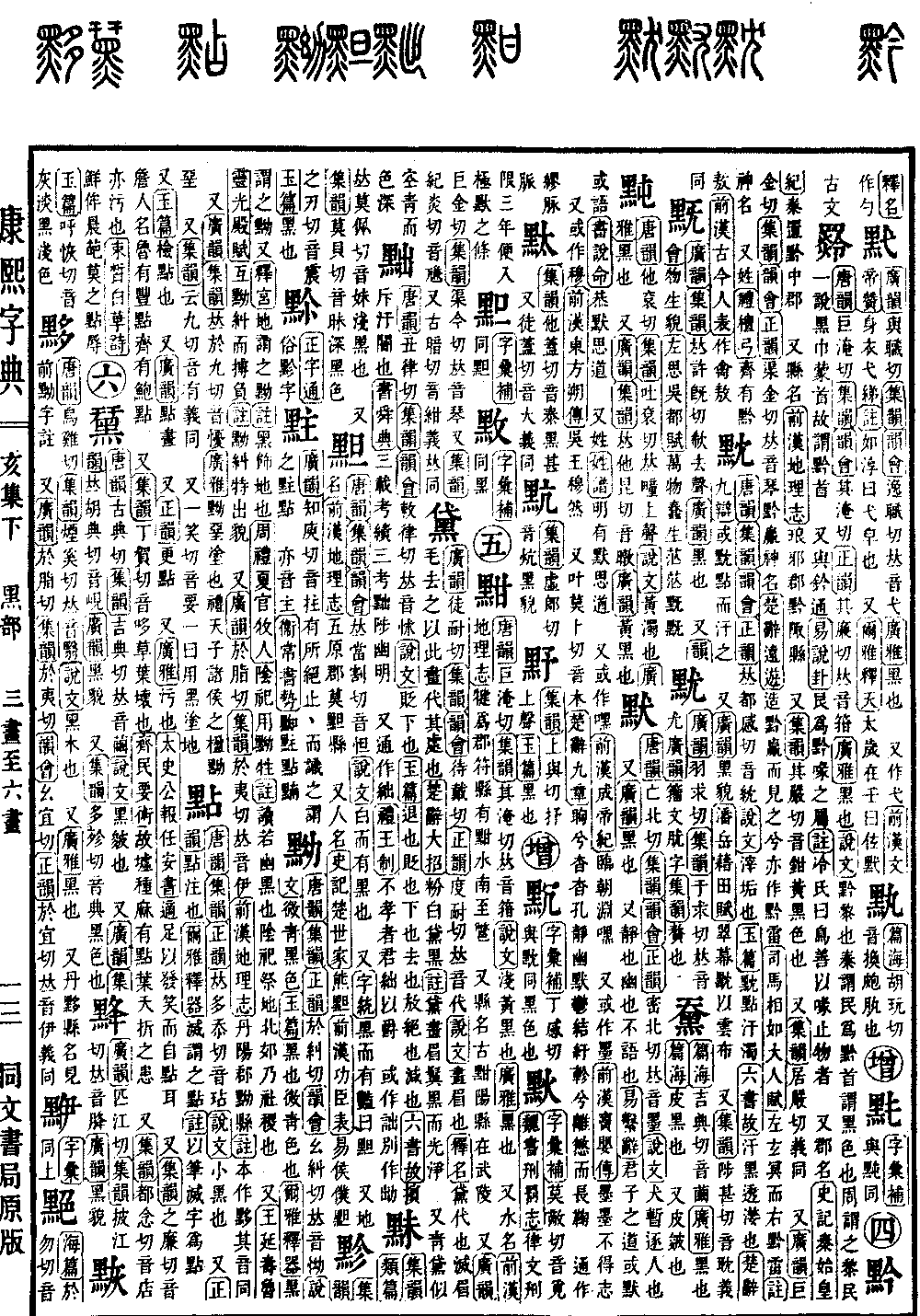
Hai Collection, Lower Volume
Radical: Black (hēi)
Kangxi strokes: 16
Page 1519, Entry 11
Pronounced mo.
According to the Explaining Graphs and Analyzing Characters (Shuowen Jiezi), it refers to a dog suddenly chasing someone.
It also refers to the color black, as well as a state of quiet, seclusion, or silence.
Book of Changes (Yijing), Commentary on the Appended Phrases: The way a noble person conducts themselves in the world involves times of silence and times of speech.
Book of Documents (Shangshu), Charge to Yue: Respectfully remain silent and contemplate the righteous path.
It also appears as a surname. According to the Record of Surnames (Xingpu), there was a man named Mo Sidao during the Ming dynasty.
It is sometimes written as the variant form hei.
History of the Former Han (Hanshu), Annals of Emperor Cheng: When attending court, he was deep, quiet, and silent.
It is sometimes written as the variant form mo.
History of the Former Han (Hanshu), Biography of Dou Ying: Silent and frustrated, unable to achieve his ambitions.
It is sometimes written as a variant form.
History of the Former Han (Hanshu), Biography of Dongfang Shuo: The King of Wu was silent.
It is also pronounced mu (rhyming with the following context).
Songs of Chu (Chuci), Nine Chapters: Before my eyes, all is dark and vast, all around is silent and still. My sorrowful thoughts are bound and lingering, suffering from pain and long-standing poverty.
It is also interchangeable with the characters pronounced miu or mo (as in mo-mo).