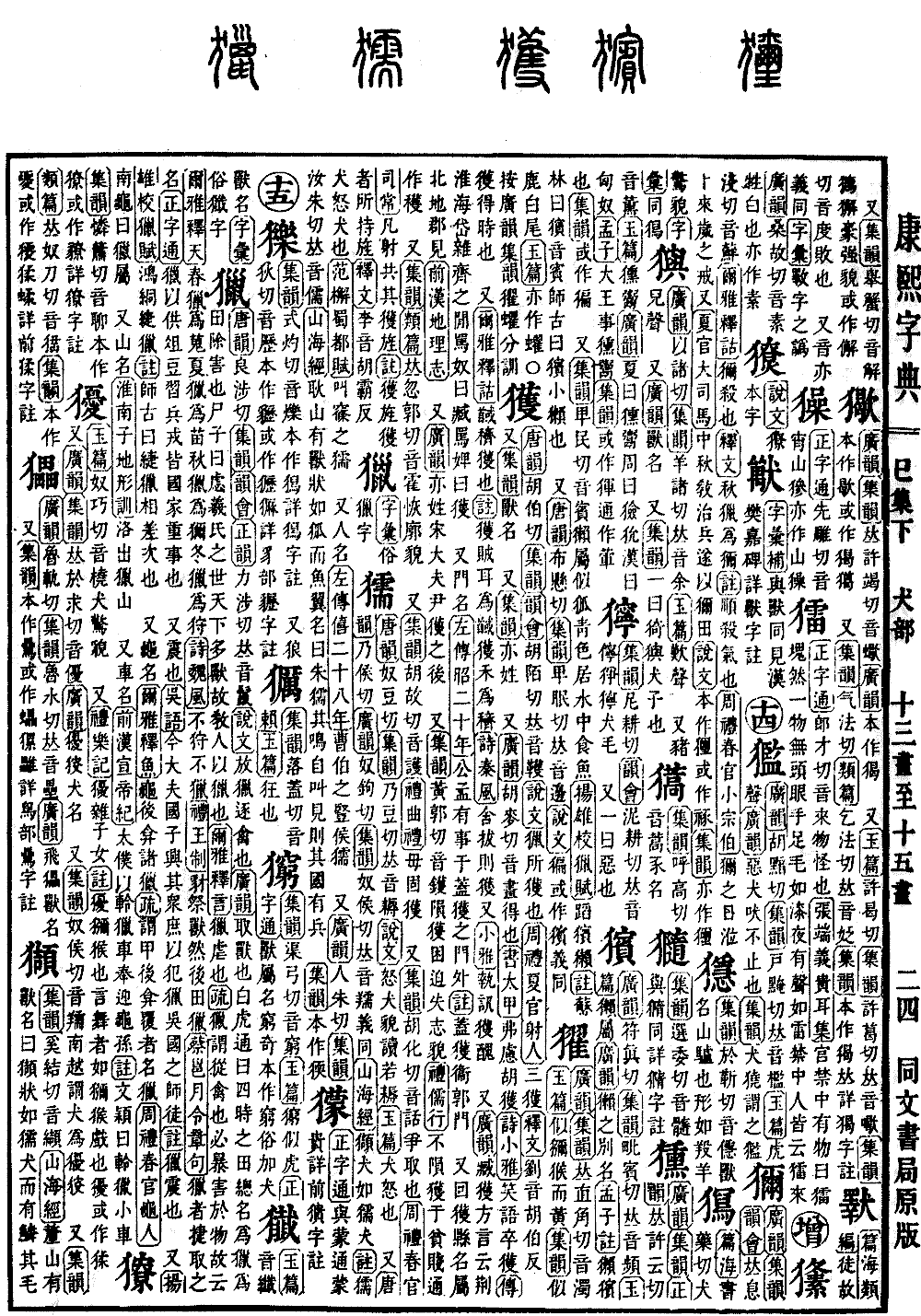
Si Collection, Lower Volume
Radical: Dog (quǎn)
Kangxi Strokes: 18
Page 720, Entry 14
Pronounced huò.
From the Analytical Dictionary of Characters (Shuowen Jiezi): That which is captured in hunting.
From the Rites of Zhou (Zhouli), Summer Offices, Shooter Official: The three captures.
From the Explanations of Texts (Shiwen): Liu pronounces it as huò.
Also, per the Collection of Rhymes (Jiyun): A type of beast.
Also, per the Collection of Rhymes (Jiyun): A surname.
Also, per the Extensive Dictionary of Rhymes (Guangyun): Pronounced huà. To obtain.
From the Book of Documents (Shujing), Taijia: Do not reflect on how to obtain.
From the Book of Odes (Shijing), Lesser Odes of the Kingdom: Laughter and speech finally obtained.
Commentary: To obtain the appropriate time.
Also, per the Approaches to Literature (Erya), Explanations of Ancient Terms: Guo and ji mean to obtain.
Note: To obtain the ear of an enemy is called guo; to obtain grain is called ji.
From the Book of Odes (Shijing), Odes of Qin: Cast the target and then obtain it.
Also, Lesser Odes of the Kingdom: Seize prisoners and capture the ugly.
Also, per the Extensive Dictionary of Rhymes (Guangyun): Zanghuo. The Regional Dictionary (Fangyan) states: In the regions of Jing, Huai, Hai, Dai, and the various Qi areas, scolding a male slave is called zang, and scolding a female slave is called huo.
Also, the name of a gate.
From the Zuo Tradition (Zuozhuan), Year 20 of Duke Zhao: Gongmeng had business outside the Gaihuo Gate.
Note: Gaihuo is a gate in the outer wall of the State of Wei.
Also, Huihuo, the name of a county. Belonging to Beidi Commandery. Seen in the History of the Former Han (Qian Hanshu), Treatise on Geography.
Also, per the Extensive Dictionary of Rhymes (Guangyun): A surname. Descendants of Yin Huo, a grand officer of the State of Song.
Also, per the Collection of Rhymes (Jiyun): Pronounced huò. Yunhuo, the appearance of being distressed, constrained, and having lost one's resolve.
From the Book of Rites (Liji), Conduct of Scholars: Do not become distressed in poverty or humble status. Often written with the grain radical variant.
Also, per the Collection of Rhymes (Jiyun) and the Classified Dictionary (Leipian): Pronounced huò. The appearance of being grand and spacious.
Also, per the Collection of Rhymes (Jiyun): Pronounced hù.
From the Book of Rites (Liji), Summary of the Rites: Do not be stubborn and demanding.
Also, per the Collection of Rhymes (Jiyun): Pronounced huà. To strive to obtain.
From the Rites of Zhou (Zhouli), Spring Offices, Director of Flags: For all archery, provide the capture flag.
Note: The capture flag is the flag held by the person who retrieves the arrows.
From the Explanations of Texts (Shiwen): Li pronounces it as huà.