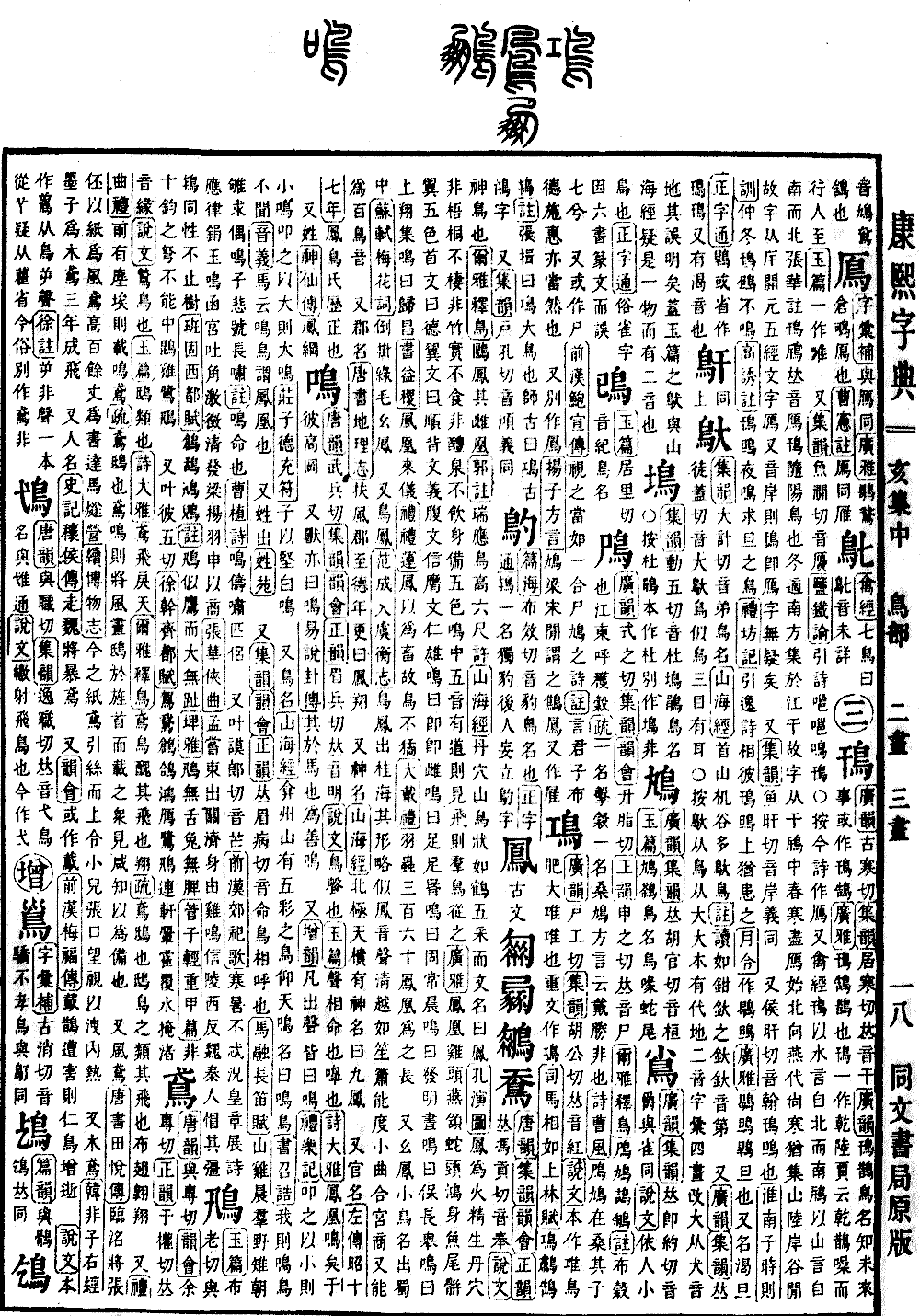
Hai Collection, Middle Volume
Radical: Bird (niǎo)
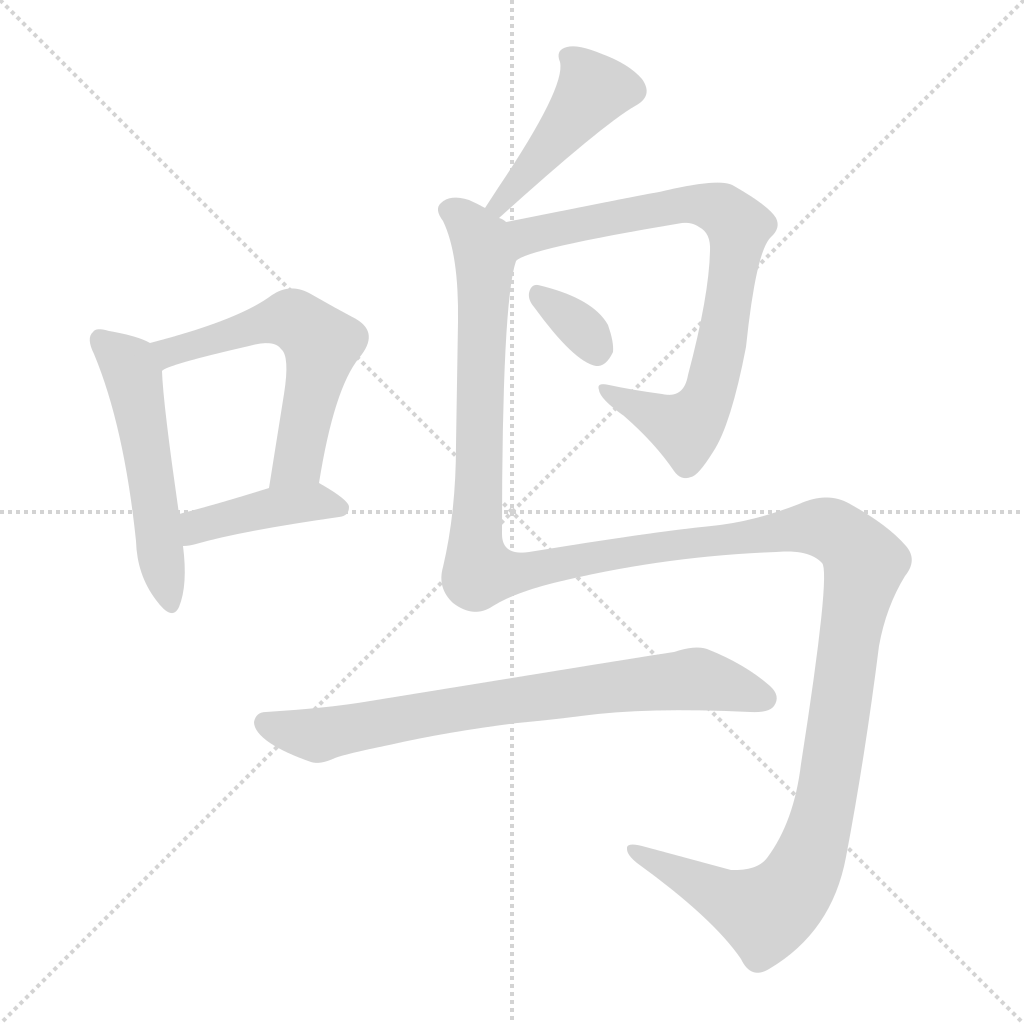
鳴
Kangxi strokes: 14
Page 1482, Entry 01
Tang Rhymes (Tangyun): Pronounced ming.
Collected Rhymes (Jiyun), Rhyme Meetings (Yunhui), Correct Rhymes (Zhengyun): Pronounced ming.
Shuowen: The sound of a bird calling.
Jade Chapter (Yupian): The sound of mutual calling, or roaring.
Book of Odes (Shijing), Greater Odes (Daya): The phoenixes are calling upon the high mountain ridge.
Also, the calls of wild beasts are also called ming.
Book of Changes (Yijing), Commentary on the Trigrams (Shuogua Zhuan): Among horses, it represents those that are good at calling.
Expanded Rhymes (Zengyun): Anything that emits a sound is called ming.
Book of Rites (Liji), Record of Music (Yueji): Strike it with a small force, and it emits a small sound; strike it with a large force, and it emits a large sound.
Zhuangzi, Sign of Virtue Complete (Dechongfu): You use arguments of hardness and whiteness to contend and resound.
Also, a bird name.
Classic of Mountains and Seas (Shanhaijing): On Yanzhou Mountain, there is a five-colored bird that looks up to the sky and calls; its name is the calling bird.
Book of Documents (Shangshu), Announcement of the Duke of Shao (Zhaogao): I cannot even hear the sound of the calling bird.
Pronunciation and Meaning (Yinyi): Ma Rong says: The calling bird refers to the phoenix.
Also, a surname. From the Garden of Surnames (Xingyuan).
Also, Collected Rhymes (Jiyun), Rhyme Meetings (Yunhui), Correct Rhymes (Zhengyun): Pronounced ming (falling tone).
Birds calling to each other.
Ma Rong, Rhapsody on the Long Flute (Changdi Fu): The mountain pheasants gather in the early morning, the wild pheasants call in the early dawn. Seeking mates and calling to their young, sadly howling and long whistling.
Commentary: Ming means to call.
Cao Zhi, Poems: Calling to companions, summoning friends.
Also, rhyming with mang.
History of the Former Han (Qianhan), Hymns for the Suburban Sacrifices (Jiaosi Ge): Cold and heat alternate without error, manifesting the laws of heaven; presenting poems to harmonize with the sounds of the jade chimes as they resound. The gong tone is inclusive, the jue tone is vibrant, the zhi tone is clear and high, flourishing in the music of Liangzhou, relaxing the yu melody, and accompanied by the shang.
Zhang Hua, Song of the Knight-Errant (Xia Qu): Lord Mengchang went east out of Hangu Pass, relying on a rooster's crow to escape. Lord Xinling went west back to the state of Wei, and the Qin people grew strong because of this.
Textual Research:
Book of Rites (Liji), Record of Music (Yueji): Strike it with a small force, then it emits a small sound. Strike it with a large force, then it emits a large sound.
Note: Corrected Record of Learning (Xueji) to Record of Music (Yueji) in accordance with the original text.