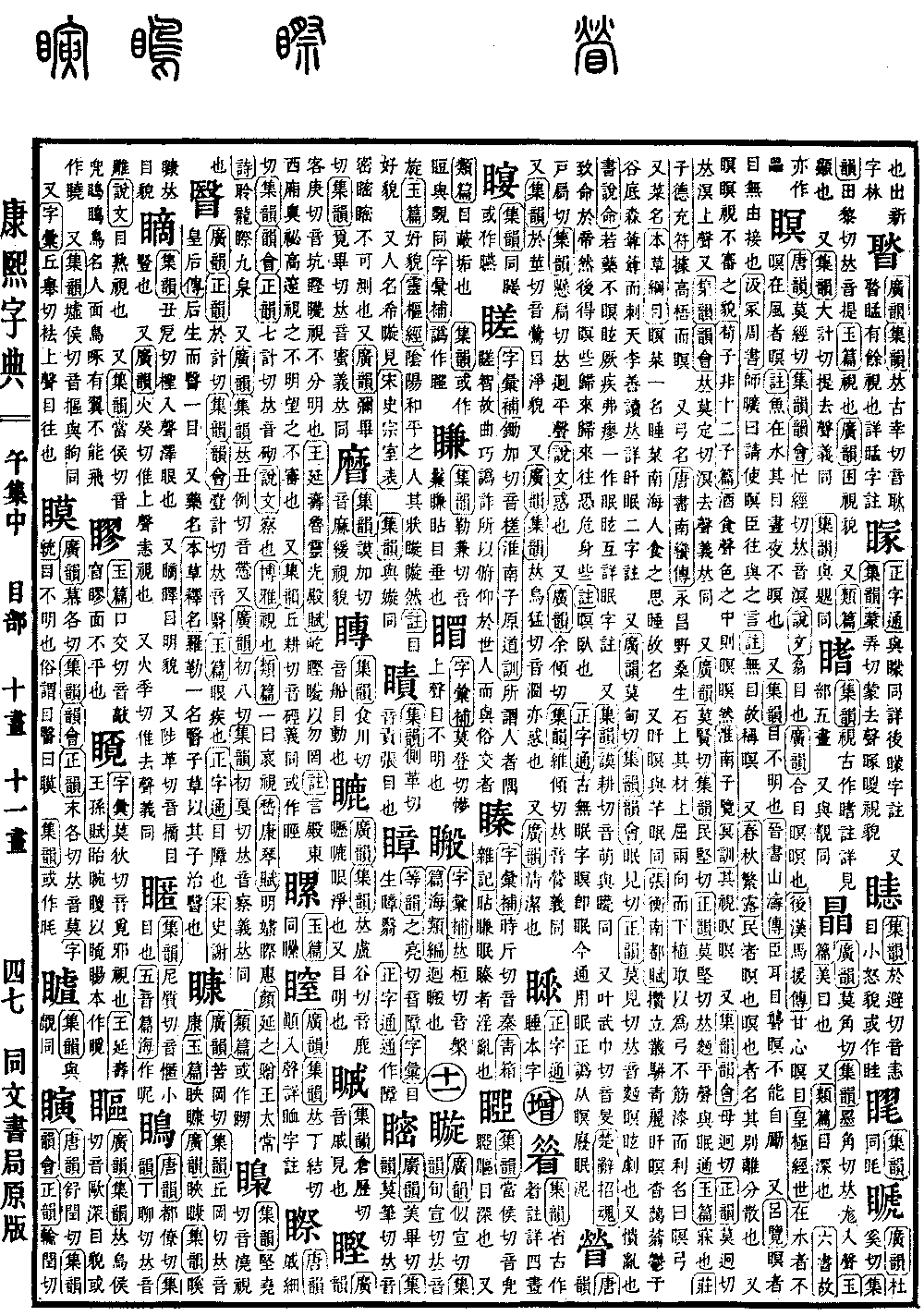
Wu Collection, Middle Volume
Radical: Eye (mù)
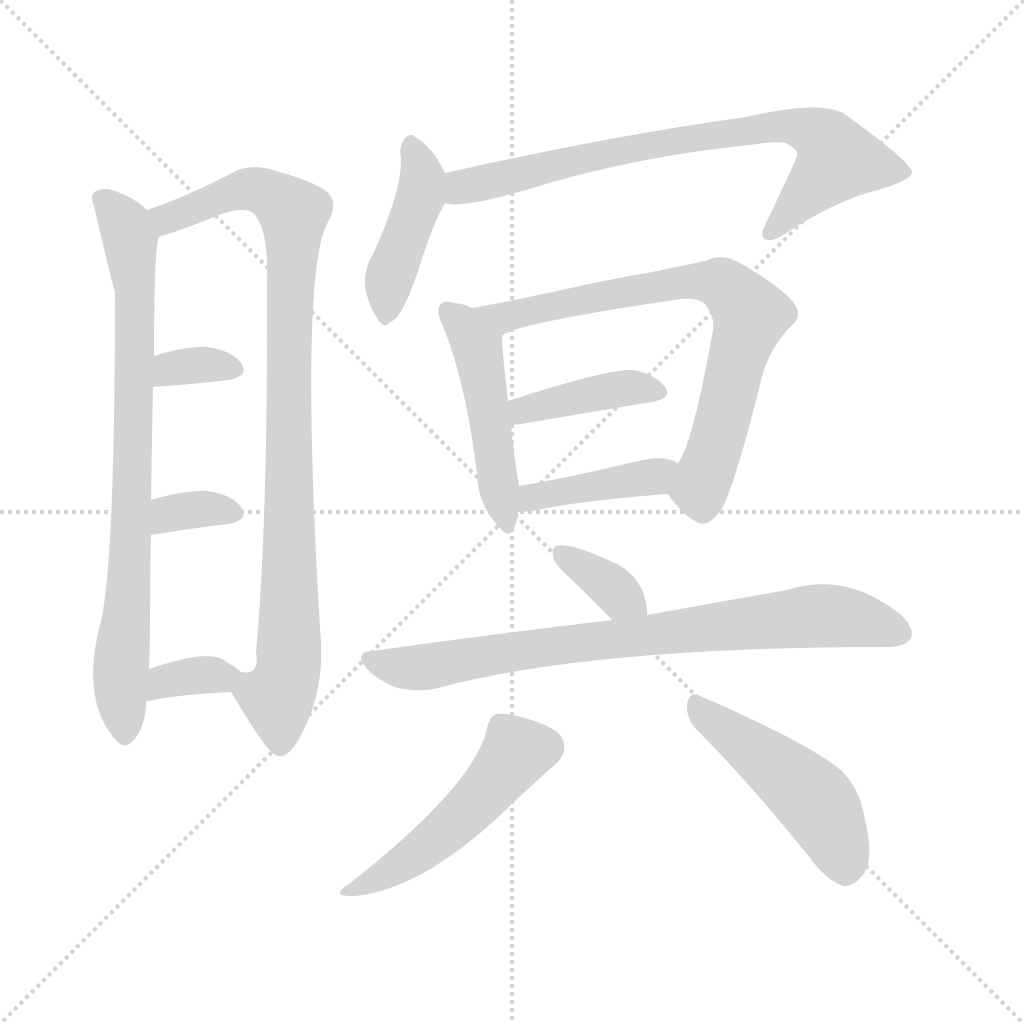
瞑
Kangxi Strokes: 15
Page 815, Entry 08
Pronounced ming.
In Shuowen Jiezi (Shuowen), it means to close the eyes.
In Guangyun, it means to close the eyes tightly.
From the Biography of Ma Yuan in the History of the Later Han (Hou Hanshu): To close one's eyes contentedly in death.
From the Supreme Principles of Governing the World (Huangji Jingshi): Those in water do not close their eyes, those in wind do close their eyes. Commentary: Fish are in water, their eyes never close day or night.
Also, in Jiyun, it means eyes that cannot see clearly.
From the Biography of Shan Tao in the Book of Jin (Jinshu): My ears and eyes are dull and dark, unable to exert myself.
Also, from the Lu School of Philosophy (Lülan): To close the eyes is to have no way to make contact with objects.
From the Bamboo Annals Zhou Documents (Jizhong Zhoushu): Shi Kuang said, please let a blind minister go and speak with them. Commentary: Being without eyes, he is called blind.
Also, from Luxuriant Dew of the Spring and Autumn Annals (Chunqiu Fanlu): The people are the blind. To be blind means to be separated and scattered.
Also, to gaze with blurred vision, an appearance of not discerning clearly.
From the Xunzi, Chapter on Denouncing the Twelve Philosophers: Amidst wine, food, sound, and color, one is in a dazed and blurry state.
From the Huainanzi, Chapter on Viewing the Obscure (Lanming Xun): Their gaze is dazed and unfocused.
Also pronounced ming (rising tone).
Also pronounced ming (falling tone).
The meaning is the same as above.
Also pronounced mian.
Synonymous with sleep.
In Yupian, it means to sleep.
From the Zhuangzi, Chapter on the Sign of Virtue Complete (Dechongfu): Leaning on a withered parasol tree to sleep.
Also the name of a bow.
From the Book of Tang (Tangshu), Chapter on the Southern Barbarians: In Yongchang, wild mulberry grows on rocks. The wood bends upward and then downward. It is harvested to make bows, which are sharp without the need for sinew or lacquer; they are called dark bows.
Also the name of a vegetable.
From the Compendium of Materia Medica (Bencao Gangmu): Dark vegetable, also known as sleep vegetable. People of the Southern Sea eat it and feel the desire to sleep, hence the name.
Also xuming, synonymous with lush and overgrown.
From Zhang Heng, Rhapsody on the Southern Capital (Nandu Fu): Clustered trees standing together, lush and blue, deep and dense in the valley bottom, thick and piercing the sky. Li Shan reads these, detailed in the commentary on the two characters for lush growth.
Also pronounced mian.
Refers to the dizziness caused by medicine. Also refers to confusion.
From the Book of Documents (Shujing), Chapter on the Charge to Yue: If the medicine does not cause dizziness, the illness will not be cured. Sometimes written as a variant form (mianxuan). Refer to the entry for the character sleep for further details.
Also pronounced meng.
Synonymous with the character sprout.
Also rhymes with min.
From the Songs of Chu (Chuci), Chapter on Summoning the Soul: To offer one's life to the Emperor, only then to find rest. Return, return! To go further is to endanger one's body. Commentary: To close the eyes, to lie down.
In the Correct Meaning of Characters (Zhengzitong): In ancient times there was no character for sleep. This character was originally used for sleep. Now sleep is commonly used. It is a mistake to abandon this character in favor of the modern version.
Textual Research: In the Zhuangzi, Chapter on the Sign of Virtue Complete, the text has been corrected to read withered parasol tree instead of high parasol tree according to the original text.