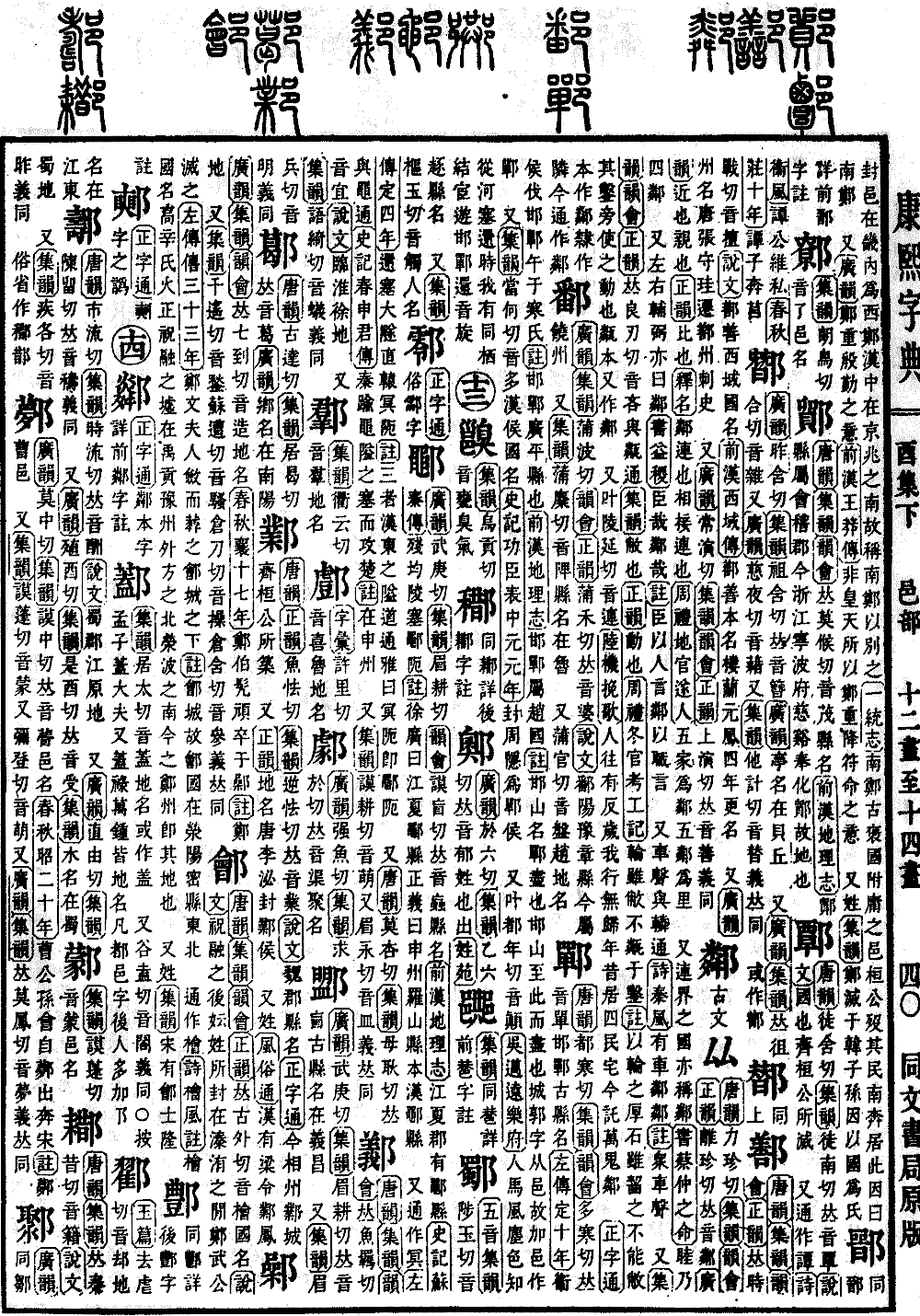
You Collection, Lower Volume, Radical: City (yì)
Page 1278, Entry 01
The ancient form of the character was "厸".
Pronounced li zhēn (falling tone), same as "粼" (lín).
Explained as "near, intimate."
Explained as "to be next to."
Said: "Lín refers to connection, indicating mutual connection."
"Five households form a lín, and five lín form a lǐ."
Also refers to neighboring countries, also called lín.
Said: "One should live in harmony with neighboring countries in all directions."
Also refers to close assisting ministers, also called lín.
Said: "Ministers, close ministers." (Note: "chén" is from the perspective of a person, while "lín" is from the perspective of official duty.)
Also refers to the sound of carriages. It is interchangeable with "辚" (lín).
There is a poem in the "Book of Odes (Shijing)" (Qin Feng): "The sound of carriages rumbling." (Note: Describes the sound of many carriages.)
Pronounced liáng rèn (falling tone), same as "吝" (lìn). Interchangeable with "甐" (lìn).
Explained as "worn out" (old and broken).
Explained as "to move."
"Even if the carriage wheels are worn out, the mortise will not loosen or be damaged." (Note: Because the wheel is thick, even if stones wear it down, it cannot cause the mortise to be damaged or loosened.)
"甐" is also written as "邻" in some versions.
Also has a leaf sound pronounced líng yán (rising tone), same as "连" (lián).
Poem: "Others still have a day to return home, but this journey of mine has no year of return. In the past, I lived among the common people, but now I am among the ghosts."
Originally written as "鄰", and in clerical script written as "隣". Now commonly written as "邻".