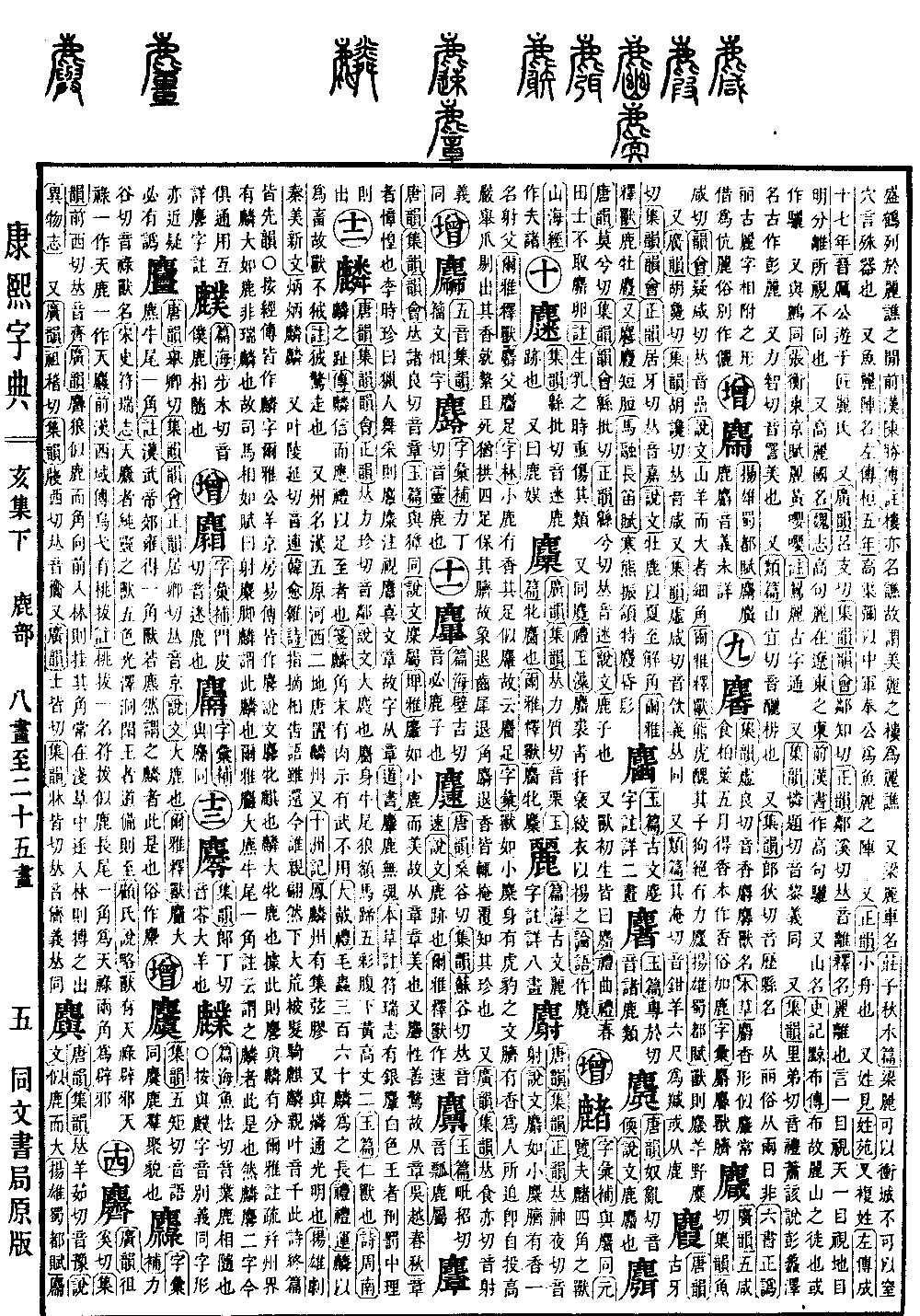
Hai Collection, Lower Volume
Radical: Deer (lù)
Kangxi stroke count: 23
Page 1511, Entry 20
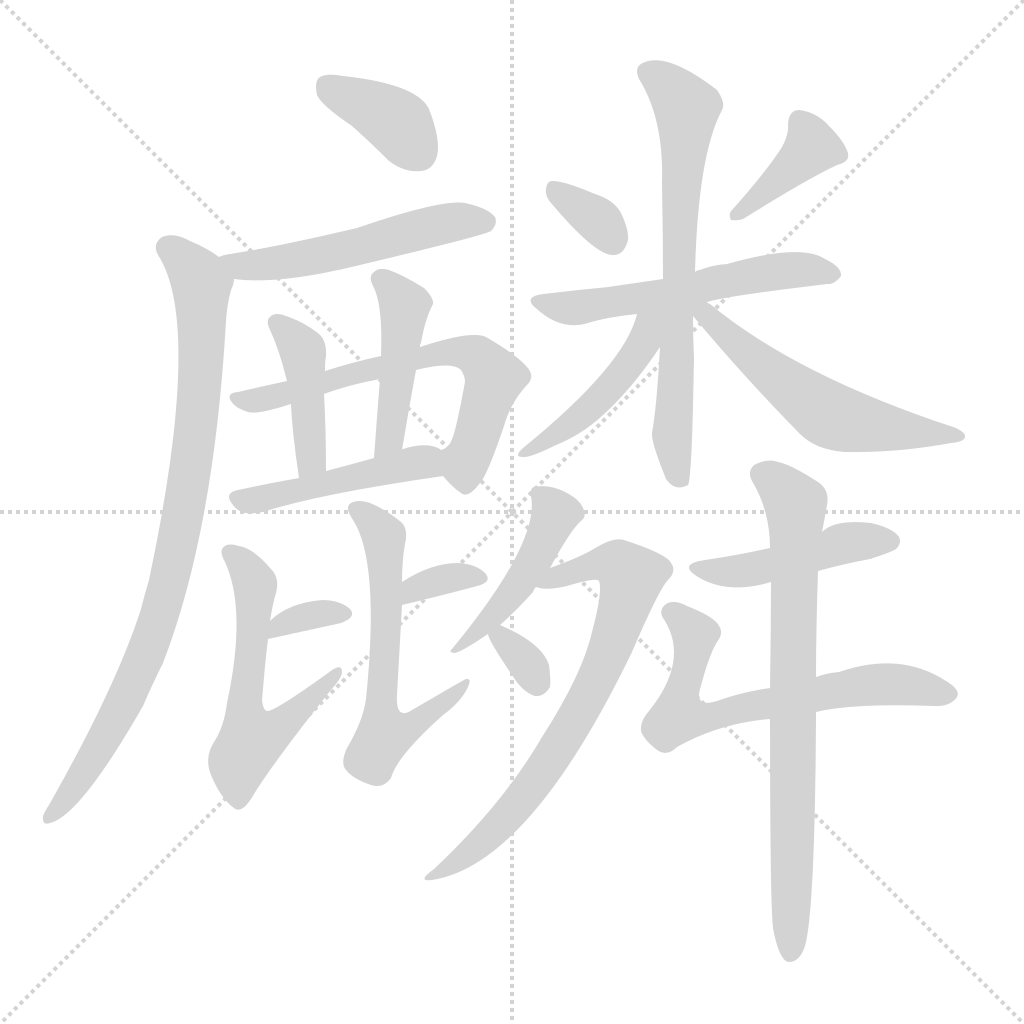
Pronounced lín.
Shuowen Jiezi (Shuowen) states: A large deer. It has the body of a muntjac, the tail of an ox, the forehead of a wolf, and the hooves of a horse. Its belly is yellow and it is twelve feet tall.
Yupian states: A benevolent beast.
Book of Odes (Shijing), Zhou Nan: The feet of the lin.
Commentary: The lin is faithful and responds to propriety, it arrives with its feet.
Sub-commentary: The tips of the lin's horns have flesh on them, indicating that while it possesses martial power, it does not use it.
Dadai Liji: Among the three hundred and sixty furry creatures, the lin is their leader.
Book of Rites (Liji), Liyun: The lin is kept as livestock, thus beasts do not flee in terror.
Note: Flee in terror means to be startled and run away.
Also a prefecture name. During the Han dynasty, it occupied the regions of Wuyuan and Hexi; the Tang dynasty established Lin Prefecture.
Also, Ten Continents Record (Shizhouji) mentions that Fenglin Prefecture possesses glue made from strings.
Also used interchangeably with lin (meaning bright or luminous). Yang Xiong, Ju Qin Mei Xin Wen: Shining and bright.
Also rhymes with lian. Han Yu, Miscellaneous Poems: Pointing and whispering to one another, though returned now, who is close? Fluttering down from the great wilderness, with disheveled hair, riding a qilin. The character qin rhymes with the sound qian. This entire poem concludes using the xian rhyme group.
According to the classics and commentaries, both are written with the character lin. Erya, Gongyang Zhuan, and Jing Fang Yi Zhuan all use the character lin (with the deer radical on the left and the lin phonetic on the right). Shuowen Jiezi states: The character lin (with the deer radical on the left and the lin phonetic on the right) is a female qilin. The character lin (with the deer radical on the left and the lin phonetic on the right) is a large female deer. Based on this, there is a distinction between the two. The Erya Zhushu notes that in the borderlands of Bing Prefecture, there is a lin, large like a deer, which is not an auspicious lin. Therefore, Sima Xiangru's rhapsody says: Shooting the milu deer and the lin, referring to this type of lin. Erya states: The jing is a large deer with an ox tail and one horn. The note says: That which is called a lin refers to this. However, the two characters for lin are now used interchangeably. See the entry for the character lin (with the deer radical on the left and the lin phonetic on the right) for further details.
Textual research: In the Book of Rites (Liji), Liyun, the text states the lin is kept as livestock, thus beasts do not flee in terror. The note says: Flee in terror means to be startled and run away. Based on the original text, both instances of the character have been corrected to read as flee in terror.