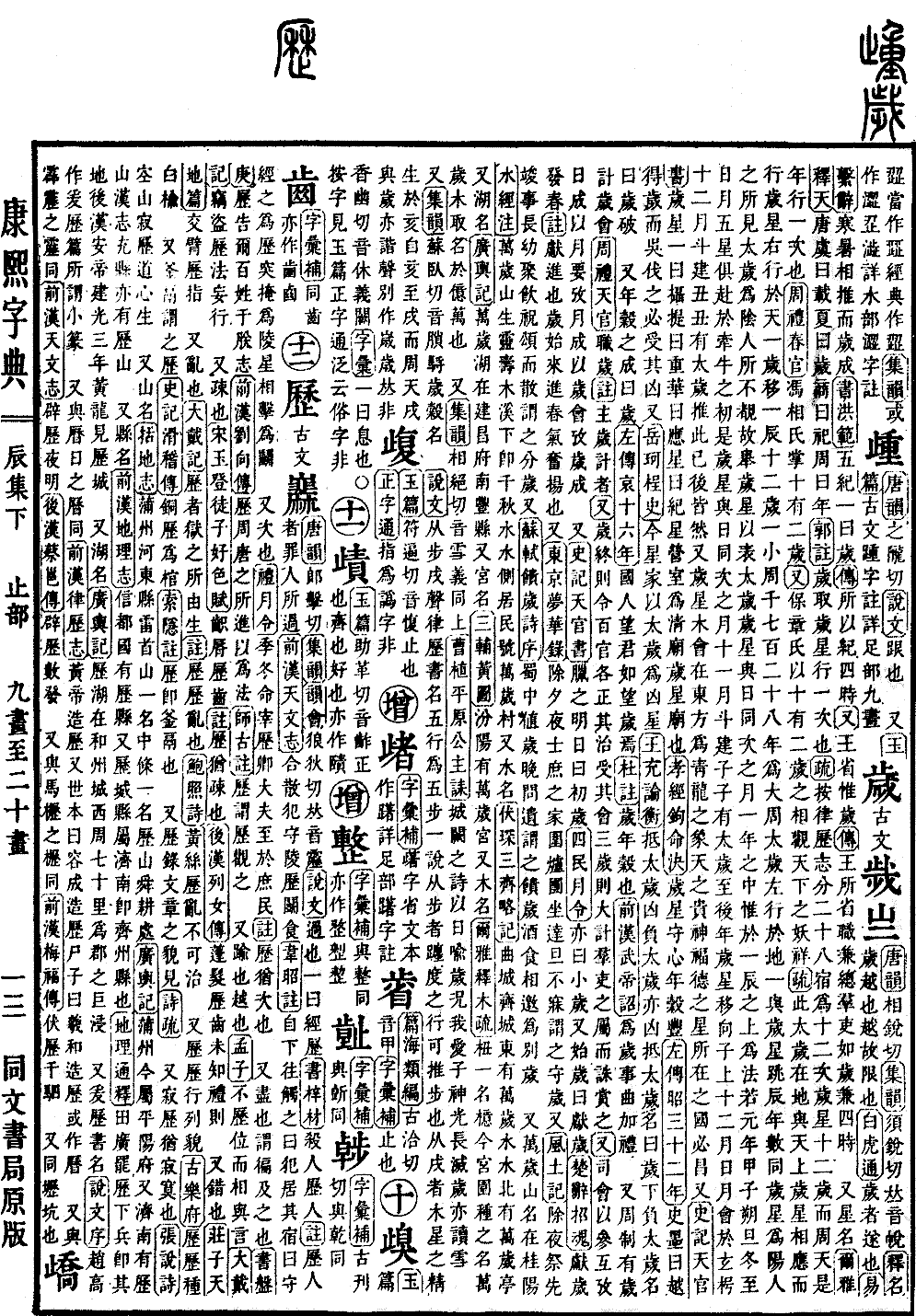
Chen Collection, Lower Volume
Radical: Stop (zhǐ)
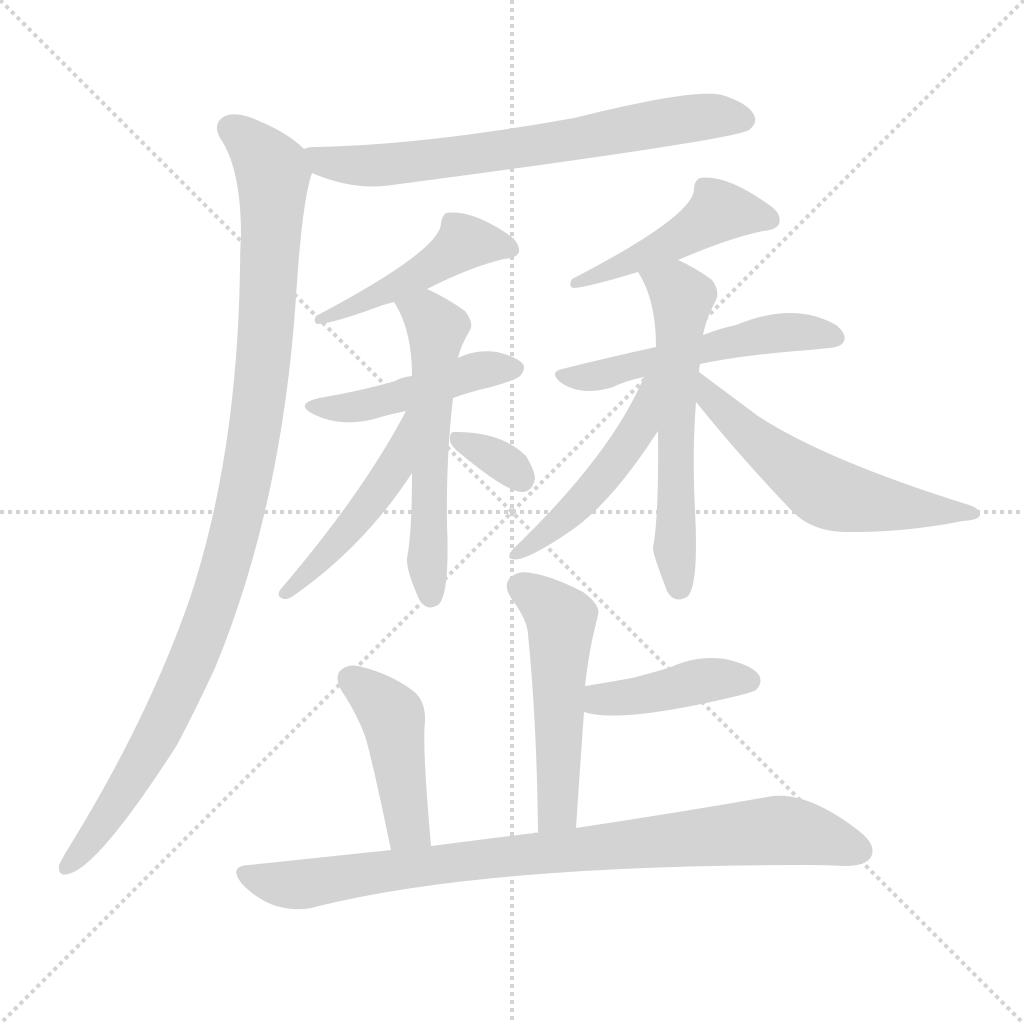
歷
Kangxi strokes: 16
Page 577, Entry 14
Ancient script. According to Tang Rhymes (Tangyun), pronounced li (falling tone). According to Collected Rhymes (Jiyun) and Rhyme Collection (Yunhui), pronounced li (rising tone).
According to Explaining Graphs and Analyzing Characters (Shuowen): To pass through. Another interpretation is to experience.
Book of Documents (Shujing), Chapter on Timber for Artisans (Zicai): To kill a person, to pass through [the case of] a person. Commentary: This refers to the places a criminal has passed through.
History of the Former Han Dynasty (Qianhan Shu), Treatise on Astronomy: Concerning convergence, separation, violation, and lingering. Commentary by Wei Zhao: Approaching from below is called violation (fan); dwelling within a constellation is called lingering (shou); passing through is called progression (li); sudden encroachment is called transgression (ling); celestial bodies colliding is called struggle (dou).
Also refers to order. Book of Rites (Liji), Monthly Ordinances (Yueling): In the final month of winter, command the officials to register the ranks of the nobility down to the common people. Commentary: This means to arrange in order.
Also refers to exhaustive. Means to comprehensively cover. Book of Documents (Shujing), Announcement of Pan Geng: I have exhaustively proclaimed my intentions to you, the people. History of the Former Han Dynasty (Qianhan Shu), Biography of Liu Xiang: He exhaustively examined the advancements of the Zhou and Tang dynasties to use as a model. Commentary by Shigu: This means to observe one by one.
Also refers to overstepping or crossing. Mencius: Do not bypass your rank to speak with others. Records of Elder Dai (Dadaiji): To steal, violate laws, and act recklessly.
Also refers to sparse. Song Yu, Rhapsody on Master Dengtu’s Sensuality: With parted lips and sparse teeth. Commentary: This means sparse. Book of the Later Han (Houhan Shu), Biographies of Notable Women: With disheveled hair and sparse teeth, she did not know the rules of propriety.
Also refers to crossed or intertwined. Zhuangzi, Heaven and Earth Chapter: With arms crossed and fingers intertwined.
Also refers to chaotic. Records of Elder Dai (Dadaiji): Chaos is the source from which lawsuits arise. Commentary: This means confusion. Poetry by Bao Zhao: Yellow silk is tangled and chaotic, impossible to manage.
Also signifies distinct and orderly, as in the appearance of rows. Old Music Bureau (Gu Yuefu): Distinctly planted white elm trees.
Also refers to a cooking vessel known as a li. Records of the Grand Historian (Shiji), Biographies of Jesting Retainers: A copper vessel used as a coffin. Commentary by Suoyin: The li is the same as a tripod or cooking vessel.
Also refers to lili, the appearance of patterns. See Commentary on the Book of Odes (Shi Shu).
Also refers to jili, meaning lonely or quiet. Poetry by Zhang Yue: In the empty mountains, solitude gives rise to a spiritual mind.
Also refers to a mountain name. Geography of the Land (Kuodiji): Mount Leishou in Hedong County, Pu Prefecture, also known as Mount Zhongtiao or Mount Lishan, where Emperor Shun farmed. Comprehensive Geography (Guangyu Ji): Pu Prefecture is now part of Pingyang Prefecture.
Also, there is Mount Lishan in Jinan; the Geography of the Han (Han Zhi) also mentions a Mount Lishan in Chong County.
Also refers to a county name. History of the Former Han Dynasty (Qianhan Shu), Treatise on Geography: There was a Li County in the State of Xindu.
Also refers to Licheng County, subordinate to Jinan, the capital of Qi Province. General Explanation of Geography (Dili Tongshi): Tian Guang dismissed the troops in Lixia, which refers to this area. In the third year of the Jian’guang era of Emperor An of the Later Han, a yellow dragon appeared in Licheng.
Also refers to a lake name. Comprehensive Geography (Guangyu Ji): Li Lake, located west of the city of He Prefecture, seventy li in circumference, is a major lake of the prefecture.
Also refers to the Yuanli, a book title. Preface to Explaining Graphs and Analyzing Characters (Shuowen): Zhao Gao wrote the Yuanli Chapter, which contains what is known as small seal script.
Also synonymous with the li in calendar/almanac. History of the Former Han Dynasty (Qianhan Shu), Treatise on Laws and Calendars: The Yellow Emperor created the calendar.
Also, the Genealogy of Generations (Shiben) says Rongcheng created the calendar. Master Shi (Shizi) says Xi and He created the calendar. Sometimes written as the other character.
Also synonymous with the li in thunderbolt (pili). History of the Former Han Dynasty (Qianhan Shu), Treatise on Astronomy: A thunderbolt illuminated the night. Book of the Later Han (Houhan Shu), Biography of Cai Yong: Thunderbolts struck repeatedly.
Also synonymous with the li in horse trough (mali). History of the Former Han Dynasty (Qianhan Shu), Biography of Mei Fu: Crouching in the stables among a thousand horses.
Also synonymous with li. A pit or furrow.
Textual verification: The Suoyin commentary says the li is a tripod or cooking vessel. Note: As Suoyin is a commentary on the Records of the Grand Historian, it should not be referred to again as commentary; it has been amended to say According to Suoyin.