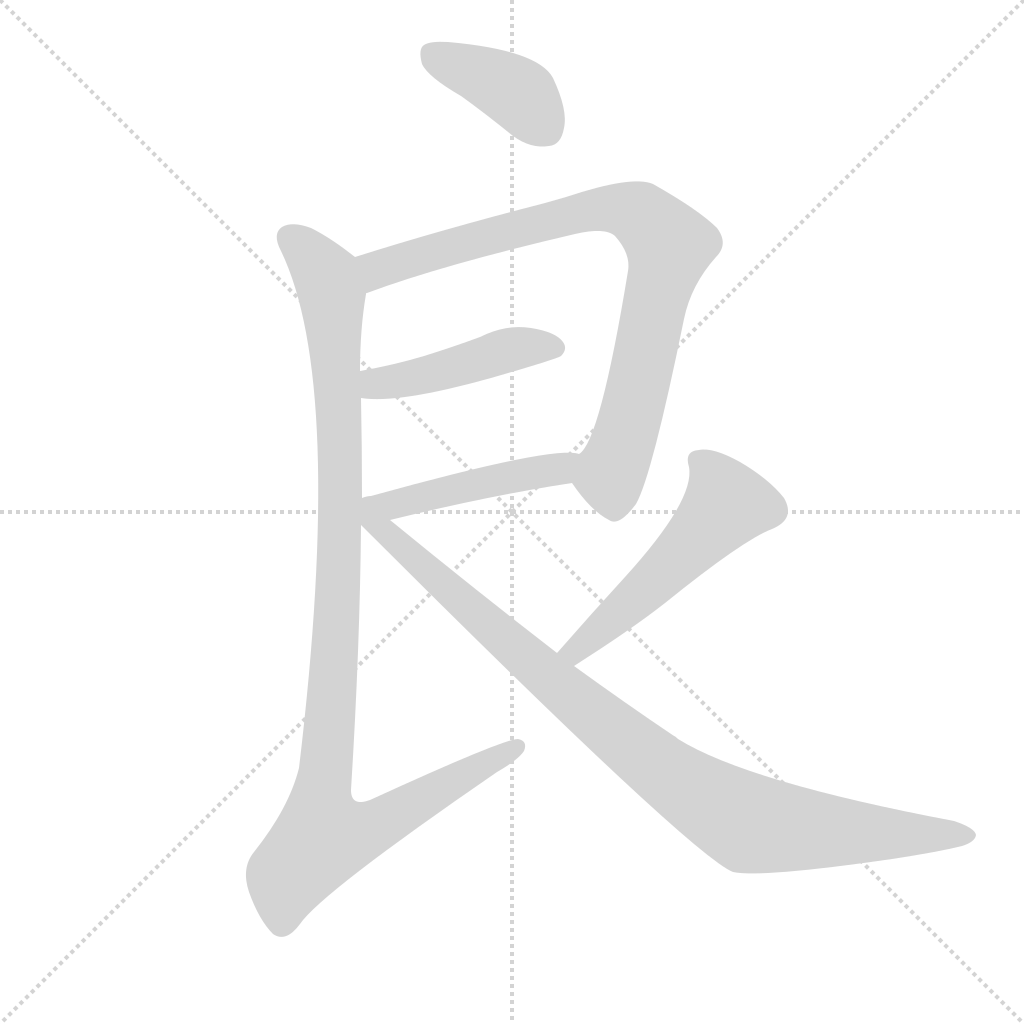
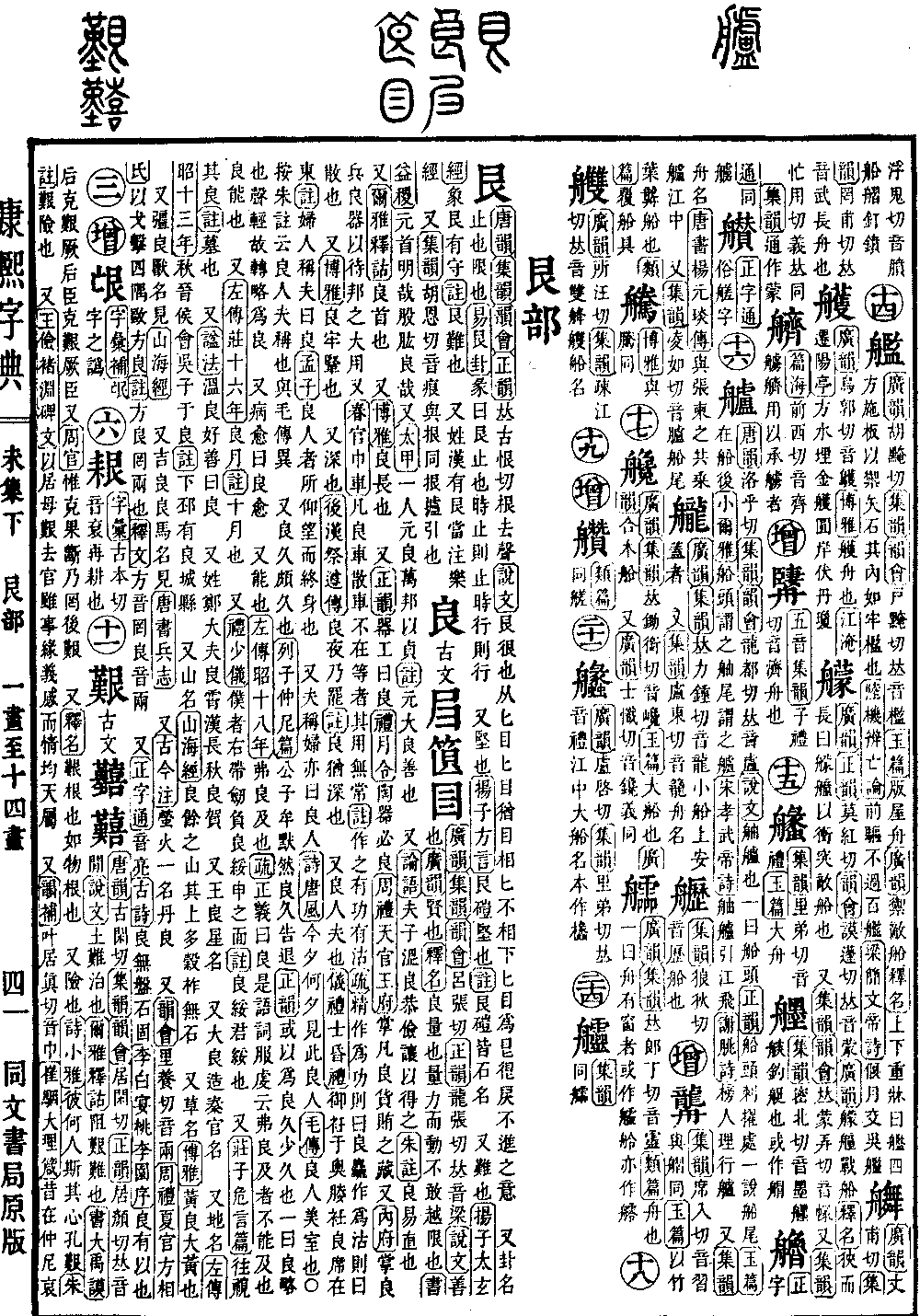
Wei Collection, Lower Volume, Radical: Mound (gèn); Kangxi strokes: 7; Page 1013, Entry 23
Ancient script. According to Extensive Dictionary of Sounds and Meanings (Guangyun) and Collection of Rhymes (Jiyun) and Treasury of Rhymes (Yunhui), the pronunciation is liang (rising tone). According to Correct Rhymes (Zhengyun), the pronunciation is liang. The reading is the same as the word for beam. Explaining Characters and Writing (Shuowen Jiezi) defines it as good. Extensive Dictionary of Sounds and Meanings (Guangyun) defines it as virtuous. Explanations of Names (Shiming) defines it as to measure, meaning to gauge one's own strength before acting, not daring to exceed limits. Book of Documents (Shangshu), section Yi Ji, states: The ruler is virtuous, the ministers are excellent. Furthermore, in the Tai Jia section, it states: The ruler alone is very good, and thus the nations of the world return to the righteous path. Note: Yuan means great. Liang means good. Furthermore, Analects of Confucius (Lunyu) states: The Master attained this through his gentle, good, respectful, frugal, and humble attitude. Zhu Xi's commentary states: Liang means easy-going and upright. Furthermore, Erya, chapter on Explaining Glosses (Shigu), states: Liang means head. Furthermore, Broad Study (Boya) states: Liang means long. Furthermore, Correct Rhymes (Zhengyun) states: Objects crafted with exquisite skill are called liang. Record of Rites (Liji), section Monthly Ordinances (Yueling), states: Earthenware must be of fine quality. Rites of Zhou (Zhouli), section Heaven Official, Royal Treasury, manages the storage of all fine goods. Furthermore, the Inner Treasury manages fine weapons and objects for use in major state affairs. Furthermore, in the section Spring Official, Chariot Steward, it states: All fine carriages and crude carriages, if not within the regulated rank, have no fixed norm for their use. Note: Fine craftsmanship that is effective is called gong; crude craftsmanship is called gu. Commentary: Finely crafted and effective work is called liang. Crude work is called san. Furthermore, Broad Study (Boya) states: Liang means to store, meaning to display. It is also defined as deep. Book of the Later Han (Hou Hanshu), Biography of Ji Zun, states: Stopped only in the deep night. Note: Liang is like the word for deep. Furthermore, liangren refers to a husband. Record of Rites (Yili), section Gentleman's Marriage Ceremony, states: Lay out the mat in the southwest corner of the room; the mat for the bride's attendant is laid to the east of the husband's (liangren) mat. Note: A woman refers to her husband as liang. Mencius states: The husband is the person upon whom a woman relies and to whom she entrusts her life. A husband also refers to his wife as liangren. Book of Odes (Shijing), Tang Odes, states: What kind of night is tonight, to see my good person? Mao Commentary states: Liangren refers to a beautiful wife. Note: Zhu Xi's commentary states that liangren is a term for a husband, which differs from the Mao Commentary. Furthermore, liangjiu refers to a considerable amount of time or a long time. Master Lie (Liezi), section Zhongni, states: Gongzi Mou was silent for a long time, then took his leave and withdrew. Correct Rhymes (Zhengyun) suggests that liangjiu means a short time. One opinion holds that liang means lüe (briefly). The sound is light, so lüe shifted to liang. It is also used to describe recovering from an illness. It is also defined as able. Zuo Commentary (Zuozhuan), Year 18 of Duke Zhao, states: Unable to arrive in time. Commentary: The orthodox meaning is that liang is a modal particle. Fu Qian states: Bu liang ji means cannot reach. Liang means able. Furthermore, Zuo Commentary (Zuozhuan), Year 16 of Duke Zhuang, contains the phrase liang month. Note: This refers to the tenth month. Furthermore, Record of Rites (Liji), section Lesser Rituals (Shaoyi), states: The driver carries a sword on the right side of his body, carrying the rope (liangsui) used by the ruler to mount the chariot, placing the end of the rope in front. Note: Liangsui is the rope used by the ruler to mount the chariot. Furthermore, Zhuangzi, section Lie Yukou, states: To go to see his grave. Note: Liang refers to a grave. Furthermore, Principles of Posthumous Titles (Shifa) states: Being gentle and fond of doing good is called liang. It is also a surname. There was Daifu Liang Xiao in the State of Zheng, and Liang He who served as Changqiu official in the Han Dynasty. There is also Wangliang, which is the name of a star. There is also Daliangzao, which was an official title in the State of Qin. It is also a place name. Zuo Commentary (Zuozhuan), Year 13 of Duke Zhao, states: In autumn, the Duke of Jin met the Viscount of Wu at the place called Liang. Note: There is a Liangcheng County in Xiapi. It is also the name of a mountain. Mountain and Sea Classic (Shanhaijing) states: Liangyu Mountain, where there are many paper mulberry trees and oak trees, and no rocks. It is also the name of a plant. Broad Study (Boya) states: Huangliang is another name for rhubarb. There is also Qiangliang, the name of a wild beast, found in Mountain and Sea Classic (Shanhaijing). There is also Jiliang, the name of a fine horse, found in Tang History (Tangshu), Treatise on Military Affairs. Furthermore, Records of Ancient and Modern Things (Gujin Zhu) states: Fireflies have another name, danliang. Furthermore, Treasury of Rhymes (Yunhui) notes the pronunciation as liang (rising tone). Rites of Zhou (Zhouli), section Summer Official, Fangxiangshi, uses a halberd to strike the four corners of a tomb to drive away the fangliang. Note: Fangliang is wangliang (a mountain spirit). Explanations of Texts: Dialect: Wangliang, pronounced liang. Furthermore, Correct Meaning of Characters (Zhengzitong) notes the pronunciation as liang. Ancient poetry states: Indeed, it is not as solid as a rock. Li Bai's Preface to the Banquet in the Peach and Plum Garden on a Spring Night states: Indeed, there is a reason.
Textual research: In Zhuangzi, section Weiyan, to go to see his grave. According to the original book, this is changed from section Weiyan to section Lie Yukou. To go to see is changed to attempt to see.