Zi Collection, Page Position: Upper
Radical: Dot (zhǔ)
Kangxi Strokes: 19
Page Number: Page 81, Character 04
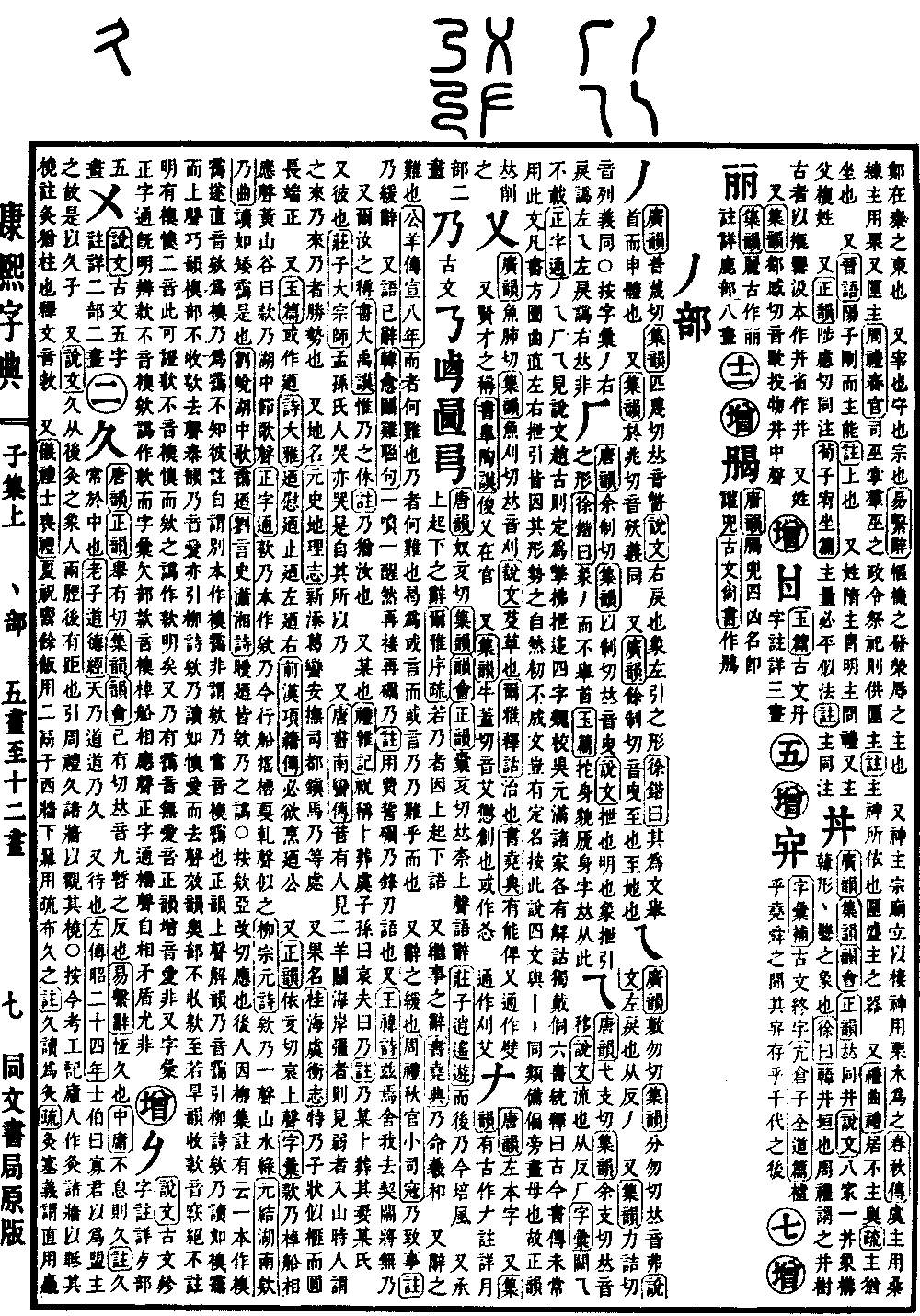
In the Collected Rhymes (Jiyun), the character lì was anciently written as 麗. Detailed notes are found under the Radical: Deer (lù) with eight additional strokes. In ancient script, lì was written as 麗.
According to the Tang Rhymes (Tangyun), Collected Rhymes (Jiyun), Collected Rhymes (Yunhui), and Correct Rhymes (Zhengyun), it is pronounced with the initial l and the final i in the falling tone, sounding like lì. The Explanation of Script (Shuowen) defines it as traveling in a line. It is the nature of deer that when they see food urgently, they must travel together in a line. In the Rhapsody of the Great Man (Daren Fu) by Sima Xiangru, it describes driving a carriage drawn by responding dragons and elephants in a winding and graceful manner. Yan Shigu's commentary notes this refers to the appearance of walking, advancing, and stopping.
The Jade Chapters (Yupian) defines it as a pair. In the Book of Changes (Yijing) under the Dui Hexagram, it mentions linked marshes; the commentary states that lì is like being connected. In the Rites of Zhou (Zhouli) under the Offices of Summer, it mentions a pair of horses for one groom; the commentary explains this means two horses. It also mentions a bundle of silk and a pair of skins; the commentary explains this means two skins. In the Records of the Ages (Shishiji), it is noted that Taihao first established the ritual of marriage using a pair of skins as a gift. The definition here is that lì means an even number.
The Jade Chapters (Yupian) defines it as good. The Expanded Rhymes (Guangyun) defines it as beautiful. In the Songs of Chu (Chu Ci) within the Summoning of the Soul (Zhao Hun), it describes wearing patterned clothes and fine, beautiful garments that are not strange. In the History of the Former Han (Qian Han Shu) in the Biography of Dongfang Shuo, it mentions taking morality as beauty.
The Jade Chapters (Yupian) also defines it as a number. In the Book of Odes (Shijing) within the Greater Odes, it says the descendants of Shang, their number is more than hundreds of thousands. The Expanded Rhymes (Guangyun) defines it as to hit or attach. In the Zuo Commentary (Zuo Zhuan) for the twelfth year of Duke Xuan, it describes shooting an elk and hitting the turtle-shell on a shield; the commentary states that lì means to hit or attach. The Correct Rhymes (Zhengyun) defines it as to be attached to. In the Book of Changes (Yijing) under the Li Hexagram, it says Li means being attached; the sun and moon are attached to the heavens, and the hundred grains, grasses, and trees are attached to the earth. In the Book of Rites (Liji) under the Royal Regulations, it says punishments should be attached to the specific deed; the commentary explains that when penalizing people, the punishment should be attached to the specific act and not influenced by personal joy or anger. It also means to tie or bind. In the Book of Rites (Liji) under the Meaning of Sacrifices, it says on the day of sacrifice, the ruler leads the sacrificial animal, and once inside the temple gate, it is tied to a pillar.
The Jade Chapters (Yupian) defines it as ornate and beautiful. The Correct Rhymes (Zhengyun) defines it as splendid. In the Book of Documents (Shangshu) within the Charge to Bi, it mentions the corrupting influence of luxury and splendor flowing through ten thousand generations. In the Outer Commentary on the Han Version of the Odes (Hanshi Waizhuan), Yuan Xian told Zigong that hiding benevolence and righteousness while wearing splendid furs was something he could not bear to do.
The Jade Chapters (Yupian) also defines it as to bestow or apply. In the Book of Documents (Shangshu) within the Numerous Regions, it mentions being unable to enlighten the people regarding the policies bestowed upon them; the commentary explains that lì means to bestow or apply, referring to being muddled or ignorant.
The Correct Rhymes (Zhengyun) defines it as brightness. It is also a place name. In the Zuo Commentary (Zuo Zhuan) for the thirteenth year of Duke Cheng, it mentions the Jin army crossing the Jing River and returning upon reaching Houli; the commentary notes Houli was in the land of Qin. In the History of the Former Han (Qian Han Shu) within the Geography Gazette, it mentions Huali County in Lelang Commandery. It is also used interchangeably with the character pronounced lì meaning a roof beam, as seen in Liezi. The term Liqiao refers to a high tower; in Zhuangzi, it mentions not standing among the crowds at the high towers. The History of the Former Han (Qian Han Shu) notes that a tower is also called a qiao, thus a beautiful tower is called a liqiao. Liangli is the name of a carriage; in Zhuangzi, it is said that a Liangli carriage can ram a city wall but cannot plug a small hole, illustrating that different tools have different uses. Yuli is the name of a battle formation; in the Zuo Commentary (Zuo Zhuan) for the fifth year of Duke Huan, it mentions Gao Qumi leading the central army in a fish-scale formation. The Correct Rhymes (Zhengyun) also defines it as a small boat. It is also a surname found in the Dictionary of Surnames (Xingyuan). It is a compound surname as well; in the Zuo Commentary (Zuo Zhuan) for the seventeenth year of Duke Cheng, it mentions Duke Li of Jin visiting the Jiangli clan.
According to the Expanded Rhymes (Guangyun), Collected Rhymes (Jiyun), Collected Rhymes (Yunhui), and Correct Rhymes (Zhengyun), it is also pronounced with the initial l and the final i in the level tone, sounding like lí. In the Explanation of Names (Shiming), it says lì means separation; it describes one eye looking at the sky and the other at the ground, where the clarity of the eyes is separated and what is seen is different. It is also part of the name Gaoli, a kingdom; the Records of the Three Kingdoms (Wei Zhi) notes that Gaogouli is east of Liaodong, while the History of the Former Han (Qian Han Shu) writes it as Gaogouli. It is also a mountain name; in the Records of the Grand Historian (Shiji) in the Biography of Qing Bu, it mentions that Bu was formerly a laborer at Mount Li, sometimes written with the horse radical. It is also used interchangeably with the character for oriole, pronounced lí; in the Tokyo Rhapsody (Dongjing Fu) by Zhang Heng, it mentions the orioles chirping, where the ancient character for lì was used interchangeably.
The Collected Rhymes (Jiyun) also records the pronunciation lí. The meaning remains the same. The Collected Rhymes (Jiyun) also records the pronunciation lǐ. Xiao Gai mentions Pengli as the name of a marsh, anciently written as Pengli. It is also pronounced lì, meaning beautiful. The Category Chapters (Leipian) records the pronunciation shī, referring to a name or a process of straining. The Collected Rhymes (Jiyun) also records the pronunciation lì, as a county name.
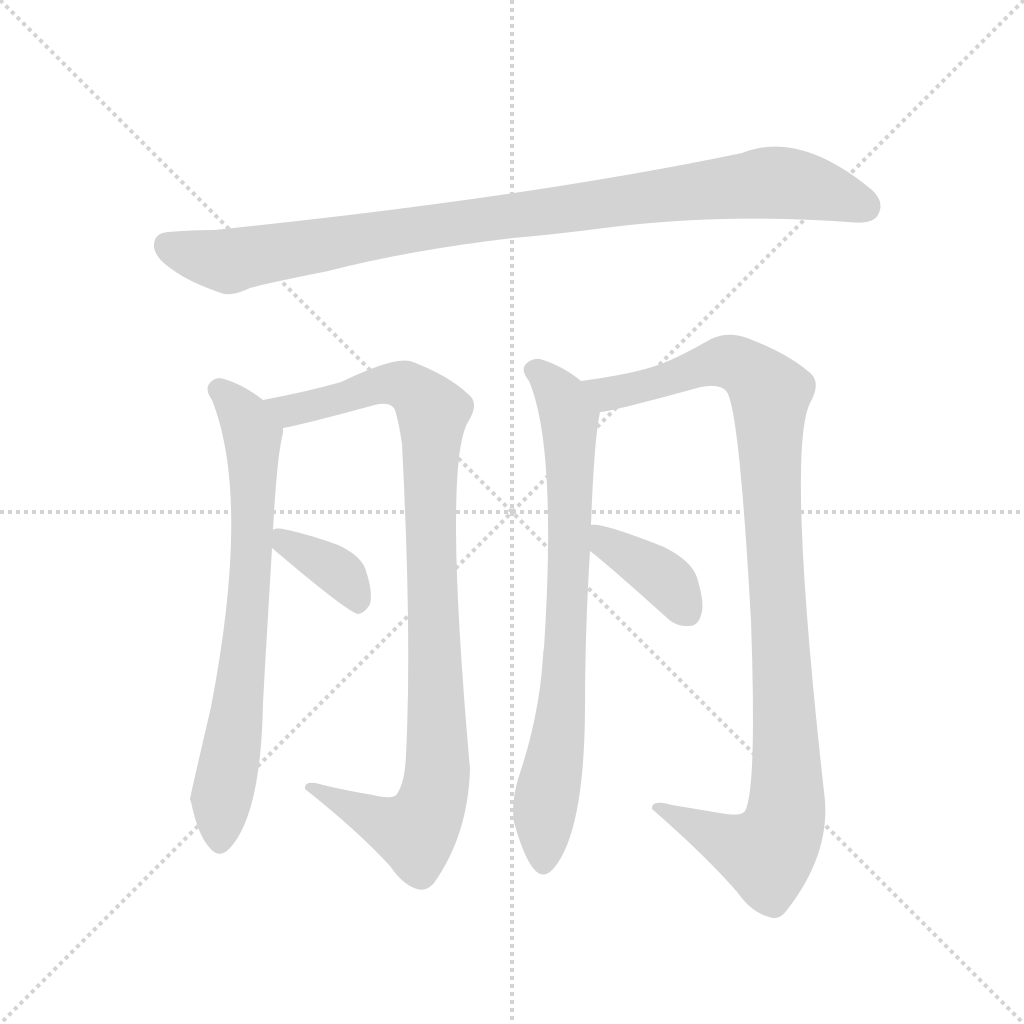
The character is written as 丽; the vulgar form using two sun characters is incorrect. The Correction of the Six Scripts (Liushu Zheng'e) states that 丽 is the ancient form of 麗. It depicts the form of things attached to each other and is borrowed to mean a spouse, pronounced kànglì, though the vulgar form uses a different character with the person radical.
Textual Evidence Corrections: In the Songs of Chu (Chu Ci), the word "clothing" should be added before "fine and beautiful." In the Zuo Commentary (Zuo Zhuan), the character for "formation" should be corrected to the alternative form used in the original text.