Zi Collection, Page Position: Lower
Radical: Ice (bīng)
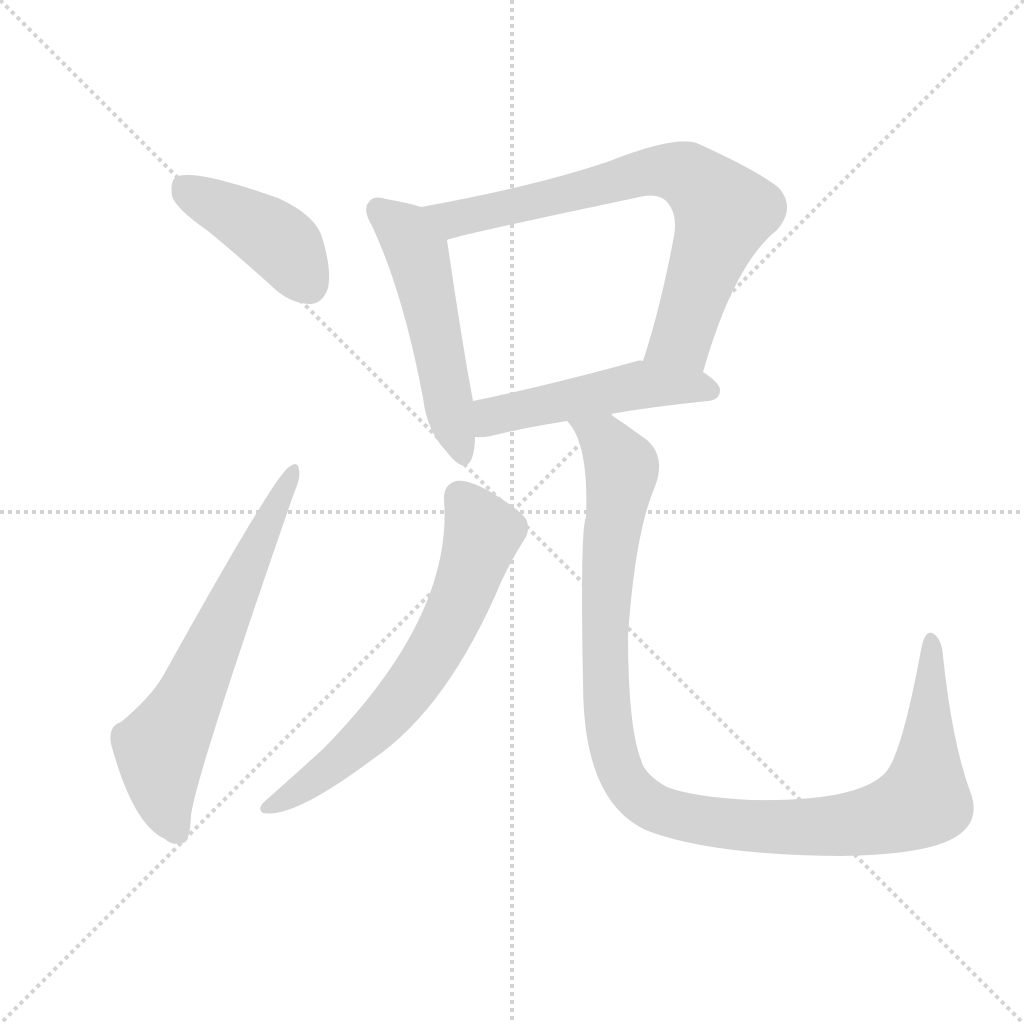
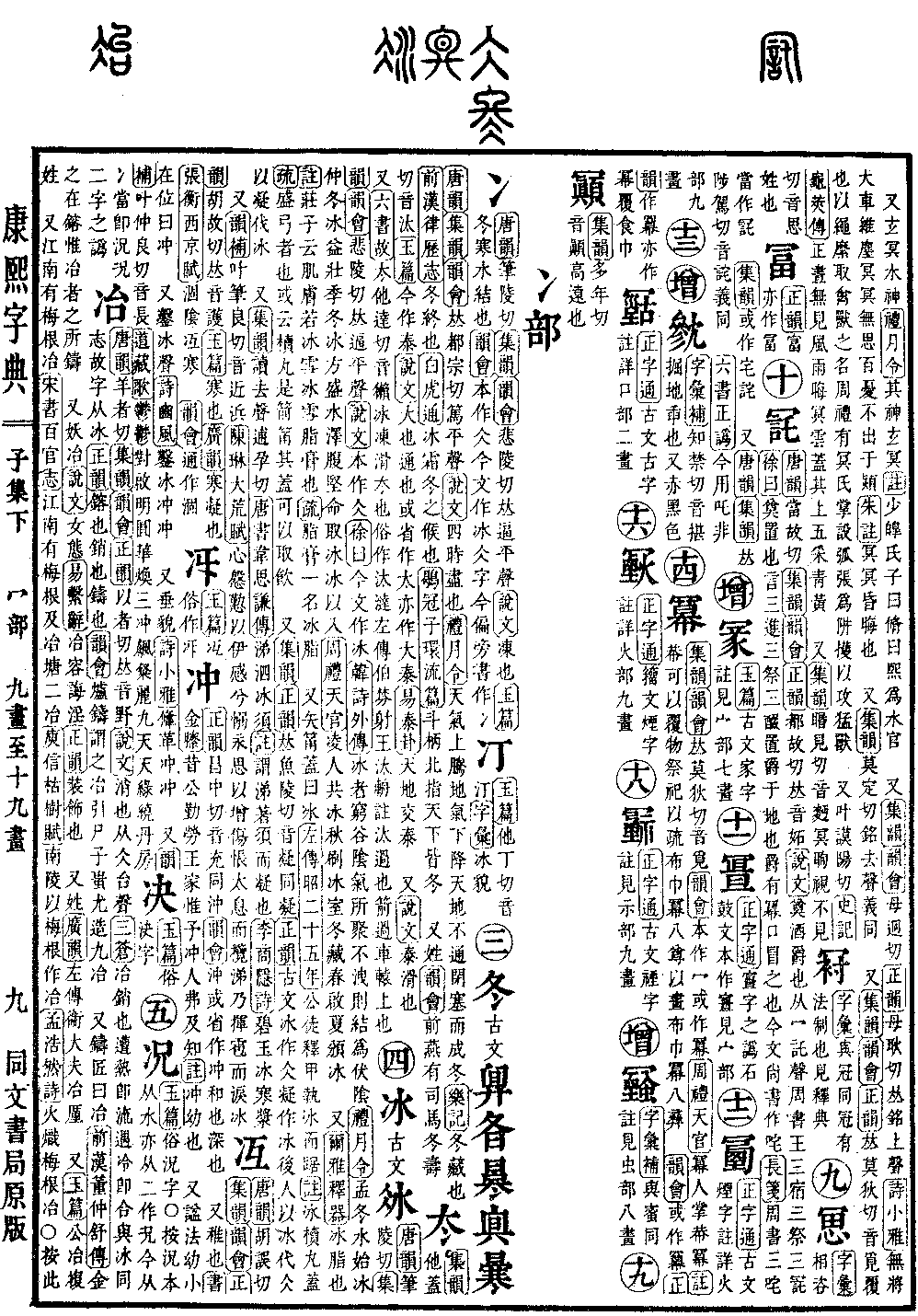
Entry: Kuàng
Kangxi Dictionary Strokes: 9
Page: Page 131, Entry 30
[Yùpiān] states this is a common variant of the character "kuàng". Note: The character "kuàng" originally comes from "water" and is also written with "two" and "person" (kuàng). This character, from "ice", is likely a corruption from the transmission of the characters "kuàng" and "kuàng". The character "kuàng" is composed of "two" and "brother".
[Guǎngyùn], [Jíyùn], [Yùnhuì], [Zhèngyùn] provide the pronunciation as "xū fàng qiè", which sounds the same as "kuàng". It is an introductory particle. In the "Book of Odes (Shijing)", "Book of Odes, Minor Odes, Daya" there is the phrase "kuàng yě yǒng tàn" (况也永叹). It is composed of "two" and "brother", slightly different from the character "kuàng". It is also borrowed to represent the character "zhù". In the "Han Dynasty, Lu Xiang's Stele Visiting Confucius' Temple" (Hàn·Lǔxiāng Yè Kǒngmiào Bēi), "zhù jī" (祝基) is written as "kuàng jī" (况其). The character "kuàng" is composed of "two" and "brother", and here it is used to replace the character "zhù".
The ancient script for "kuàng" [Tángyùn] provides the pronunciation as "xǔ fǎng qiè", [Jíyùn], [Yùnhuì], [Zhèngyùn] provide the pronunciation as "xǔ fàng qiè", sounding the same as "kuàng". [Shuōwén Jiězì] explains it as: cold water. It also means "moreover" and "for example". In "Zhuangzi", "Book of the South", "Knowing the North" (Zhuāngzǐ·Zhīběi Yóu), there is "měi xià yù kuàng" (每下愈况). It also means "even more". In "Guoyu", "Jin Sayings" (Guóyǔ·Jìn Yǔ), there is "zhòng kuàng hòu zhī" (众况厚之). It also means "this" or "here". In the "Book of Odes (Shijing)", "Book of Odes, Minor Odes, Daya" (Shījīng·Xiǎoyǎ), "kuàng yě yǒng tàn" (况也永叹). [Zhèng Xuán's Commentary] explains it as: one can only sigh at this. It also means "to grow". In the "Book of Odes (Shijing)", "Book of Odes, Major Odes, Daya" (Shījīng·Dàyǎ), "luàn kuàng sī xuē" (乱况斯削). It also means "to bestow". It is interchangeable with the character "kuàng". In the "Book of Han, Annals of Emperor Wu" (Qiánhàn Shū·Wǔdì Jì), "zāo tiāndì kuàng shī, zhù jiàn jǐngxiàng" (遭天地况施,著见景象). It also refers to a visit from an elder as "lái kuàng" (来况). In [Sīmǎ Xiàngrú, Zǐ Xū Fù] (Sīmǎ Xiàngrú·Zǐxū Fù), "zúxià bù yuǎn qiānlǐ, lái kuàng qí guó" (足下不远千里,来况齐国). Also, [Guǎngyùn] records "xiū kuàng" (修况), which is the name of a type of zither. It is also a surname. In the "Records of the Three Kingdoms, Shu Annals" (Sānguó Zhì·Shǔ Zhì), there is a person named Kuàng Chángníng (况长宁). According to the "Pei Xi Ji" (Pèi Xī Jí), "kuàng", "kuàng", and "kuàng" are all pronounced "xū fǎng qiè", with "kuàng" being an introductory particle, "kuàng" referring to cold water, and "kuàng" referring to the state of affairs. Nowadays, the character "kuàng" is mostly used universally. Also, [Jíyùn] records that it is sometimes written as "huáng" (湟). In ancient times, it was also interchangeable with the character "xiōng" (兄).