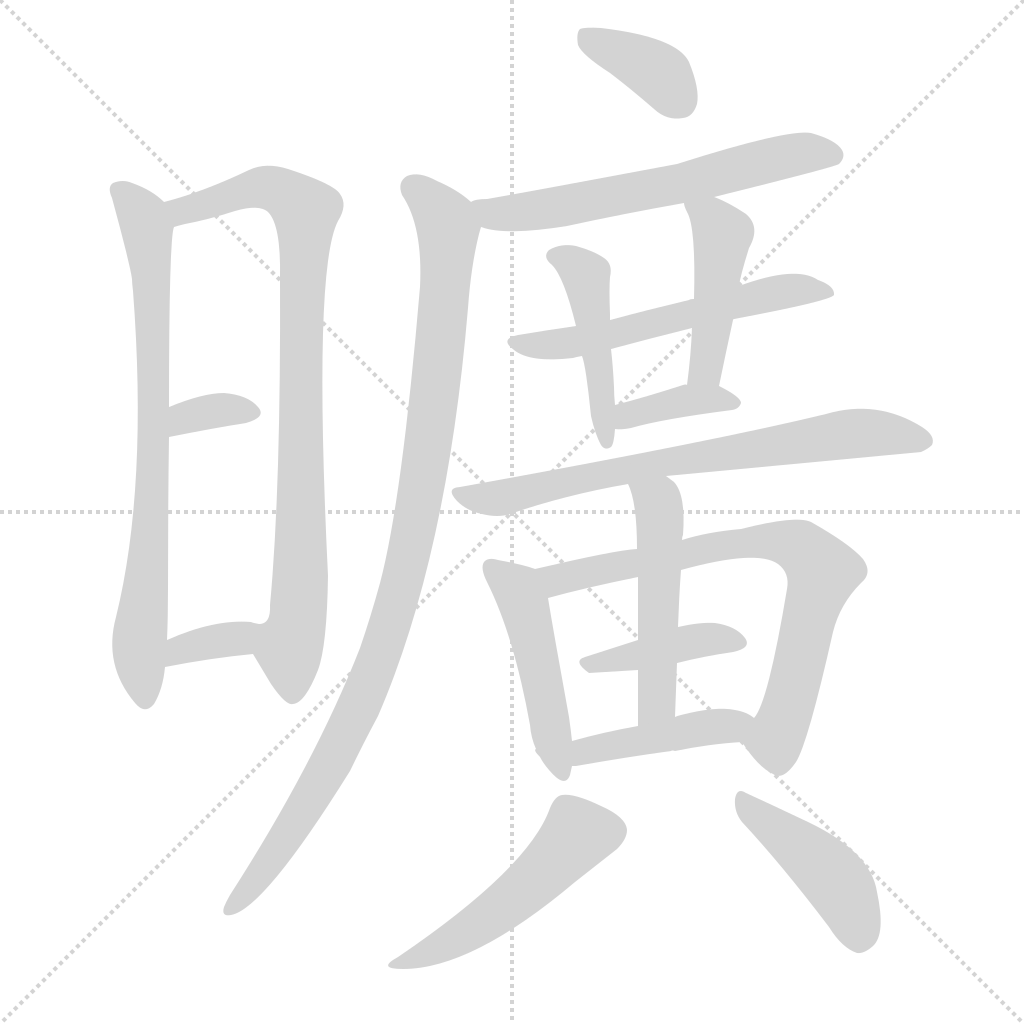
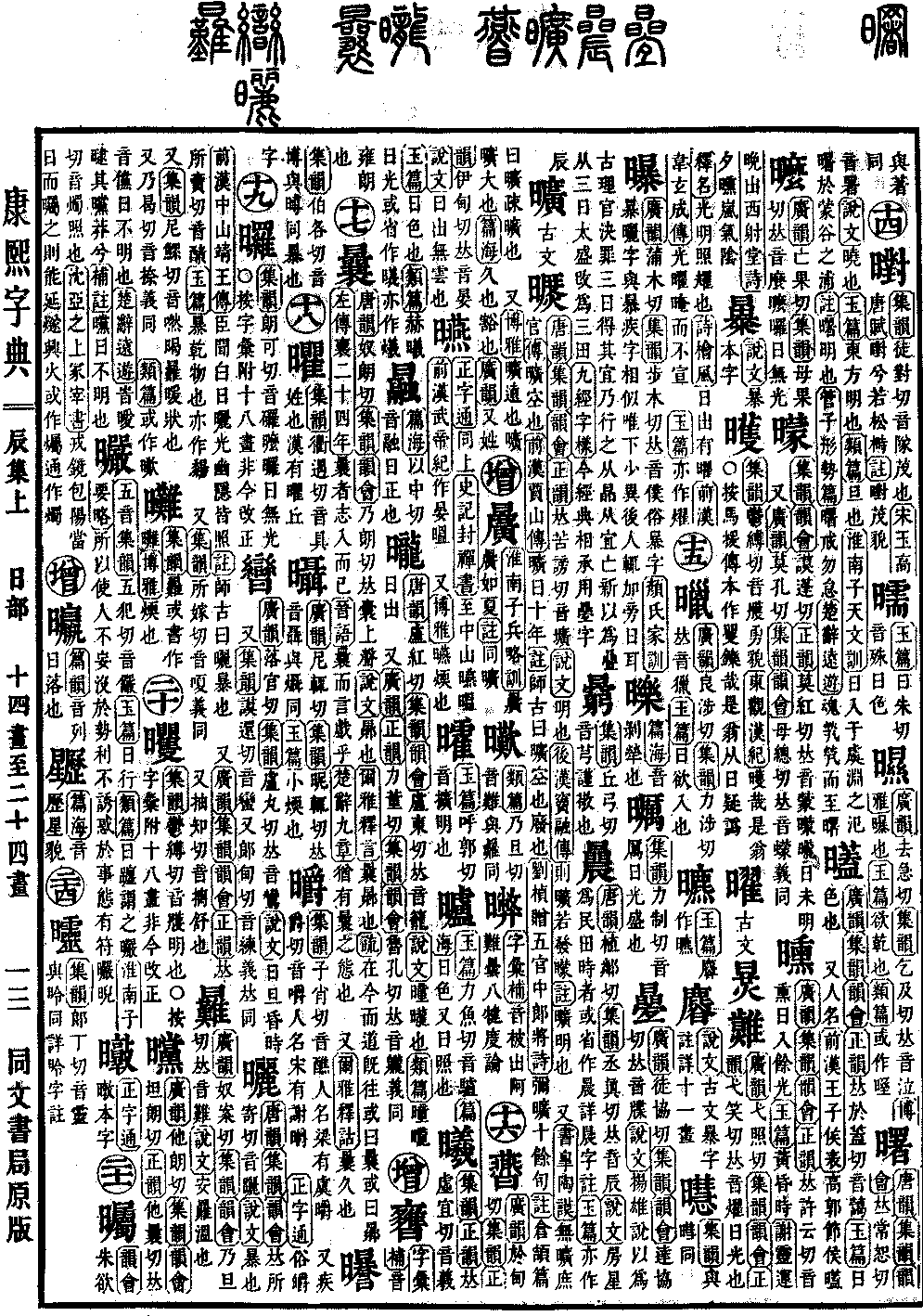
Chen Collection, Upper Volume
Radical: Sun (rì)
Kangxi Strokes: 19
Page 501, Entry 24
Ancient textual records:
According to Tang Rhymes (Tangyun), Collected Rhymes (Jiyun), Rhyme Compilation (Yunhui), and Correct Rhymes (Zhengyun), it is pronounced kuang (falling tone); the pronunciation is the same as the character for tomb.
Shuowen Jiezi defines it as meaning bright.
Book of the Later Han (Hou Hanshu), Biography of Dou Rong: "Then it is as bright as uncovering the ignorant." The commentary explains "kuang" as meaning bright.
Also, in the Book of Documents (Shangshu), Chapter of Gao Yao Mo: "Do not leave the various offices vacant." The commentary explains "kuang" as meaning vacant or idle.
Book of the Former Han (Qian Hanshu), Biography of Jia Shan: "Wasting days for ten years." The commentary by Shigu explains: "kuang" means to leave empty or to neglect.
Liu Zhen, Poem presented to the Commander of the Five Officials: "It has been empty for more than ten decades." The commentary cites the Cangjie Pian, which states: "kuang" means distant or separated.
Also, the Boya defines "kuang" as meaning remote. "Kuang kuang" means vast. The Pianhai defines it as long-lasting or open and spacious.
Guangyun records: It is also used as a surname.