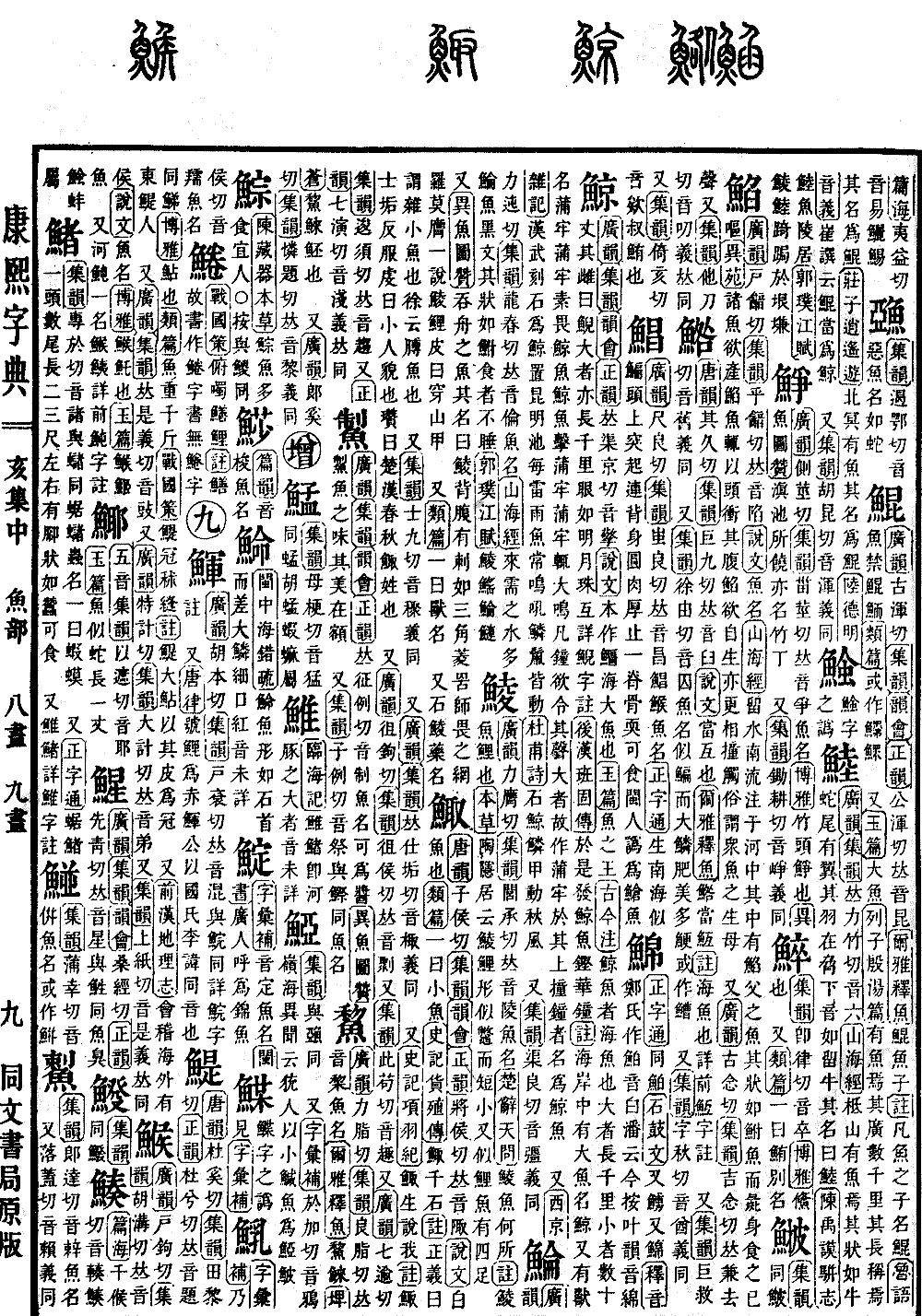
Hai Collection, Middle Volume
Radical: Fish (yú)
Whale; Kangxi strokes: 19; Page 1473, Entry 01
In Guangyun, Jiyun, Yunhui, and Zhengyun, the pronunciation is qing.
In Shuowen, it was originally written as a variant form; it is a large sea fish.
In Yupian, it is the king of fish.
In Gujin Zhu, the whale is a sea fish. Large ones are one thousand li long, and small ones are several tens of zhang. The female is called ni, and large ones are also one thousand li long, with eyes like bright moon pearls. Refer to the note under the character ni for further details.
In the Biography of Ban Gu from the Book of the Later Han (Hou Hanshu), it states: Then the whale was sounded, and the magnificent bell resonated. The commentary notes that there is a large fish in the sea named whale. There is also a beast named pulao. The pulao has a natural fear of the whale; when the whale attacks the pulao, the pulao cries out loudly. Since one wants the sound of a bell to be loud, the top is fashioned in the shape of a pulao, and the striker for the bell is called a whale.
In Xijing Zaji, it states: Emperor Wu of Han had a whale carved from stone and placed in the Kunming Pond; whenever there was thunder and rain, the fish would roar, and its scales and mane would all move.
In a poem by Du Fu: The stone whale's scales and armor stir in the autumn wind.
In Jiyun, it is pronounced qiang. The meaning is the same.