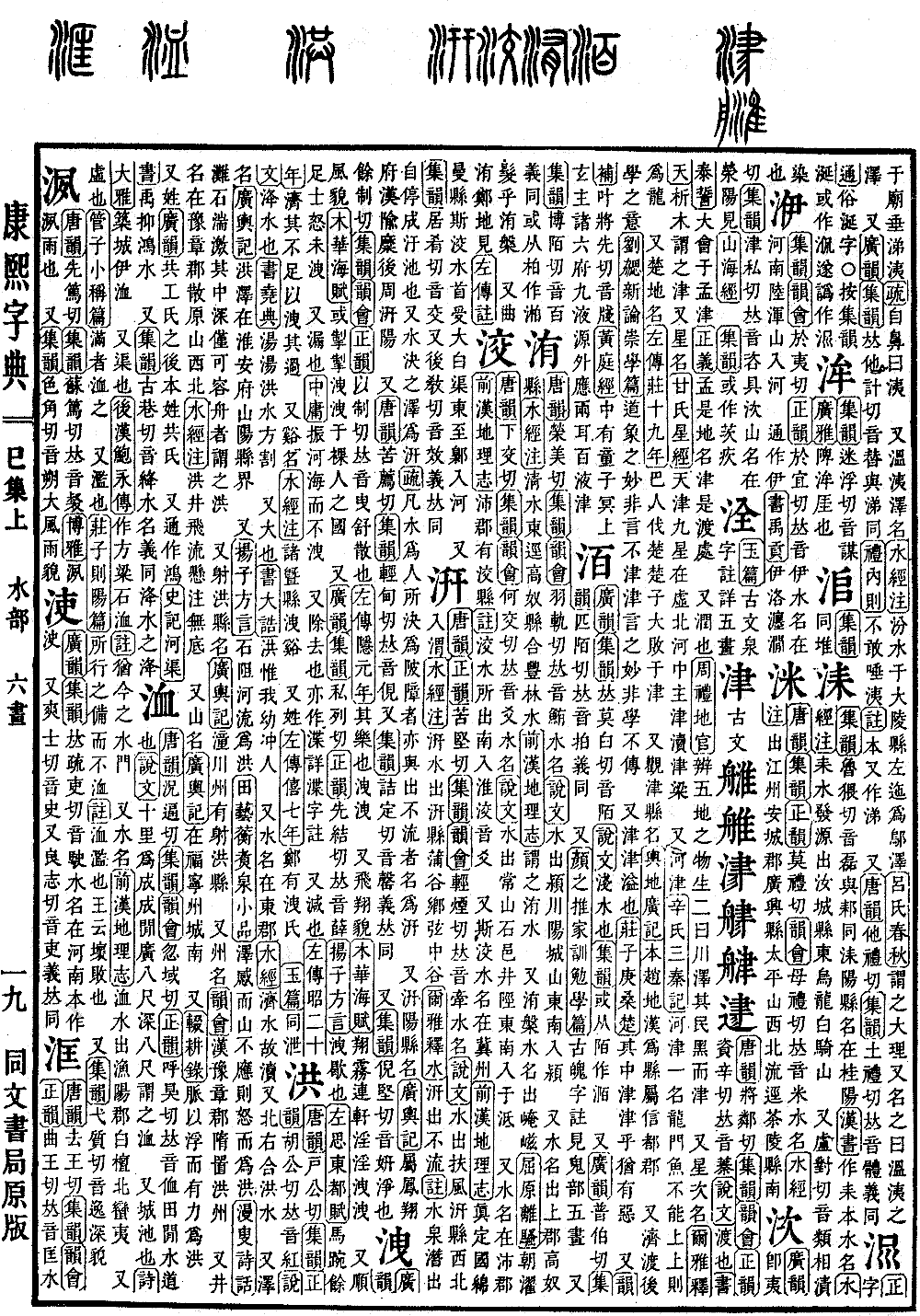
Si Collection, Upper Volume
Radical: Water (shuǐ)
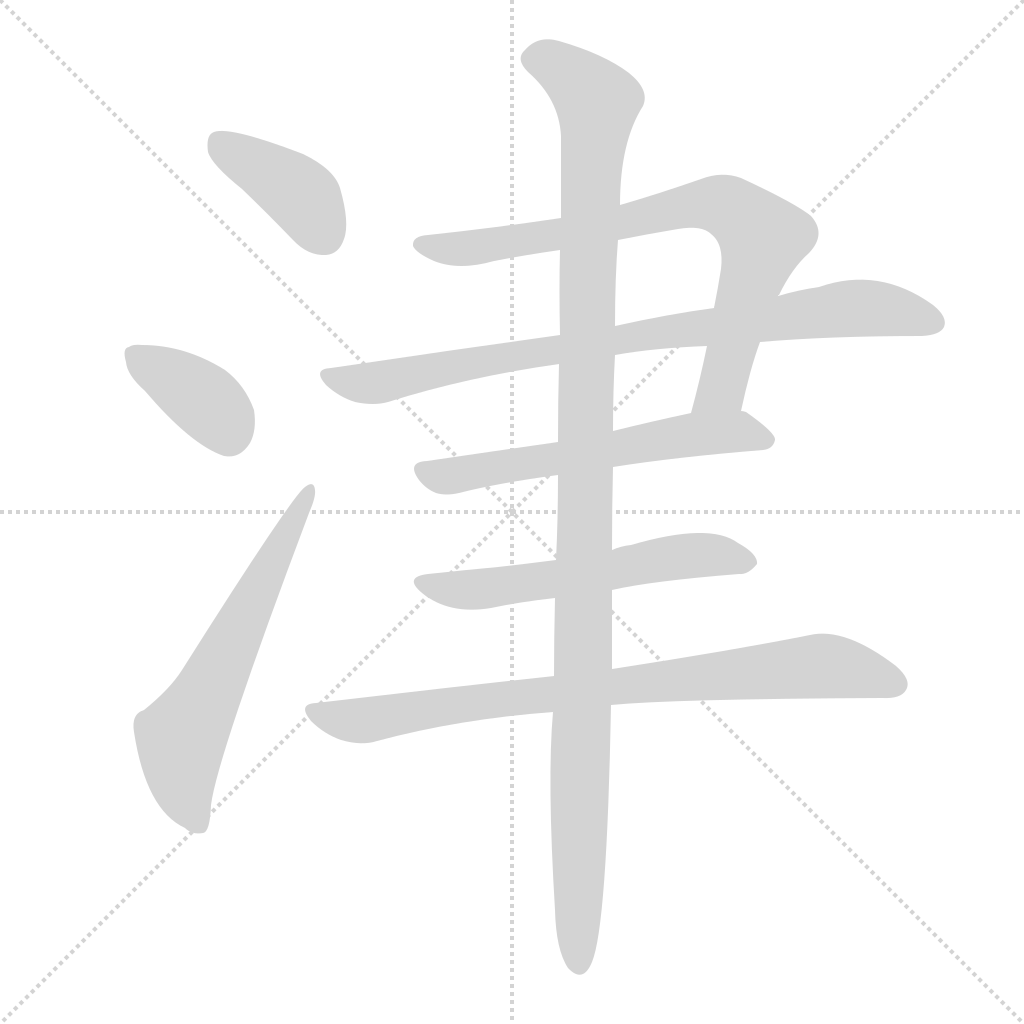
津
Kangxi strokes: 10
Page 621, Entry 09
Ancient form. Pronounced zhen.
According to the Explaining and Analyzing Characters (Shuowen), it means to cross a river.
Book of History (Shangshu), chapter Great Oath (Taishi): They gathered at Mengjin.
Commentary (Zhengyi): Meng is the name of a place, and jin is a river crossing.
Also means to moisten or enrich.
Rites of Zhou (Zhouli), Earth Officer: Distinguishing the products of the five types of land, the second is river marshland, whose people are dark-complexioned and moist (jin).
Also the name of a star division.
Erya, Explanation of the Heavens (Shitian): The division of wood is called the ford (jin).
Also a star name.
Gan's Star Classic (Ganshi Xingjing): There are nine stars in Heavenly Ford (Tianjin), located north of Void (Xu) in the middle of the river, governing fords and waterways, and bridges.
Also refers to the River Ford.
Xin's Account of the Three Qin (Xinshi Sanqinji): The River Ford is also known as the Dragon Gate; fish cannot ascend it, but if they do, they become dragons.
Also a place name in the state of Chu.
Zuo Commentary (Zuozhuan), 19th Year of Duke Zhuang: The people of Ba attacked Chu, and the Viscount of Chu was soundly defeated at Jin.
Also Guan-jin, a county name.
Universal Geography (Yudi Guangji): Originally land of Zhao, it became a county during the Han dynasty, belonging to Xindu Commandery.
Also refers to the meaning of providing aid or guiding those who follow in learning.
Liu Xie, New Discourses (Xinlun), Chapter on Respecting Learning: The subtlety of the image of the Dao is not conveyed without words; the subtlety of words is not transmitted without learning.
Also jin-jin, the appearance of being full or overflowing.
Zhuangzi, Gengsang Chu: Within it, there is still an overflowing (jin-jin) of malice.
Also, in the Rhyme Supplement (Yunbu), rhyming with jian.
Yellow Court Classic (Huangtingjing): Within are divine youths in the dark upper palace, presiding over the sources of the six internal organs and nine fluids, externally corresponding to the hundred fluids and moisture (jin) of the two ears.