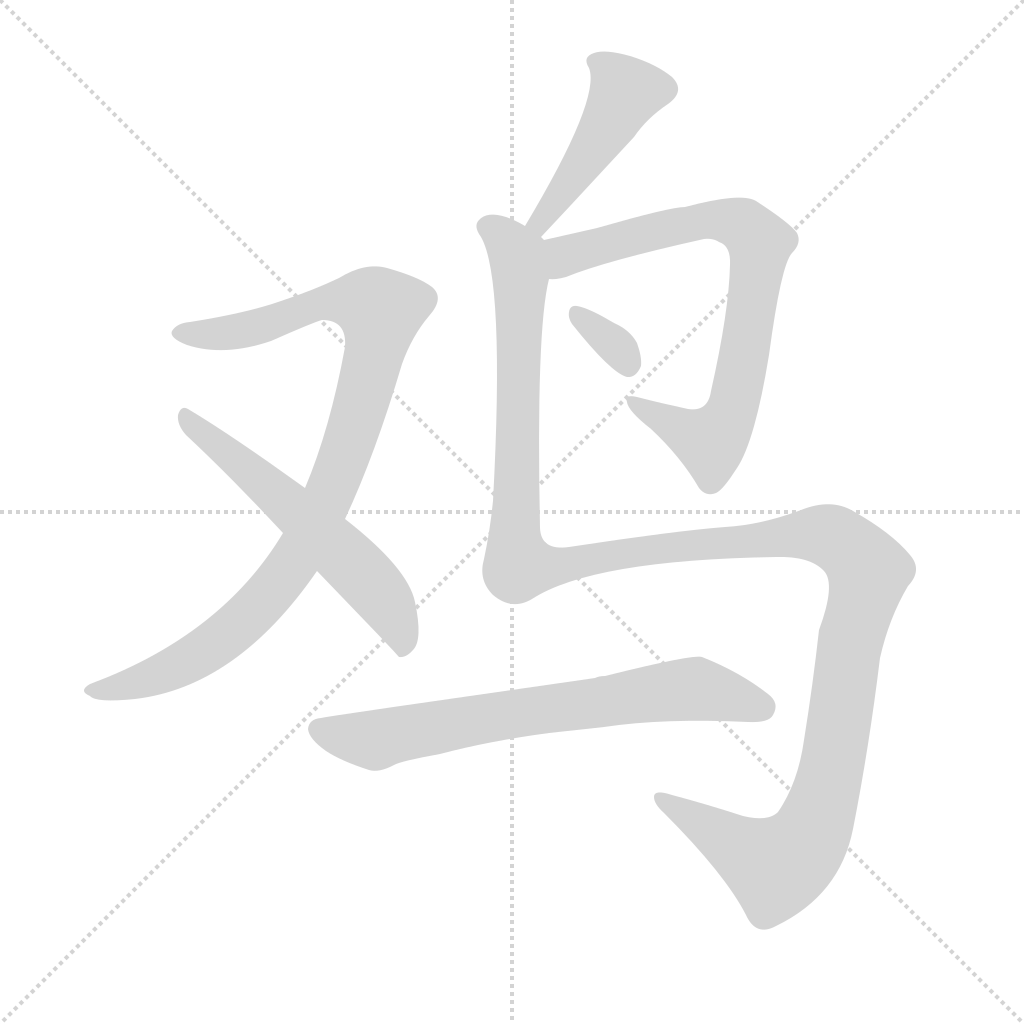
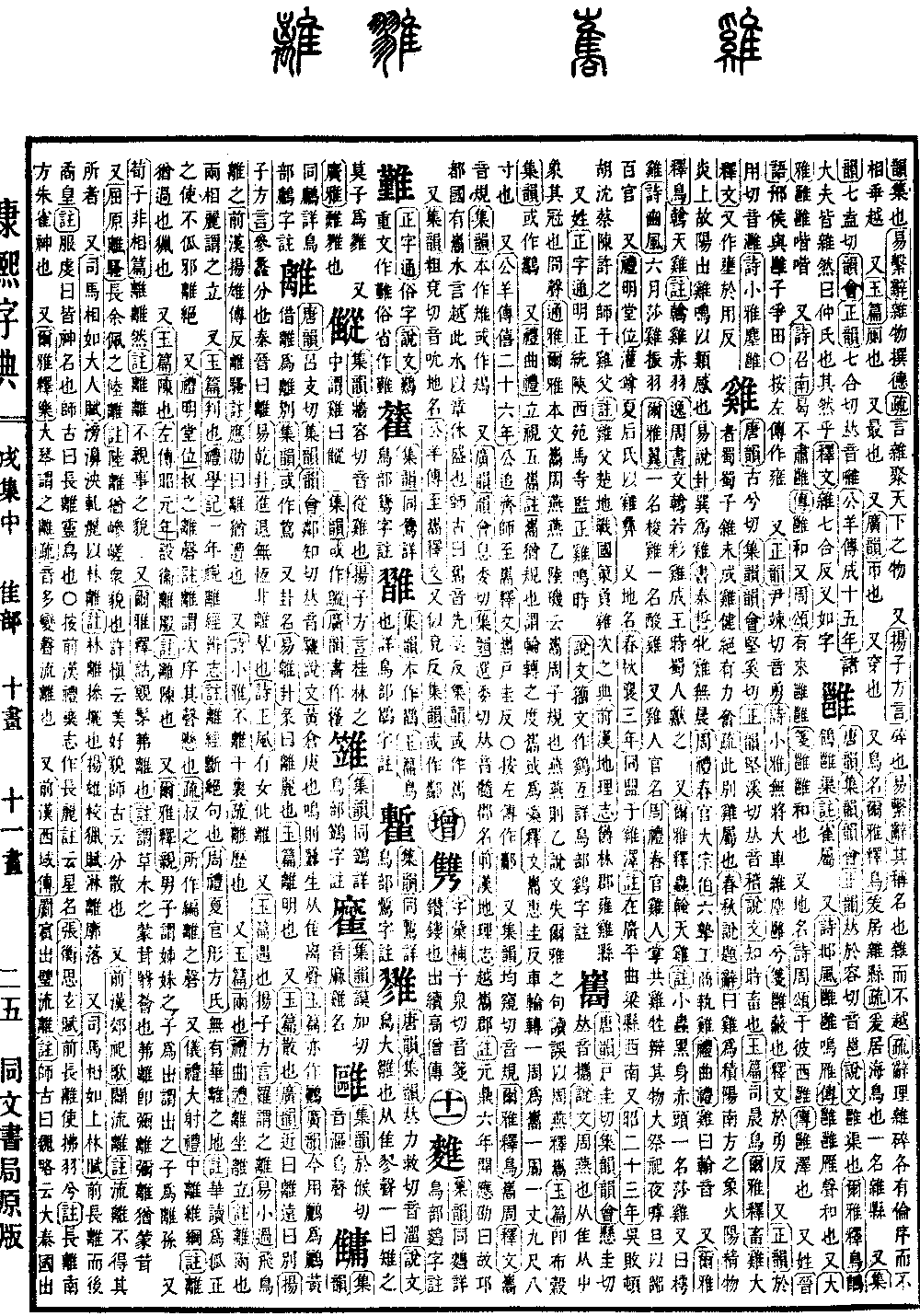
Xu Collection, Middle Volume
Radical: Short-tailed bird (zhuī)
Kangxi stroke count: 18
Page 1369, Entry 01
Pronounced ji.
According to the Shuowen Jiezi (Analytical Dictionary of Characters), it is a domestic animal that knows the time. According to the Yupian (Jade Chapters), it is a bird that announces the dawn.
According to the Erya (Approaching Elegance), commentary on livestock: a large chicken is called shu. The young of a shu is called yu, an immature chicken is called lian, and an especially strong and powerful one is called fen. The sub-commentary states that these are distinctions of chicken categories.
The Chunqiu Shuotici (Explications of the Spring and Autumn Annals) states: The chicken is a creature that accumulates yang energy and is a symbol of the south. Fire is the essence of yang, and flames rise upward, so when yang energy emerges, the chicken cries out; this is due to the mutual resonance of like entities.
The I Ching (Book of Changes), Commentary on the Trigrams: The Xun trigram represents the chicken.
The Book of Documents (Shujing), Oath at Tai: A hen is not responsible for announcing the dawn.
The Rites of Zhou (Zhouli), Spring Offices, Grand Master of Ceremonies: For the six kinds of formal meetings, craftsmen and merchants use chickens as gifts.
The Book of Rites (Liji), Qu Li: The chicken is known as the voice of the brush.
According to the Erya (Approaching Elegance), commentary on birds: han is the celestial chicken. The commentary notes that the han chicken has red feathers.
The Yizhoushu (Lost Book of Zhou): The wenhan resembles a colorful chicken; the people of Shu presented it during the reign of King Cheng of Zhou.
According to the Erya (Approaching Elegance), commentary on insects: han is the celestial chicken. The commentary notes it is a small insect with a black body and red head, also known as the sha chicken, or the chu chicken.
The Book of Odes (Shijing), Binfeng: In the sixth month, the sha chicken vibrates its wings.
The Eryayi (Wing of the Erya): Also called the suo chicken. Also called the suan chicken.
Also, the Chicken Official is an official title. The Rites of Zhou (Zhouli), Spring Offices, Chicken Official: In charge of providing sacrificial chickens, identifying their categories, and calling out the dawn during major sacrifices to awaken the various officials.
The Book of Rites (Liji), Mingtangwei: As for the wine vessels used for libations, the Xia dynasty used the chicken sacrificial vessel.
It is also a place name. The Spring and Autumn Annals (Chunqiu), third year of Duke Xiang: A covenant was held at Jize. The commentary notes it is located southwest of Quliang County in Guangping.
Also, the twenty-third year of Duke Zhao: The state of Wu defeated the armies of the states of Dun, Hu, Shen, Cai, and Xu at Jifu. The commentary notes that Jifu is a place name in the state of Chu.
The Strategies of the Warring States (Zhanguo Ce): Carrying the tradition of Jici.
The Book of Han (Hanshu), Treatise on Geography: Yulin Commandery has Yongji County.
It is also a surname. The Zhengzitong (Correction of Characters): During the Zhengtong era of the Ming dynasty, there was an official named Ji Mingshi in the Shaanxi Imperial Horse Bureau.
The Shuowen Jiezi (Analytical Dictionary of Characters): The ancient script form is written as shown in the Bird radical, Ji. Detailed information can be found in the commentary on the character Ji under the Bird radical.
Textual research: According to the Erya, commentary on livestock: a large chicken is a shu. The young of a shu is a yu, and an immature chicken is a lian. The original text has been corrected from the character for strong to the character for lian.
The Book of Han (Hanshu), Treatise on Geography: Yulin Commandery, Yongji County. The original text has been corrected from the character for melancholy to the character for Yulin.