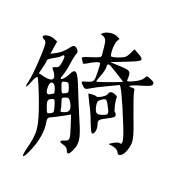
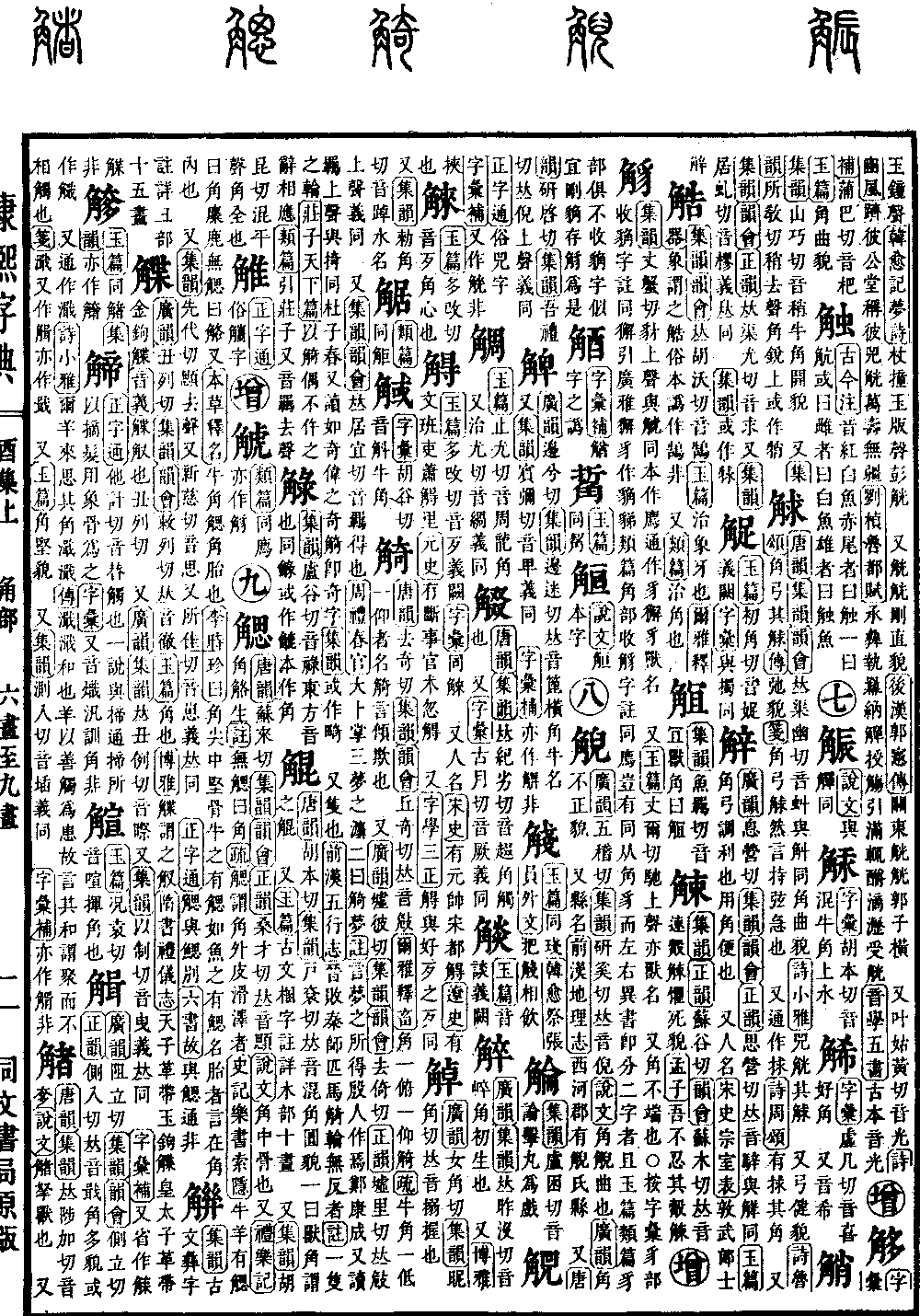
You Collection, Upper Volume
Radical: Horn (jiǎo)
Kangxi Strokes: 15
Page 1143, Entry 31
Tang Rhyme (Tang Yun): Pronounced qi (falling tone).
Collected Rhymes (Jiyun) and Rhyme Collection (Yunhui): Pronounced qi (level tone).
Erya: Explaining Domestic Animals (Erya: Shichu): If one horn points down and one points up, it is called qi.
Commentary: When a bull's horns are one lowered and one raised, it is called qi, which means tilted or unbalanced.
Also, Guang Rhyme (Guang Yun): Pronounced bi (rising tone).
Collected Rhymes (Jiyun) and Rhyme Collection (Yunhui): Pronounced qi (rising tone).
Correct Rhymes (Zhengyun): Pronounced bi (rising tone).
Meaning is the same.
Also, Collected Rhymes (Jiyun) and Rhyme Collection (Yunhui): Pronounced ji (level tone).
To obtain.
Rites of Zhou: Spring Officials (Zhouli: Chunguan): The Grand Diviner manages the methods of the three dreams, the second of which is the qi dream.
Commentary: Refers to what is obtained from a dream; the Yin people practiced this.
Zheng Kangcheng also reads this with a rising tone, equivalent to ji.
Du Zichun reads it like the qi in qiwei (extraordinary/magnificent); qi is simply the character for extraordinary.
Collected Rhymes (Jiyun): Sometimes written in a variant form (ji).
Also means single.
Book of Han: Records of the Five Phases (Qianhan: Wuxingzhi): When Jin defeated the Qin army, not a single horse or a single wheel returned.
Commentary: A single wheel.
Zhuangzi: Under Heaven Chapter (Zhuangzi: Tianxiapian): Responding with words that are singular, paired, and incompatible.
Classified Chapters (Leipian): Citing Zhuangzi, also pronounced ji (falling tone).