Xu Collection, Middle Volume
Radical: Mound (fù)
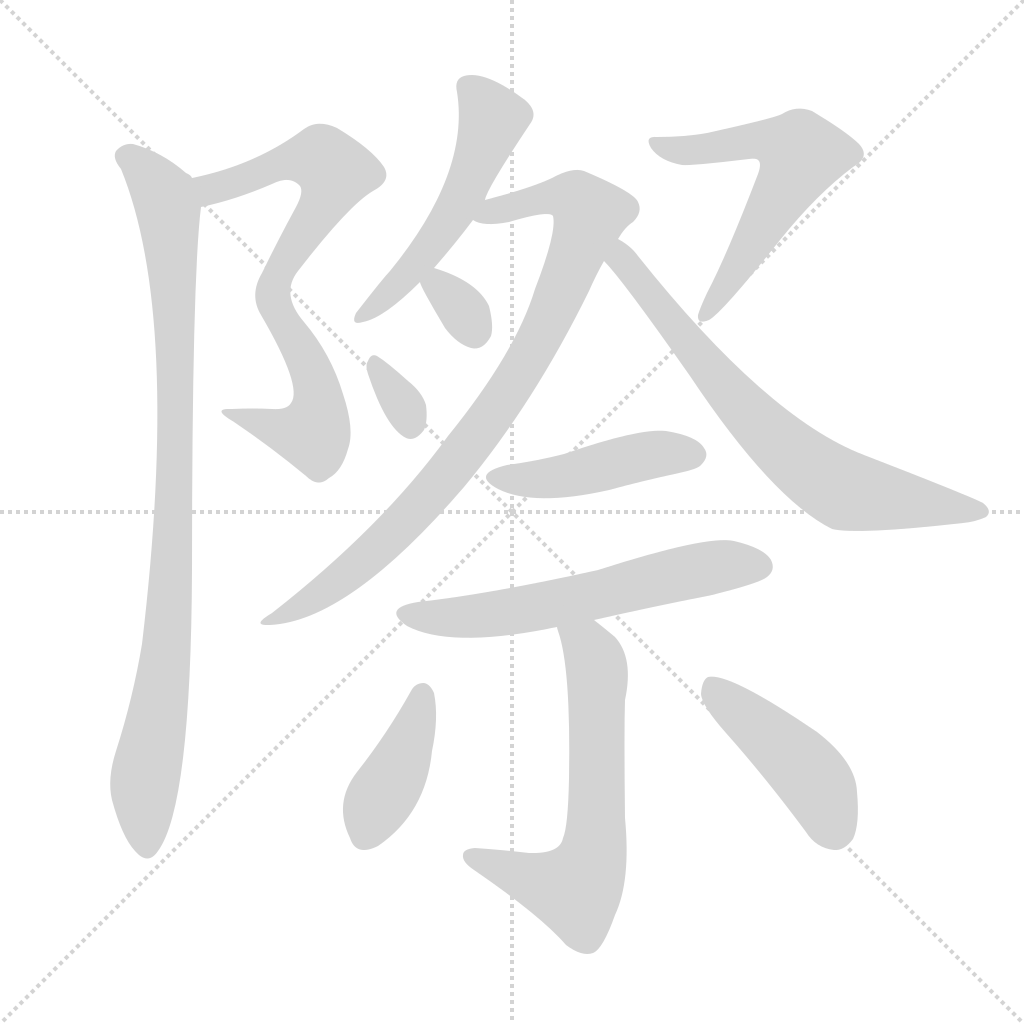
际
Kangxi stroke count: 19; Page number: 1359, item 28
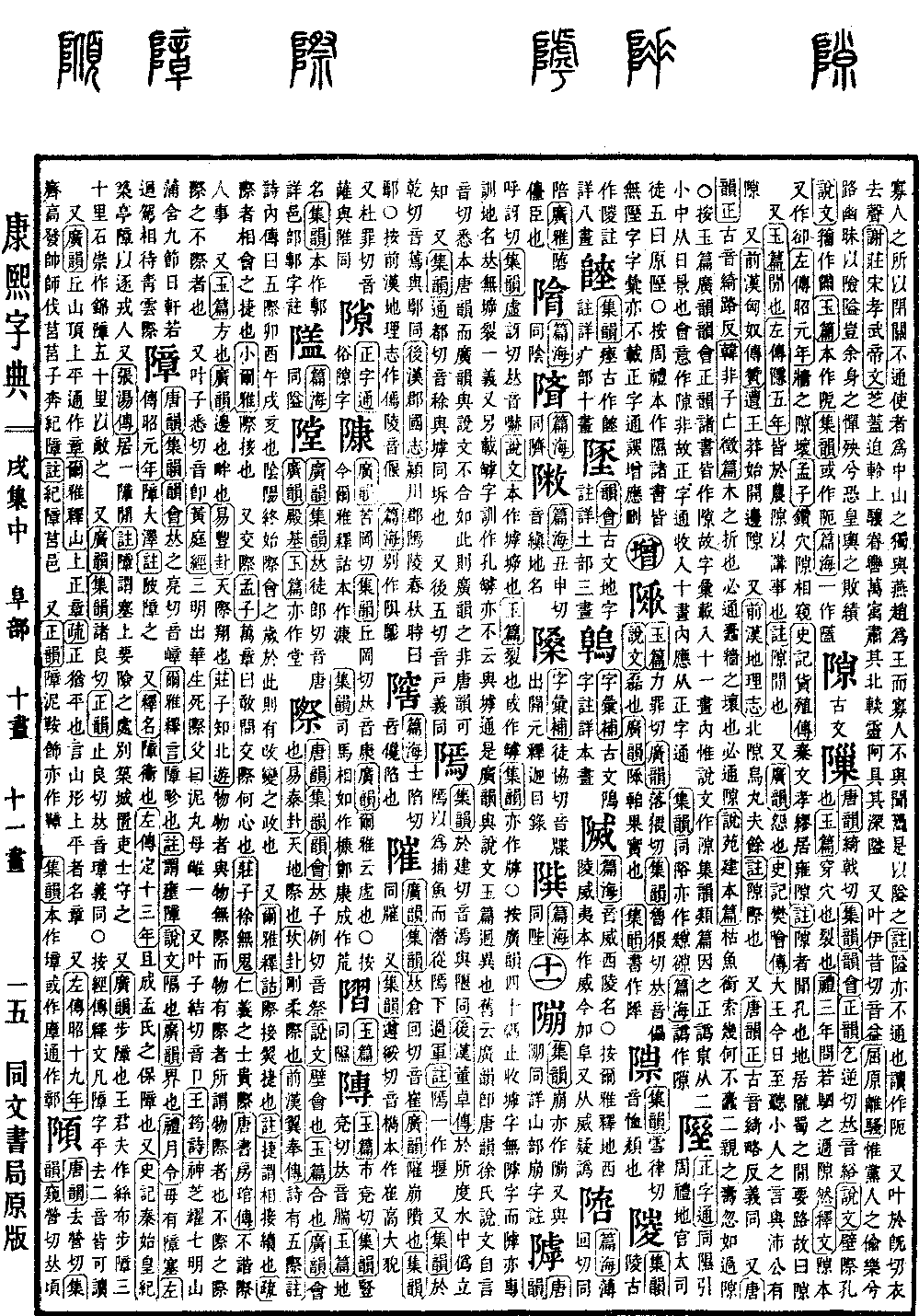
From Tang Rhymes (Tangyun), Collected Rhymes (Jiyun), and Rhyme Conventions (Yunhui): pronounced zǐ lì qiè, sounding like jì. In Explaining and Analyzing Characters (Shuowen Jiezi), it means 'where walls meet'. The Jade Chapters (Yupian) states: 'to join'. The Vast Rhymes (Guangyun) states: 'to meet'. In the 'Peace' hexagram of the Classic of Changes (Yijing): 'where heaven and earth meet'. In the 'Gorge' hexagram: 'where the firm and the yielding meet'. From the Biography of Yi Feng in the Book of Han (Hanshu): 'The Book of Odes (Shijing) speaks of the Five Junctures'. The commentary states that the Inner Commentary to the Odes (Shi Neizhuan) says: 'The Five Junctures are the years mao, you, wu, xu, hai. These are the years when yin and yang reach their beginning and end, and meet, at which point there are changes in governance'. Also, from the 'Explanations of Ancient Words' section of the Elegant Definitions (Erya): 'Ji, jiē, shà, jié mean swiftness'. The commentary explains: 'Jié refers to continuous connection'. The sub-commentary explains: 'Ji is the swiftness of meeting'. The Little Elegant Definitions (Xiaoya) states: 'Ji means to connect'.
Also, social interaction. In Mencius (Mengzi), Wan Zhang asked: 'May I ask what spirit guides social interaction?' In the 'Xu Wugui' chapter of Zhuangzi: 'A scholar of benevolence and righteousness values connections'. From the Biography of Fang Guan in the Old Book of Tang (Jiu Tangshu): 'did not harmoniously engage with human affairs'.
Again, The Jade Chapters (Yupian) states: 'direction'. The Vast Rhymes (Guangyun) states: 'edge, side, bank'. In the 'Abundance' hexagram of the Classic of Changes (Yijing): 'soaring to the edge of the sky'. In the 'Knowledge Rambles in the North' chapter of Zhuangzi: 'That which gives things their thingness has no boundary with things; yet things have boundaries. What is called a 'thing's boundary' is the boundary of the un-bounded, and the un-bounded of the bounded'.
Also, pronounced zǐ xī qiè, sounding like jí, as a rhyming particle. From the Yellow Court Classic (Huangting Jing): 'Three luminosities emerge, flourishing at the boundary of life and death; the father is called Niwan (mud pill), mother is Ciyi (female one)'.
Also, pronounced zǐ jié qiè, sounding like jié, as a rhyming particle. From a poem by Wang Jun: 'The divine ganoderma shines with seven luminosities, mountain calamus contains nine joints. The sun's carriage seems to turn, waiting amidst the green clouds'.