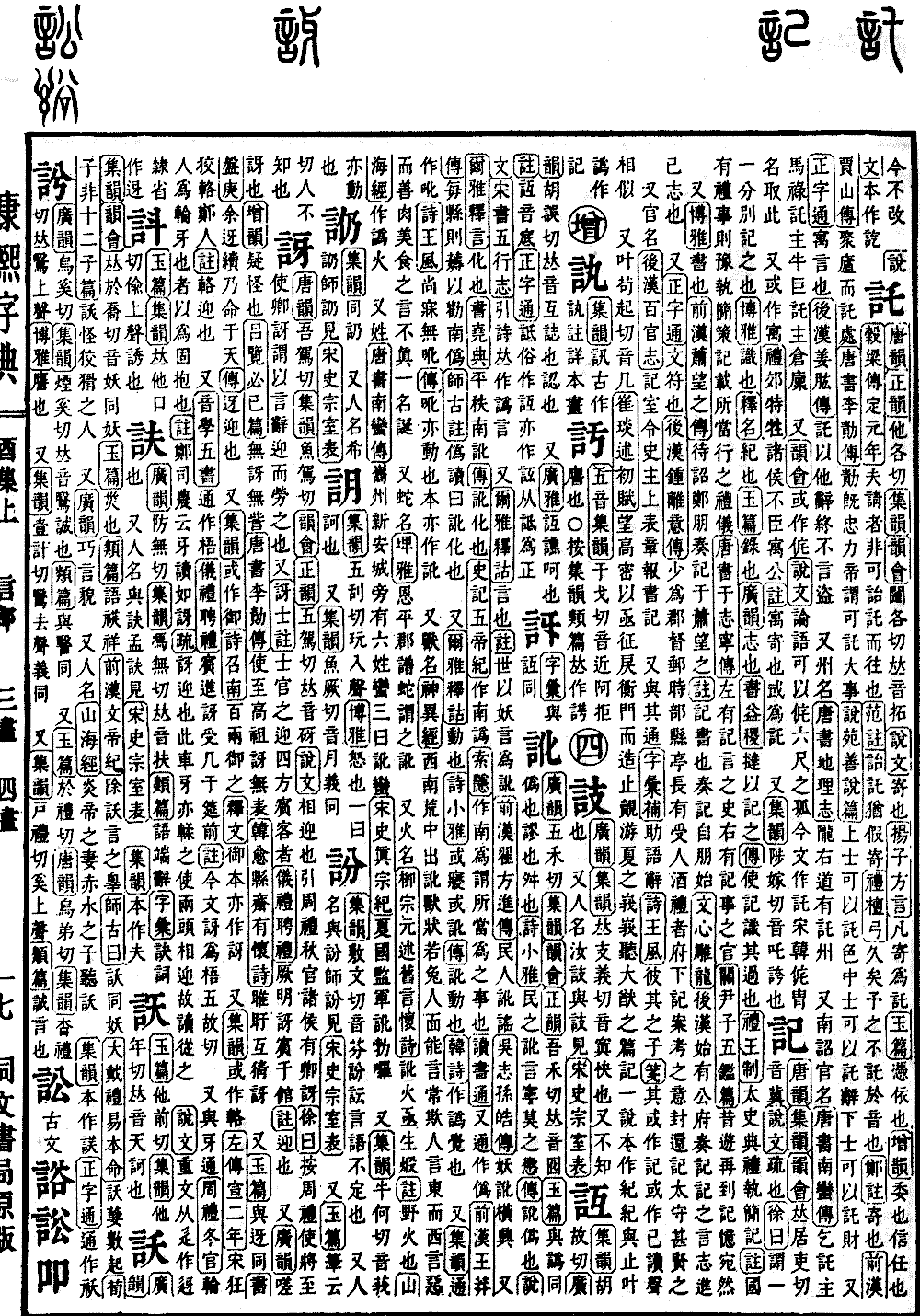
You Collection, Upper Volume
Radical: Speech (yán)
Kangxi Strokes: 10
Page 1149, Entry 02
Tangyun, Jiyun, and Yunhui state the pronunciation is ji (falling-rising tone), sounding the same as the word for hope.
Shuowen Jiezi defines it as sparse, meaning to record in items.
Xu says it means to record things one by one.
Boya defines it as to recognize, meaning to remember.
Shiming defines it as to chronicle, meaning to record.
Yupian defines it as to record, meaning to make a record.
Guangyun defines it as intention, meaning to note down events.
Book of Documents (Shujing), section Yiji, records to whip them to make them remember.
Commentary states it means to make one remember their faults.
Book of Rites (Liji), section Wangzhi, records that the Grand Historian oversees rituals and holds the records.
Annotation states that when the state has ritual activities, one holds bamboo slips in advance to record the rituals that should be performed.
Book of Tang (Tangshu), Biography of Yu Zhining, states that on the left were the historians who recorded speech, and on the right were the officials who recorded events.
Guan Yinzi, section Wujian, states that when one returns to a place visited in the past, the memory remains clear.
Also, Boya defines it as book, meaning written documents.
Book of Former Han (Qian Hanshu), Biography of Xiao Wangzhi, records that the official waiting for summons, Zheng Peng, submitted a ji to Xiao Wangzhi.
Annotation states that ji is a written document. The form of submitting a ji began with Zheng Peng.
The Literary Mind and the Carving of Dragons (Wenxin Diaolong) states that during the Eastern Han period, public offices began to use the format of submitting a ji, which is to express one's intention and present one's opinions.
Also, Zhengzitong refers to it as official documents or paperwork.
Book of Later Han (Hou Hanshu), Biography of Zhongli Yi, records that when he was young and served as a district overseer, a township head in his jurisdiction accepted food and drink gifts from others; the county government issued an official document ordering an investigation, but Zhongli Yi sealed the document and returned it, and the prefect considered him virtuous.
It also refers to an official title.
Book of Later Han (Hou Hanshu), section Records of Officials, records the title of Record Chamber Clerk, mainly responsible for submitting memorials and replying to official documents.
It is also used interchangeably with the character qi.
Zihui Bu states it is a particle.
Book of Odes (Shijing), section Wangfeng, contains the phrase that man.
Annotation says that qi is sometimes written as ji, and sometimes as ji. The pronunciations are similar.
Also, rhyming with the sound gouqi, sounding the same as ji (rising tone).
Cui Yan, Shuchu Fu, writes: Gazing at Gaomi, I travel urgently, arriving at the gate, I stop. Seeing high-minded scholars like Ziyou and Zixia, I listen to the grand strategies recorded in the chapters. One theory suggests it was originally written as chronicle; chronicle rhymes with stop, and it was mistakenly written as record.