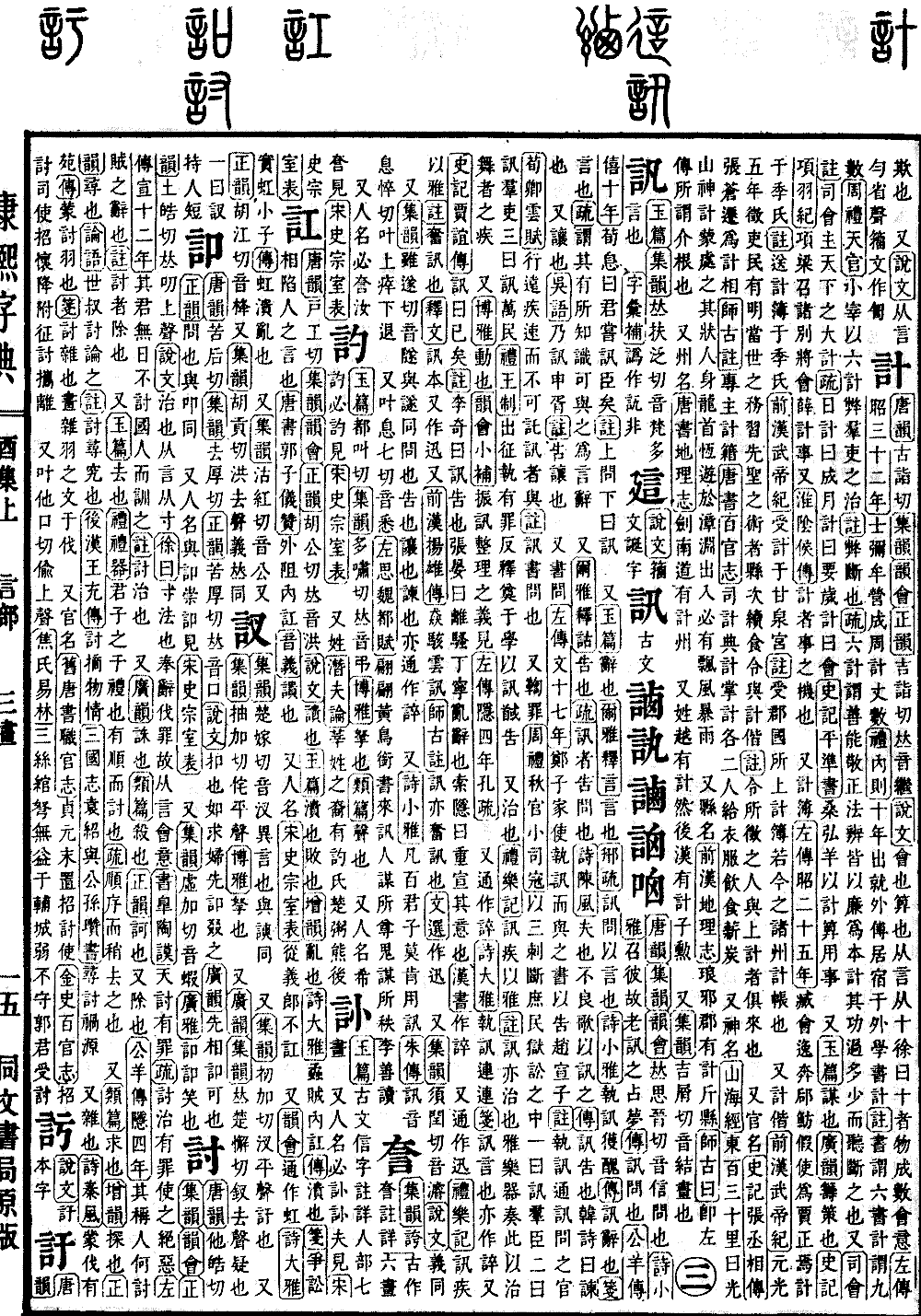
You Collection, Upper Volume
Radical: Speech (yán)
Page 1147, Entry 01
Pronounced ji
According to the Explaining Graphs and Analyzing Characters (Shuowen Jiezi), the meaning is to assemble or to calculate. The graph is composed of Speech and Ten. Xu Kai explains: Ten is the number representing completion of all things. This is a compound ideograph.
Zuo Tradition (Zuozhuan), 32nd Year of Duke Zhao: Shi Mimou oversaw the construction of Chengzhou and calculated the measurements.
Book of Rites (Liji), Inner Rules: When a child is ten years old, he goes out to follow a teacher to learn, resides abroad, and studies writing and calculation. Commentary: Writing refers to the Six Writings (the six methods of character formation), and calculation refers to the Nine Numbers (the nine mathematical algorithms).
Rites of Zhou (Zhouli), Officers of Heaven: The Small Prefect uses six standards to evaluate the performance of the various officials. Commentary: Evaluation is judgment. Sub-commentary: The six calculations refer to the ability to handle affairs, being respectful, upright, law-abiding, and discerning, all rooted in integrity, calculating the quantity of their merits and faults to judge and decide.
Also, Commentary on the Master of Accounts: The Master of Accounts manages the major statistics of the world. Sub-commentary: Daily calculations are called cheng, monthly calculations are called yao, and annual calculations are called hui.
Records of the Grand Historian (Shiji), Treatise on the Balance of Standards: Sang Hongyang held power because he was skilled in calculation and managing finances.
Also, Jade Chapters (Yupian): The meaning is to plan.
General Rhymes (Guangyun): The meaning is to devise strategies.
Records of the Grand Historian (Shiji), Annals of Xiang Yu: Xiang Liang summoned the various commanders to meet at Xue to discuss important matters.
Also, Biography of Marquis of Huaiyin: Strategy is the key to success or failure in affairs.
Also refers to accounting ledgers (registers for households, taxes, etc.).
Zuo Tradition (Zuozhuan), 25th Year of Duke Zhao: Zang Hui fled to the area of Hou, and Fang Jia appointed him as the Jia Zheng to submit the accounting ledgers to the Ji family. Commentary: To submit accounting ledgers to the Ji family.
Book of Han (Hanshu), Annals of Emperor Wu: Accepted accounting ledgers at Ganquan Palace. Commentary: Accepted the accounting ledgers submitted by the various commanderies and states, just like the account books of the various prefectures today.
Also refers to ji-xie (an ancient practice where those summoned to the capital traveled with local officials delivering reports).
Book of Han (Hanshu), Annals of Emperor Wu: In the fifth year of Yuanguang, officials and commoners who understood contemporary affairs and were familiar with the methods of ancient sage kings were summoned, provided with food by the counties along the way, and allowed to travel with the officials delivering accounts. Commentary: Ordered the summoned persons to come to the capital together with the officials delivering accounts.
Also an official title.
Records of the Grand Historian (Shiji), Biography of Chancellor Zhang: Zhang Cang was promoted to Minister of Accounts. Commentary by Yan Shigu: Specifically in charge of accounting ledgers.
Book of Tang (Tangshu), Treatise on Officialdom: Offices for Controllers of Accounts and Clerks of Accounts were established, each managing two accounting clerks, providing them with clothing, food, firewood, and charcoal.
Also the name of a deity.
Classic of Mountains and Seas (Shanhaijing): One hundred thirty li to the east is Mount Guang, where the deity Jimeng resides; his appearance is a human body with a dragon's head, often wandering in the Zhang Abyss, appearing and disappearing with storms and heavy rain.
Also a county name.
Book of Han (Hanshu), Treatise on Geography: Langye Commandery had Jiejin County. Yan Shigu states: This is what is referred to as Jiegen in the Zuo Tradition.
Also a prefecture name.
Book of Tang (Tangshu), Treatise on Geography: Jiannan Circuit had Jizhou.
Also a surname. There was Ji Ran in the State of Yue, and Ji Zixun in the Eastern Han dynasty.
Also, Collected Rhymes: Pronounced jie. The meaning is to divide or distinguish.