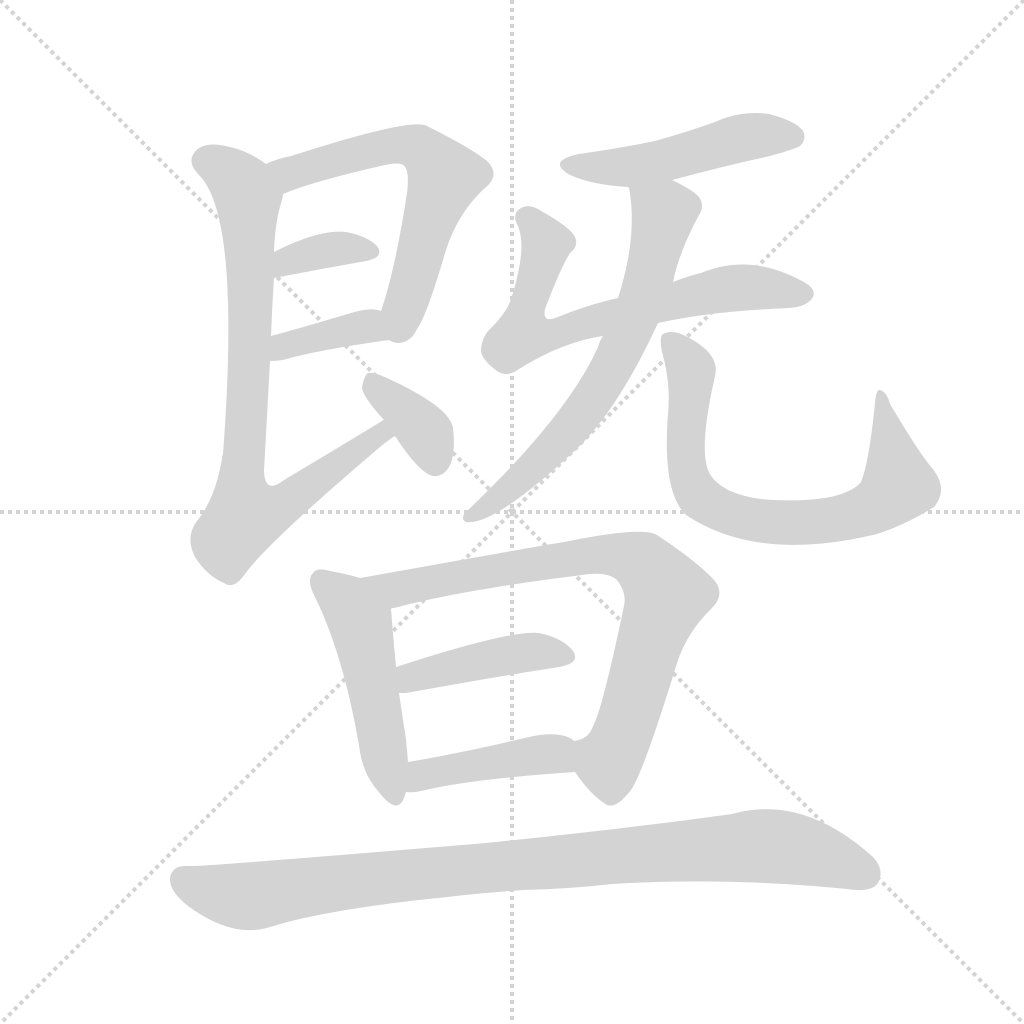
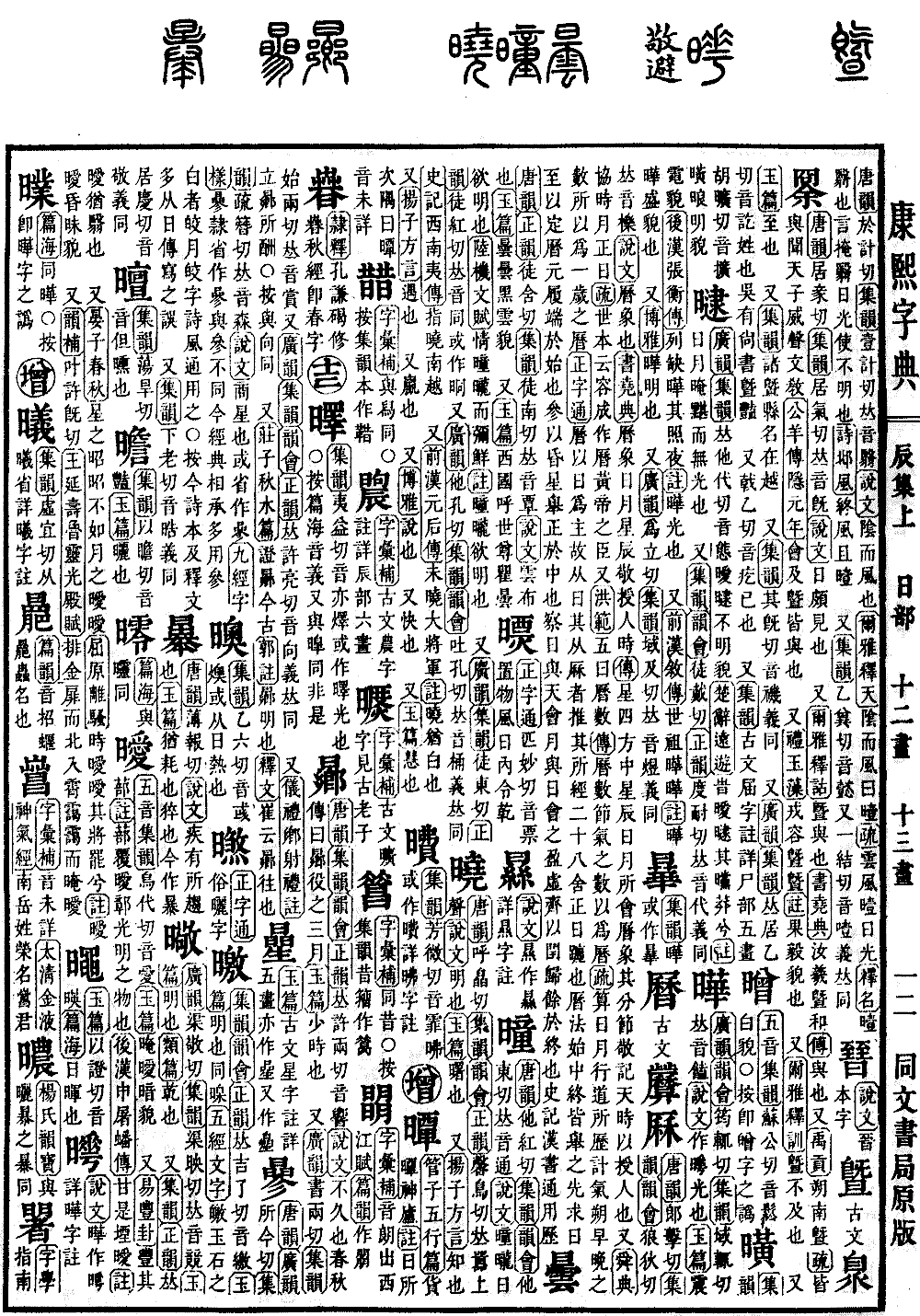
Chen Collection, Upper Volume
Radical: Sun (rì)
Kangxi Strokes: 16
Page 500, Entry 12
Ancient form. Pronounced ji (falling tone).
Shuowen Jiezi (Explanation of Simple and Compound Characters): The sun just beginning to appear.
Also, Erya (Approaching Elegance), Interpretation of Ancient Terms: The word ji signifies and.
Book of Documents (Shangshu), Canon of Yao: You, Xi and He.
Commentary: This means and.
Also, Tribute of Yu (Yu Gong): From the north to the south, it extends to.
Sub-commentary: All have heard the majesty, influence, rites, and music of the Emperor.
Gongyang Commentary on the Spring and Autumn Annals (Gongyang Zhuan), First Year of Duke Yin: The terms hui, ji, and ji all signify and.
Also, Book of Rites (Liji), Jade Pattern (Yuzao): Martial demeanor that is imposing.
Note: This describes a resolute and courageous appearance.
Also, Erya (Approaching Elegance), Interpretation of Teachings (Shixun): The word ji signifies not reaching.
Also, Yupian (Jade Chapters): Signifies arriving at.
Also, Jiyun (Compilation of Rhymes): Zhuji is the name of a county located in the Yue region.
Also, Jiyun (Compilation of Rhymes): Pronounced ji (falling tone). The meaning is the same.
Also, Guangyun (Broad Rhymes) and Jiyun (Compilation of Rhymes): Pronounced qi (entering tone). Used as a surname. During the State of Wu, there was a Minister of State named Ji Yan.
Also, pronounced ge (entering tone). Signifies already.
Also, Jiyun (Compilation of Rhymes): An ancient form of the character jie. Detailed notes can be found under the Radical: Corpse (shī), five strokes.