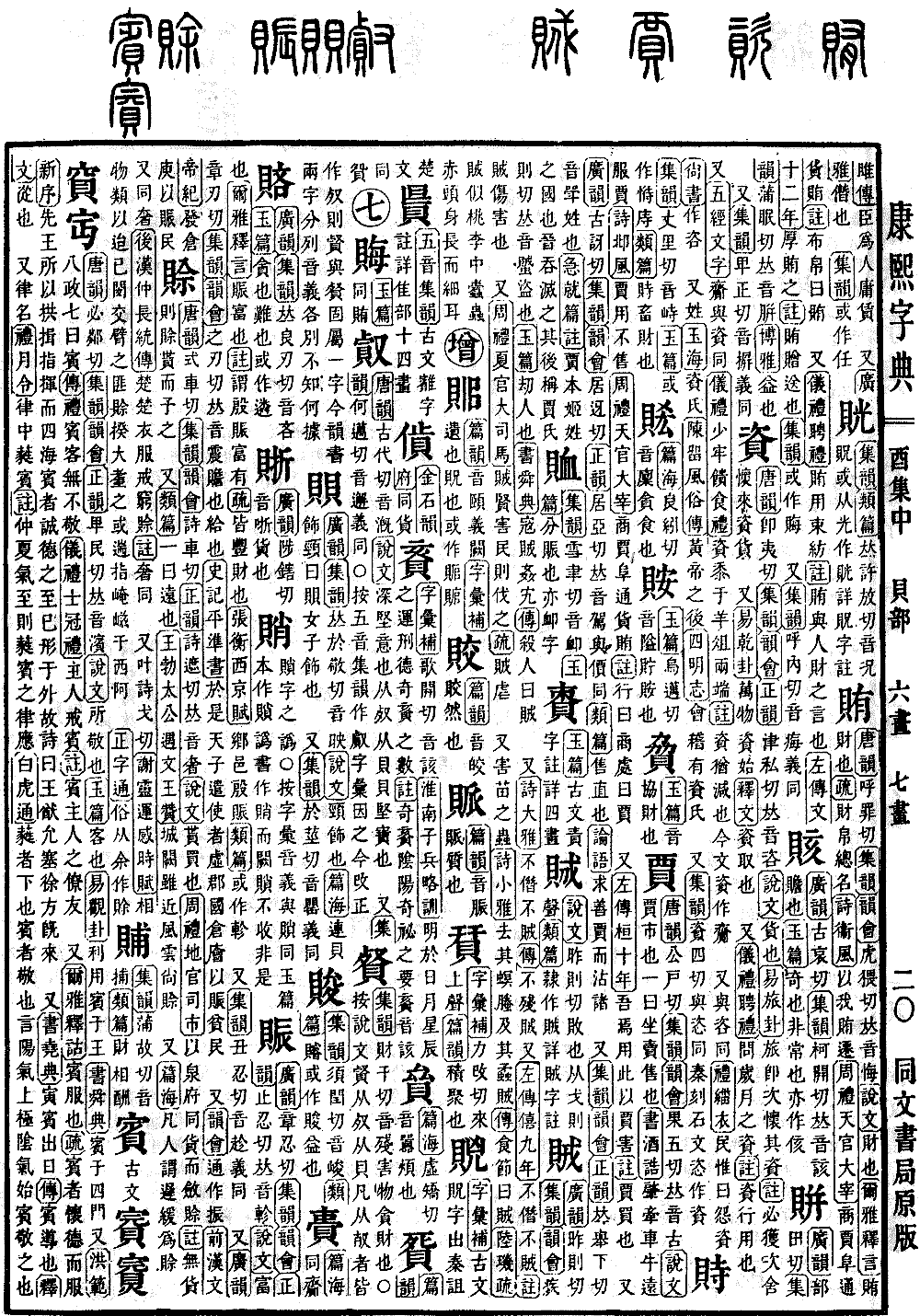
You Collection, Middle Volume
Radical: Cowrie (bèi)
13 strokes
Page 1208, Entry 01
Pronounced gu (rising tone) according to Tangyun. Pronounced gu (rising tone) according to Jiyun and Yunhui.
Shuowen Jiezi states that Jia means to engage in trade. Another interpretation is to sell goods while sitting in a fixed location.
Book of Documents (Shangshu), chapter Wine Announcement (Jiugao): To begin by leading oxen and carriages to trade in distant lands.
Classic of Poetry (Shijing), Beifeng: To offer goods for sale but fail to find a buyer.
Rites of Zhou (Zhouli), Offices of Heaven, Grand Administrator: Merchants and traders facilitate the circulation of goods and wealth.
Commentary: Those who travel to sell goods are called merchants (shang), while those who sell from a fixed location are called traders (jia).
Also in Zuo Tradition (Zuo Zhuan), tenth year of Duke Huan: Why would I use this to invite disaster?
Commentary: Jia here means to invite or to bring upon oneself.
Pronounced jia (falling tone) according to Guangyun, Jiyun, Yunhui, and Zhengyun. Equivalent to the character meaning price.
Leipian: Refers to the selling value.
Analects (Lunyu): If you seek a good price, then sell it.
Pronounced jia (falling tone) according to Jiyun, Yunhui, and Zhengyun. A surname.
Annotations to the Expedient Writings (Jijiupian): Jia was originally a feudal state with the surname Ji. The State of Jin annexed it, and descendants subsequently adopted Jia as their surname.