Wei Collection, Upper Volume
Radical: Rice (mǐ)
Su; Kangxi strokes: 12
Page 908, Entry 14
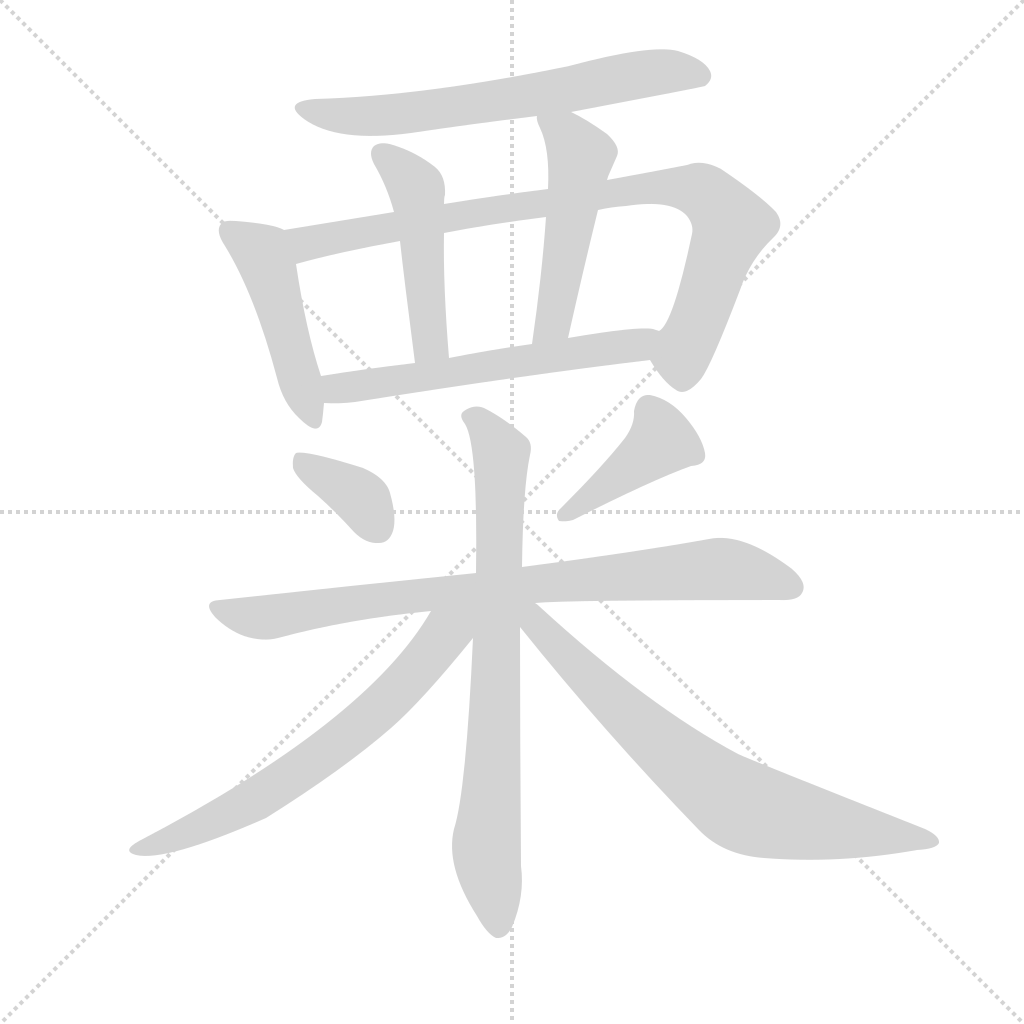
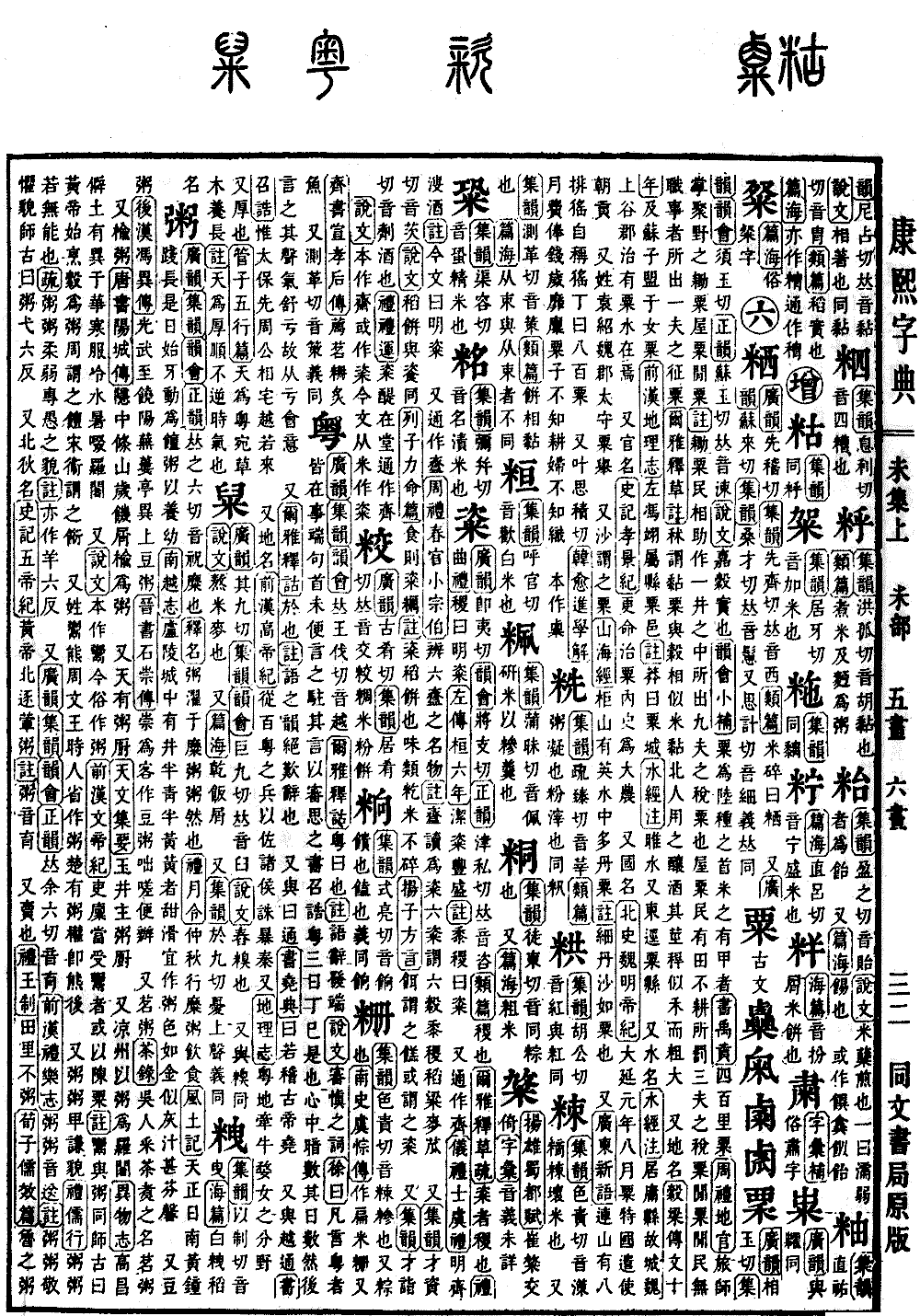
Pronounced su. According to the Shuowen Jiezi, it refers to the grain of a superior crop. According to the Yunhui Xiaobu, millet (su) is the primary land-grown crop and refers to grain that still has its husk. In the Book of Documents (Shangshu), Chapter on Yugong, it mentions four hundred li of millet. In the Rites of Zhou (Zhouli), Ministry of Earth, it states that the local official is responsible for collecting the millet from the fields, including assistance-millet, household-millet, and idle-millet. The commentary explains: assistance-millet is the tax gathered from nine men within a well-field system who assist one another; household-millet is the tax collected from three men as a penalty for owning land but not tilling it; idle-millet is the tax collected from one man who is an idle commoner without official duties. The commentary to the Erya, Chapter on Explaining Grasses, states that glutinous millet is called shu, which is similar to grain but the rice is sticky. People in the north use it for brewing wine; its stalks resemble those of grain but are coarser and larger.
It is also the name of a place. The Guliang Zhuan, Year 10 of Duke Wen, mentions an alliance with the Viscount of Su at Nusu. The Book of Han (Hanshu), Treatise on Geography, mentions Su County as a district under the jurisdiction of Zuofengyi, which Wang Mang renamed Sucheng. The Commentary on the Water Classic (Shuijing Zhu) states that the Sui River flows east past Su County.
It is also the name of a river. The Commentary on the Water Classic mentions the ancient city of Juyong County, which was the seat of Shanggu Commandery under the Wei dynasty, and notes that the Su River is located there.
It is also a title of an official. The Records of the Grand Historian (Shiji), Annals of Emperor Xiaojing, states that the title of Minister of Agriculture was changed to Director of the Granary (Zhisu Neishi).
It is also the name of a country. The History of the Northern Dynasties (Beishi), Annals of Emperor Ming of Wei, records that in the first year of the Dayan era, the eighth month, the country of Sogdiana (Sute) sent envoys to pay tribute.
It is also a surname. For instance, Su Ju, who served as the Administrator of Weijun under Yuan Shao.
Sand is also referred to as millet. The Classic of Mountains and Seas (Shanhaijing) states that Mount Gui has the Ying River, which contains much cinnabar millet. The commentary notes this refers to fine red sand that resembles millet.
According to the Guangdong Xinyu, there is an eight-row Yao tribe in Lianshan who refer to themselves as Yao troops, called the eight-hundred millet.
It is also read as the rhyme si-ji. In the Han Yu essay Exhortation to Learning (Jinxue Jie), it states: Each month the salary is spent, and each year the granary grain is consumed; the son does not know how to plow, and the wife does not know how to weave. Originally written as the character for grain with the radical for rice.